


Page 758 - Clinical Immunology_ Principles and Practice ( PDFDrive )
P. 758
730          Part six  Systemic Immune Diseases


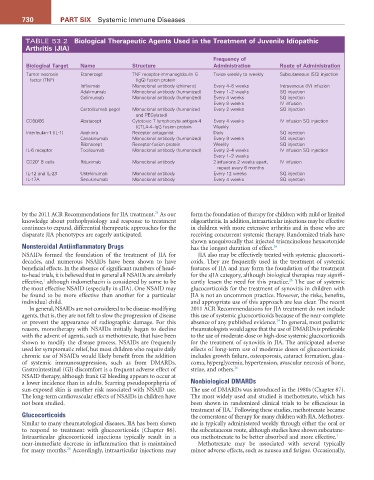
         TABLE 53.2  Biological therapeutic agents Used in the treatment of Juvenile idiopathic
         arthritis (Jia)
                                                                       Frequency of
          Biological target  Name           structure                  administration        route of administration
          Tumor necrosis   Etanercept       TNF receptor-immunoglobulin G   Twice weekly to weekly  Subcutaneous (SQ) injection
           factor (TNF)                      (IgG) fusion protein
                           Infliximab       Monoclonal antibody (chimeric)  Every 4–8 weeks  Intravenous (IV) infusion
                           Adalimumab       Monoclonal antibody (humanized)  Every 1–2 weeks  SQ injection
                           Golimumab        Monoclonal antibody (humanized)  Every 4 weeks   SQ injection
                                                                       Every 8 weeks         IV infusion
                           Certolizumab pegol  Monoclonal antibody (humanized   Every 2 weeks  SQ injection
                                             and PEGylated)
          CD80/86          Abatacept        Cytotoxic T lymphocyte antigen-4   Every 4 weeks  IV infusion SQ injection
                                             (CTLA-4–IgG fusion protein  Weekly
          Interleukin-1 (IL-1)  Anakinra    Receptor antagonist        Daily                 SQ injection
                           Canakinumab      Monoclonal antibody (humanized)  Every 8 weeks   SQ injection
                           Rilonacept       Receptor-fusion protein    Weekly                SQ injection
          IL-6 receptor    Tocilizumab      Monoclonal antibody (humanized)  Every 2–4 weeks  IV infusion SQ injection
                                                                       Every 1–2 weeks
             +
          CD20  B cells    Rituximab        Monoclonal antibody        2 infusions 2 weeks apart,   IV infusion
                                                                        repeat every 6 months
          IL-12 and IL-23  Ustekinumab      Monoclonal antibody        Every 12 weeks        SQ injection
          IL-17A           Secukinumab      Monoclonal antibody        Every 4 weeks         SQ injection


                                                    24
        by the 2011 ACR Recommendations for JIA treatment.  As our   form the foundation of therapy for children with mild or limited
        knowledge about pathophysiology and response to treatment   oligoarthritis. In addition, intraarticular injections may be effective
        continues to expand, differential therapeutic approaches for the   in children with more extensive arthritis and in those who are
        disparate JIA phenotypes are eagerly anticipated.      receiving concurrent systemic therapy. Randomized trials have
                                                               shown unequivocally that injected triamcinolone hexacetonide
        Nonsteroidal Antiinflammatory Drugs                    has the longest duration of effect. 26
        NSAIDs formed the foundation of the treatment of JIA for   JIA also may be effectively treated with systemic glucocorti-
        decades,  and  numerous  NSAIDs  have  been shown  to have   coids. They are frequently used in the treatment of systemic
        beneficial effects. In the absence of significant numbers of head-  features of JIA and may form the foundation of the treatment
        to-head trials, it is believed that in general all NSAIDs are similarly   for the sJIA category, although biological therapies may signifi-
                                                                                                26
               1
        effective,  although indomethacin is considered by some to be   cantly lessen the need for this practice.  The use of systemic
        the most effective NSAID (especially in sJIA). One NSAID may   glucocorticoids for the treatment of synovitis in children with
        be found to be more effective than another for a particular   JIA is not an uncommon practice. However, the risks, benefits,
        individual child.                                      and appropriate use of this approach are less clear. The recent
           In general, NSAIDs are not considered to be disease-modifying   2011 ACR Recommendations for JIA treatment do not include
        agents, that is, they are not felt to slow the progression of disease   this use of systemic glucocorticoids because of the near-complete
                                                                                           24
        or prevent the appearance of radiographic damage. For this   absence of any published evidence.  In general, most pediatric
        reason, monotherapy with NSAIDs initially began to decline   rheumatologists would agree that the use of DMARDs is preferable
        with the advent of agents, such as methotrexate, that have been   to the use of moderate-dose or high-dose systemic glucocorticoids
        shown to modify the disease process. NSAIDs are frequently   for the treatment of synovitis in JIA. The anticipated adverse
        used for symptomatic relief, but most children who require daily   effects of long-term use of moderate doses of glucocorticoids
        chronic use of NSAIDs would likely benefit from the addition   includes growth failure, osteoporosis, cataract formation, glau-
        of systemic immunosuppression, such as from DMARDs.    coma, hyperglycemia, hypertension, avascular necrosis of bone,
        Gastrointestinal (GI) discomfort is a frequent adverse effect of   striae, and others. 26
        NSAID therapy, although frank GI bleeding appears to occur at
        a lower incidence than in adults. Scarring pseudoporphyria of   Nonbiological DMARDs
        sun-exposed skin is another risk associated with NSAID use.   The use of DMARDs was introduced in the 1980s (Chapter 87).
        The long-term cardiovascular effects of NSAIDs in children have   The most widely used and studied is methotrexate, which has
        not been studied.                                      been shown in randomized clinical trials to be efficacious in
                                                                             1
                                                               treatment of JIA.  Following these studies, methotrexate became
        Glucocorticoids                                        the cornerstone of therapy for many children with JIA. Methotrex-
        Similar to many rheumatological diseases, JIA has been shown   ate is typically administered weekly through either the oral or
        to respond to treatment with glucocorticoids (Chapter 86).   the subcutaneous route, although studies have shown subcutane-
        Intraarticular  glucocorticoid injections  typically  result in  a   ous methotrexate to be better absorbed and more effective. 1
        near-immediate decrease in inflammation that is maintained   Methotrexate may be associated with several typically
                       28
        for many months.  Accordingly, intraarticular injections may   minor adverse effects, such as nausea and fatigue. Occasionally,

