


Page 838 - Clinical Immunology_ Principles and Practice ( PDFDrive )
P. 838
810          Part SIX  Systemic Immune Diseases


                           Vascular component                                 Extravascular component
                           Granulomatous, transmural                         intense acute phase response
                             inflammation                                     (IL-6, SAA, CRP, ESR, etc)
                           dendritic cells, CD4 T cells,                                 myalgias
                             macrophages, giant cells, etc                      malaise, anorexia, fever


                                                         Giant cell
                                                          arteritis
                           Vessel wall remodeling
                           Aorta: dissection, wall damage,
                             aneurysm, rupture                                 Age of the host
                           Branches: intimal hyperplasia,
                             luminal occlusion                                 GCA/PMR: >50 yrs
                                                                               TA: <40 yrs


                                                       Tissue tropism
                                                             th
                                                   GCA: Aorta + 3-5  branches
                                                  axillary, temporal, ophthalmic, etc
                                                          st
                                                              nd
                                                  TA: Aorta + 1  and 2  branches
                                                subclavian, carotid, mesenteric, renal, etc
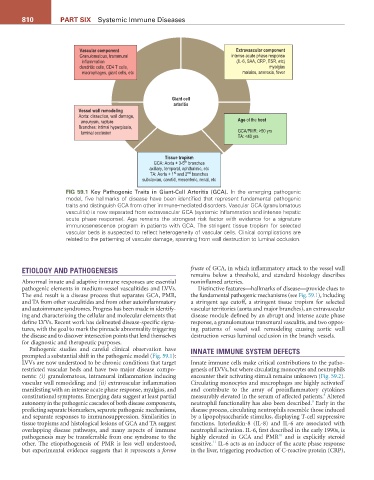
                       FIG 59.1  Key Pathogenic Traits in Giant-Cell Arteritis (GCA). In the emerging pathogenic
                       model, five hallmarks of disease have been identified that represent fundamental pathogenic
                       traits and distinguish GCA from other immune-mediated disorders. Vascular GCA (granulomatous
                       vasculitis) is now separated from extravascular GCA (systemic inflammation and intense hepatic
                       acute phase response). Age remains the strongest risk factor with evidence for a signature
                       immunosenescence program in patients with GCA. The stringent tissue tropism for selected
                       vascular beds is suspected to reflect heterogeneity of vascular cells. Clinical complications are
                       related to the patterning of vascular damage, spanning from wall destruction to luminal occlusion.


        ETIOLOGY AND PATHOGENESIS                              fruste of GCA, in which inflammatory attack to the vessel wall
                                                               remains below a threshold, and standard histology describes
        Abnormal innate and adaptive immune responses are essential   noninflamed arteries.
        pathogenic elements in medium-vessel vasculitides and LVVs.   Distinctive features—hallmarks of disease—provide clues to
        The end result is a disease process that separates GCA, PMR,   the fundamental pathogenic mechanisms (see Fig. 59.1), including
        and TA from other vasculitides and from other autoinflammatory   a stringent age cutoff, a stringent tissue tropism for selected
        and autoimmune syndromes. Progress has been made in identify-  vascular territories (aorta and major branches), an extravascular
        ing and characterizing the cellular and molecular elements that   disease module defined by an abrupt and intense acute phase
        define LVVs. Recent work has delineated disease-specific signa-  response, a granulomatous transmural vasculitis, and two oppos-
        tures, with the goal to mark the pinnacle abnormality triggering   ing patterns of vessel wall remodeling causing aortic wall
        the disease and to discover intersection points that lend themselves   destruction versus luminal occlusion in the branch vessels.
        for diagnostic and therapeutic purposes.
           Pathogenic studies and careful clinical observation have   INNATE IMMUNE SYSTEM DEFECTS
        prompted a substantial shift in the pathogenic model (Fig. 59.1):
        LVVs are now understood to be chronic conditions that target   Innate immune cells make critical contributions to the patho-
        restricted vascular beds and have two major disease compo-  genesis of LVVs, but where circulating monocytes and neutrophils
        nents:  (i) granulomatous, intramural inflammation inducing   encounter their activating stimuli remains unknown (Fig. 59.2).
                                                                                                                 7
        vascular wall remodeling; and (ii) extravascular inflammation   Circulating monocytes and macrophages are highly activated
        manifesting with an intense acute phase response, myalgias, and   and  contribute  to  the  array  of  proinflammatory  cytokines
                                                                                                           8
        constitutional symptoms. Emerging data suggest at least partial   measurably elevated in the serum of affected patients.  Altered
                                                                                                       9
        autonomy in the pathogenic cascades of both disease components,   neutrophil functionality has also been described.  Early in the
        predicting separate biomarkers, separate pathogenic mechanisms,   disease process, circulating neutrophils resemble those induced
        and separate responses to immunosuppression. Similarities in   by a lipopolysaccharide stimulus, displaying T-cell suppressive
        tissue tropisms and histological lesions of GCA and TA suggest   functions. Interleukin-8 (IL-8) and IL-6  are associated with
        overlapping disease pathways, and many aspects of immune   neutrophil activation. IL-6, first described in the early 1990s, is
                                                                                            10
        pathogenesis may be transferrable from one syndrome to the   highly elevated in GCA and PMR  and is explicitly steroid
                                                                       11
        other. The etiopathogenesis of PMR is less well understood,   sensitive.  IL-6 acts as an inducer of the acute phase response
        but experimental evidence suggests that it represents a forme   in the liver, triggering production of C-reactive protein (CRP),

