


Page 911 - Clinical Immunology_ Principles and Practice ( PDFDrive )
P. 911
880          PARt SEVEN  Organ-Specific Inflammatory Disease


                                                       Safety factor of  Failure at single  Reduced
                                                       transmission
                           Amplitude of EPP               Minimum current              margin
                                                                          junctions
                                                                                       safety
                                                           for conduction


                           Muscle action potential


                                     1       2      3s                         1       2      3s
                                    Normal response                      Myasthenic response (decremental)
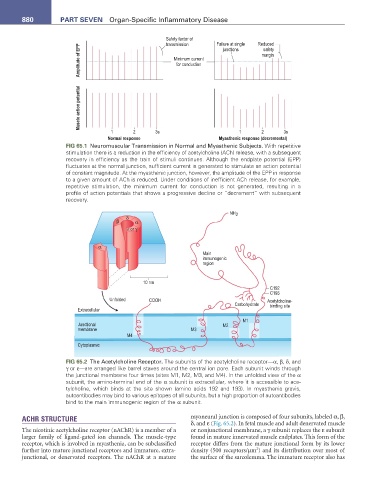
                       FIG 65.1  Neuromuscular Transmission in Normal and Myasthenic Subjects. With repetitive
                       stimulation there is a reduction in the efficiency of acetylcholine (ACh) release, with a subsequent
                       recovery in efficiency as the train of stimuli continues. Although the endplate potential (EPP)
                       fluctuates at the normal junction, sufficient current is generated to stimulate an action potential
                       of constant magnitude. At the myasthenic junction, however, the amplitude of the EPP in response
                       to a given amount of ACh is reduced. Under conditions of inefficient ACh release, for example,
                       repetitive stimulation, the minimum current for conduction is not generated, resulting in a
                       profile of action potentials that shows a progressive decline or “decrement” with subsequent
                       recovery.

                                                                            NH 2
                                          δ
                                       β     α
                                           ε or γ


                                 α
                                                                   Main
                                                                   immunogenic
                                                                   region


                                                10 nm
                                                                                         C192
                                                                                         C193
                                     Unfolded     COOH                                  Acetylcholine-
                                                                              Carbohydrate  binding site
                          Extracellular
                                                                                M1
                          Junctional                                      M2
                          membrane                              M3
                                           M4
                          Cytoplasmic

                       FIG 65.2  The Acetylcholine Receptor. The subunits of the acetylcholine receptor—α, β, δ, and
                       γ or ε—are arranged like barrel staves around the central ion pore. Each subunit winds through
                       the junctional membrane four times (sites M1, M2, M3, and M4). In the unfolded view of the α
                       subunit, the amino-terminal end of the α subunit is extracellular, where it is accessible to ace-
                       tylcholine,  which  binds  at  the  site  shown  (amino  acids  192  and  193).  In  myasthenia  gravis,
                       autoantibodies may bind to various epitopes of all subunits, but a high proportion of autoantibodies
                       bind to the main immunogenic region of the α subunit.

        ACHR STRUCTURE                                         myoneural junction is composed of four subunits, labeled α, β,
                                                               δ, and ε (Fig. 65.2). In fetal muscle and adult denervated muscle
        The nicotinic acetylcholine receptor (nAChR) is a member of a   or nonjunctional membrane, a γ subunit replaces the ε subunit
        larger  family  of  ligand-gated  ion  channels.  The  muscle-type   found in mature innervated muscle endplates. This form of the
        receptor, which is involved in myasthenia, can be subclassified   receptor differs from the mature junctional form by its lower
                                                                                     2
        further into mature junctional receptors and immature, extra-  density (500 receptors/µm ) and its distribution over most of
        junctional, or denervated receptors. The nAChR at a mature   the surface of the sarcolemma. The immature receptor also has

