


Page 912 - Clinical Immunology_ Principles and Practice ( PDFDrive )
P. 912
CHAPtER 65  Myasthenia Gravis              881


           a lower conductance, a longer open time, a more rapid turnover,
           and a decreased half-life.                                                                      AChR
             The genes for the α, δ, and γ subunits are located on chromo-
           some 2 in humans, and subunits β and ε on chromosome 17.                                        ACh vesicle
           The subunits of the AChR are homologous to each other and
           to their counterparts across species, with the greatest conservation   Motor neuron             ACh
           of sequence being in the α subunit. Two α subunits and one of
           each of the other subunits are assembled to form an asymmetrical                                AChe
           hourglass channel spanning the membrane. Each subunit has a
           large amino-terminus located extracellularly, four transmembrane                                Voltage-gated
                                                                                                             –
           regions, and a short cytoplasmic tail formed by a loop between                                  Ca  channel
           the third and fourth transmembrane domains. The receptor
           appears as a dimer as a result of disulfide bonding between the                                 Rapsyn
           δ subunits of two receptors. The two α subunits are not contiguous                              LPR4
           in each receptor but are separated by another subunit. One
           ACh-binding site is found on each of the α subunits around the                                  MuSK
           pair of cysteines at amino acids 192 and 193. The binding of
           ACh to the α subunits is believed to engender a conformational                                  Voltage-gated
           change, possibly resulting in rearrangement of charged groups.                                  Na  channel
                                                                                                             –
           The binding of ACh to both α subunits increases the probability
           of transition of the channel to an open conformation. Binding
           of curare or α-bungarotoxin to the α subunits blocks this channel.
             In normal innervated neuromuscular junctions, there are
           two forms of the AChR, the predominant form having a long
           half-life, and a small subset that is rapidly turned over. The
           rapidly turned-over receptors are the precursors of the stable
           receptors. It is not clear how these two types differ or how they
           are regulated. The receptors are concentrated at the top of the
           folds in the muscle endplate, adjacent to the nerve terminus,
                               2
           at a density of 10 000/µm . This localization reflects the action   Muscle endplate
           of agrin, a nerve-derived synaptic organizing molecule. The
           AChRs are organized into clusters by rapsyn, a 43-kilodalton   FIG 65.3  Schematic Representation of the Myoneural Junc-
           (kDa) cytoplasmic protein. The clustered AChRs are linked to the   tion. Vesicles of acetylcholine (ACh) release their contents at
           cytoskeleton by connections between rapsyn and a dystrophin–  active  zones  across  from  acetylcholine  receptors  (AChRs)  in
           glycoprotein complex.                                  response to impulses conducted down nerve axons. ACh diffuses
                                                                  across synaptic cleft and binds to AChRs, with opening of the
           NEUROMUSCULAR TRANSMISSION                             ion channel and the generation of endplate potential. Action
                                                                  potential is propagated to muscle when sufficient amplitude of
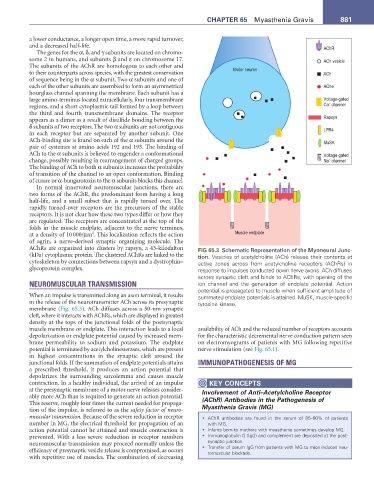
           When an impulse is transmitted along an axon terminal, it results   summated endplate potentials is attained. MuSK, muscle-specific
           in the release of the neurotransmitter ACh across its presynaptic   tyrosine kinase.
           membrane (Fig. 65.3). ACh diffuses across a 50-nm synaptic
           cleft, where it interacts with AChRs, which are displayed in greatest
           density at the tops of the junctional folds of the postsynaptic
           muscle membrane or endplate. This interaction leads to a local   availability of ACh and the reduced number of receptors accounts
           depolarization or endplate potential caused by increased mem-  for the characteristic decremental nerve conduction pattern seen
           brane permeability to sodium and potassium. The endplate   on electromyograms of patients with MG following repetitive
           potential is terminated by acetylcholinesterases, which are present   nerve stimulation (see Fig. 65.1).
           in highest concentrations in the synaptic cleft around the
           junctional folds. If the summation of endplate potentials attains   IMMUNOPATHOGENESIS OF MG
           a prescribed threshold, it produces an action potential that
           depolarizes  the  surrounding  sarcolemma  and  causes  muscle
           contraction. In a healthy individual, the arrival of an impulse    KEY CONCEPtS
           at the presynaptic membrane of a motor nerve releases consider-  Involvement of Anti–Acetylcholine Receptor
           ably more ACh than is required to generate an action potential.   (AChR) Antibodies in the Pathogenesis of
           This reserve, roughly four times the current needed for propaga-
           tion of the impulse, is referred to as the safety factor of neuro-  Myasthenia Gravis (MG)
           muscular transmission. Because of the severe reduction in receptor   •  AChR antibodies are found in the serum of 85–90% of patients
           number in MG, the electrical threshold for propagation of an   with MG.
           action potential cannot be attained and muscle contraction is   •  Infants born to mothers with myasthenia sometimes develop MG.
           prevented.  With a less severe reduction in receptor numbers   •  Immunoglobulin G (IgG) and complement are deposited at the post-
           neuromuscular transmission may proceed normally unless the   synaptic junction.
           efficiency of presynaptic vesicle release is compromised, as occurs   •  Transfer of serum IgG from patients with MG to mice induces neu-
                                                                     romuscular blockade.
           with repetitive use of muscles. The combination of decreasing

