


Page 1118 - Hall et al (2015) Principles of Critical Care-McGraw-Hill
P. 1118
CHAPTER 82: Delirium in the Intensive Care Unit  757


                                                                               33
                    than 20,000 observations. Among patients who developed delirium, pure   factors.   Patients  who are  highly vulnerable to developing delirium
                    hyperactive delirium was rare (<5%), whereas hypoactive was present   (ie, who have multiple predisposing risk factors) may become delirious
                    in 45% and the mixed subtype—with alternating periods of hypoactive   with only minor insults, whereas those with low baseline vulnerability
                    and hyperactive delirium—was the predominant manifestation (54%).   may require a greater insult to become delirious.  Predisposing risk
                                                                                                               33
                    Interestingly, hypoactive delirium was significantly more common in   factors, those related to patient characteristics or underlying chronic
                    patients over the age of 65. Similarly, in a cohort of 100 surgical and   pathology, are difficult  to alter, whereas  precipitating factors, such  as
                    trauma ICU patients, the prevalence of hypoactive delirium was greater   those related to the acute illness or the ICU environment, represent areas
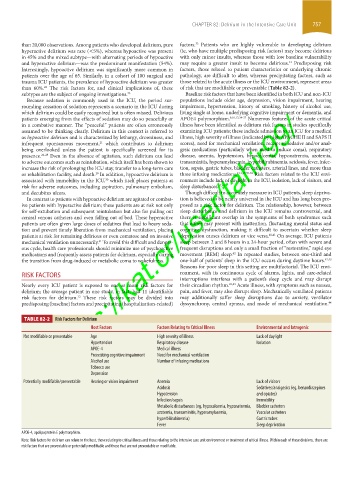
                    than 60%.  The risk factors for, and clinical implications of, these   of risk that are modifiable or preventable (Table 82-2).
                           22
                      subtypes are the subject of ongoing investigations. 23  Baseline risk factors that have been identified in both ICU and non-ICU
                     Because sedation is commonly used in the ICU, the period sur-  populations include older age, depression, vision impairment, hearing
                    rounding cessation of sedation represents a scenario in the ICU during   impairment, hypertension, history of smoking, history of alcohol use,
                                  https://kat.cr/user/tahir99/
                    which delirium could be easily recognized but is often missed. Delirious   living single at home, underlying cognitive impairment or dementia, and
                    patients emerging from the effects of sedation may do so peacefully or   APOE4 polymorphism. 9,10,13,34-37  Numerous features of the acute critical
                    in a combative manner. The “peaceful” patients are often erroneously   illness have been identified as delirium risk factors in studies specifically
                    assumed to be thinking clearly. Delirium in this context is referred to   examining ICU patients; these include admission to an ICU for a medical
                    as hypoactive delirium and is characterized by lethargy, drowsiness, and   illness, high severity of illness (indicated by high APACHE II and SAPS II
                                              21
                    infrequent spontaneous movement,  which contributes to delirium   scores), need for mechanical ventilation, receipt of sedative and/or anal-
                    being overlooked unless the patient is specifically screened for its   gesic medications (particularly when used to induce coma), respiratory
                    presence. 24-28  Even in the absence of agitation, such delirium can lead     disease, anemia, hypotension, hypocalcemia,   hyponatremia, azotemia,
                    to adverse outcomes such as reintubation, which itself has been shown to   transaminitis, hyperamylasemia, hyperbilirubinemia,  acidosis, fever, infec-
                    increase the risk of prolonging the ICU stay, transfer to a long-term care   tion, sepsis, gastric tubes, bladder catheters, arterial lines, and more than
                    or rehabilitation facility, and death.  In addition, hypoactive delirium is   three infusing medications. 9,13,17,35-39  Risk factors related to the ICU envi-
                                             29
                                                30
                    associated with immobility in the ICU,  which itself places patients at   ronment include lack of daylight in the ICU, isolation, lack of visitors, and
                    risk for adverse outcomes, including aspiration, pulmonary embolism,   sleep disturbances. 37,40
                    and decubitus ulcers.                                  Though difficult to accurately measure in ICU patients, sleep depriva-
                     In contrast to patients with hypoactive delirium are agitated or combat-  tion is believed to be nearly universal in the ICU and has long been pro-
                    ive patients with hyperactive delirium; these patients are at risk not only   posed as a risk factor for delirium. The relationship, however, between
                    for self-extubation and subsequent reintubation but also for pulling out   sleep disturbance and delirium in the ICU remains controversial, and
                    central venous catheters and even falling out of bed. These hyperactive   there is significant overlap in the symptoms of both syndromes such
                    patients are often given large doses of sedatives that lead to heavy seda-  that either may present with inattention, fluctuating mental status and
                    tion and prevent timely liberation from mechanical ventilation, placing   cognitive dysfunction, making it difficult to ascertain whether sleep
                    patients at risk for remaining delirious or even comatose and on invasive   deprivation causes delirium or vice versa. 40,41  On average, ICU patients
                                              31
                    mechanical ventilation unnecessarily.  To avoid this difficult and danger-  sleep between 2 and 8 hours in a 24-hour period, often with severe and
                    ous cycle, health care professionals should minimize use of psychoactive   frequent disruptions and only a small fraction of “restorative,” rapid eye
                    medications and frequently assess patients for delirium, especially during   movement (REM) sleep.  In repeated studies, between one-third and
                                                                                            42
                    the transition from drug-induced or metabolic coma to wakefulness.  one-half of patients’ sleep in the ICU occurs during daytime hours. 42,43
                                                                          Reasons for poor sleep in this setting are multifactorial. The ICU envi-
                    RISK FACTORS                                          ronment, with its continuous cycle of alarms, lights, and care-related
                                                                          interruptions interferes with a patient’s sleep cycle and may disrupt
                    Nearly every ICU patient is exposed to one or more risk factors for   their circadian rhythm. 41,43  Acute illness, with symptoms such as nausea,
                    delirium; the average patient in one study, in fact, had 11 identifiable   pain, and fever, may also disrupt sleep. Mechanically ventilated patients
                    risk factors for delirium.  These risk factors may be divided into   may additionally suffer sleep disruptions due to anxiety, ventilator
                                       32
                    predisposing (baseline) factors and precipitating (hospitalization-related)   dyssynchrony, central apneas, and mode of mechanical ventilation.
                                                                                                                            44
                      TABLE 82-2    Risk Factors for Delirium
                                           Host Factors           Factors Relating to Critical Illness  Environmental and Iatrogenic
                    Not modifiable or preventable  Age            High severity of illness          Lack of daylight
                                           Hypertension           Respiratory disease               Isolation
                                           APOE-4                 Medical illness
                                           Preexisting cognitive impairment  Need for mechanical ventilation
                                           Alcohol use            Number of infusing medications
                                           Tobacco use
                                           Depression
                    Potentially modifiable/preventable  Hearing or vision impairment  Anemia        Lack of visitors
                                                                  Acidosis                          Sedatives/analgesics (eg, benzodiazepines
                                                                  Hypotension                       and opiates)
                                                                  Infection/sepsis                  Immobility
                                                                  Metabolic disturbances (eg, hypocalcemia,  hyponatremia,   Bladder catheters
                                                                  azotemia, transaminitis, hyperamylasemia,   Vascular catheters
                                                                    hyperbilirubinemia)             Gastric tubes
                                                                  Fever                             Sleep deprivation
                    APOE-4, apolipoprotein E polymorphism.
                    Note: Risk factors for delirium can relate to the host, those relating to critical illness and those relating to the intensive care unit environment or treatment of critical illness. Within each of these divisions, there are
                    risk factors that are preventable or potentially modifiable and those that are not preventable or modifiable.


            section06.indd   757                                                                                       1/23/2015   12:55:25 PM

