


Page 1119 - Hall et al (2015) Principles of Critical Care-McGraw-Hill
P. 1119
758     PART 6: Neurologic Disorders


                 Finally, medications commonly given to ICU patients, such as seda-  A
                 tives, analgesics, vasopressors, β-agonists, and corticosteroids, disrupt   100
                 slow-wave and REM sleep.  Further study of sleep in the ICU is   90
                                      45
                 necessary to understand the underlying mechanisms for sleep disrup-
                 tion and the relationship between sleep and delirium. Meanwhile,   80
                 clinicians should attend to modifiable risk factors by reducing noise   Probability of transitioning  to delirium (%)
                 and light at night, minimizing other disruptions in the ICU environ-  70
                 ment, treating symptoms, and judiciously using sleep-disrupting
                 medications.                                                 60
                   The deliriogenic effects of medications given for sedation and/or
                 analgesia—drugs used to treat nearly all ICU patients at some time   50  No drug  0-1  1-2  2-3  3-4  4+  Log scale
                                https://kat.cr/user/tahir99/
                   during their ICU stay—have received specific attention in many      0-2.7  2.7-7.4 7.4-20 20-55  55+ Original scale
                   studies, as they represent a potent yet potentially modifiable risk fac-  Lorazepam dose (mg)
                 tor for delirium. Though sedative and analgesic medications are pre-
                 scribed to relieve pain and anxiety and to improve patient tolerance
                 of treatments during critical illness, these medications have important        Midazolam
                 side effects. Continuous infusion of sedatives, for example, is associ-  B  100
                 ated with   prolonged   mechanical ventilation,  whereas interruption                  Users
                                                   31
                 of sedative infusions expedites weaning from mechanical ventilation,   80              Non-users
                 speeds discharge from the ICU and hospital, and improves long-term      p = 0.014      p = 0.031
                 survival. 12,46                                                    60
                   Multiple  studies  have  now  clearly  demonstrated  a  link  between   % Days delirious
                 benzodiazepines and development of delirium. Lorazepam dose was    40
                 found to be an independent risk factor for the delirium in medical ICU
                 patients, such that each day a patient was treated with the drug, the odds   20
                 of being delirious the next day increased by 20%. In fact, patients treated
                 with greater than 20 mg of lorazepam in a day were nearly all delirious or   0
                 comatose the following day.  Numerous other studies have consistently    Surgical      Trauma
                                     13
                 found similar links between benzodiazepine administration (whether    Daily midazolam use (exc. coma days)
                 lorazepam or midazolam) and delirium in patients in surgical, trauma,
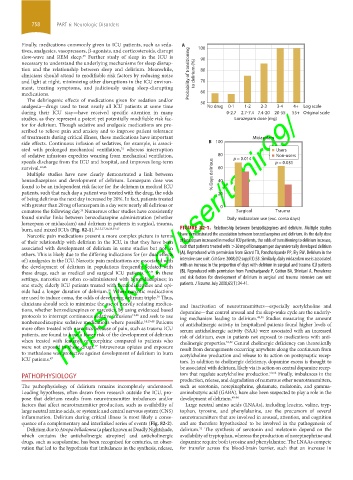
                 burn, and mixed ICUs (Fig. 82-1). 14,15,17,36,38,39,47  FIGURE 82-1.  Relationship  between  benzodiazepines  and delirium. Multiple  studies
                   Narcotic pain medications present a more complex picture in terms   have demonstrated the association between benzodiazepines and delirium. As the daily dose
                 of their relationship with delirium in the ICU, in that they have been   of lorazepam increased in medical ICU patients, the odds of transitioning to delirium increase,
                 associated with development of delirium in some studies but not in   such that patients treated with >20 mg of lorazepam per day universally developed delirium
                 others. This is likely due to the differing indications for (or dual effects   (A). Reproduced with permission from Girard TD, Pandharipande PP, Ely EW. Delirium in the
                 of) analgesics in the ICU. Narcotic pain medications are associated with   intensive care unit. Crit Care. 2008;(12 suppl 3):S3. Similarly, daily midazolam use is associated
                 the development of delirium in populations frequently sedated with   with an increase in the proportion of days with delirium in surgical and trauma ICU patients
                 these  drugs, such as medical and surgical ICU patients. 9,17,37  In these   (B). Reproduced with permission from Pandharipande P, Cotton BA, Shintani A. Prevalence
                 settings, narcotics are often co-administered with benzodiazepines; in   and risk factors for development of delirium in surgical and trauma intensive care unit
                 one study, elderly ICU patients treated with benzodiazepines and opi-  patients. J Trauma. July 2008;65(1):34-41.
                 oids had a longer duration of delirium.  When narcotic medications
                                               39
                 are used to induce coma, the odds of developing delirium triple.  Thus,
                                                               36
                 clinicians should seek to minimize the use of heavily sedating medica-  and inactivation of neurotransmitters—especially acetylcholine and
                 tions, whether benzodiazepines or narcotics, by using evidenced based   dopamine—that control arousal and the sleep-wake cycle are the underly-
                 protocols to interrupt continuous sedative infusions 12,46  and seek to use   ing mechanism leading to delirium. 49,50  Studies measuring the amount
                 nonbenzo diazepine sedative medications where possible. 14,15,48  Patients   of anticholinergic activity in hospitalized patients found higher levels of
                 more often treated with narcotics because of pain, such as trauma ICU   serum anticholinergic activity (SAA) were associated with an increased
                 patients, are found to have a lower risk of the development of delirium   risk of delirium, even in patients not exposed to medications with anti-
                 when treated with fentanyl or morphine compared to patients who   cholinergic properties. 51,52  Central cholinergic deficiency can theoretically
                 were not exposed to these drugs.  Intravenous opiates and exposure   result from derangements occurring anywhere along the continuum from
                                          17
                 to methadone was protective against development of delirium in burn   acetylcholine production and release to its action on postsynaptic recep-
                 ICU patients. 47                                      tors. In addition to cholinergic deficiency, dopamine excess is thought to
                                                                       be associated with delirium, likely via its action on central dopamine recep-
                 PATHOPHYSIOLOGY                                       tors that regulate acetylcholine production. 50-54  Finally, imbalances in the
                                                                       production, release, and degradation of numerous other neurotransmitters,
                 The pathophysiology of delirium remains incompletely understood.   such as serotonin, norepinephrine, glutamate, melatonin, and gamma-
                 Leading hypotheses, often drawn from research outside the ICU, pro-  aminobutyric acid (GABA), have also been suspected to play a role in the
                 pose that delirium results from neurotransmitter imbalances and/or   development of delirium. 49-54
                 factors that affect neurotransmitter production, such as availability of   Large neutral amino acids (LNAAs), including leucine, valine, tryp-
                 large neutral amino acids, or systemic and central nervous system (CNS)   tophan,  tyrosine,  and  phenylalanine,  are  the  precursors  of  several
                 inflammation. Delirium during critical illness is most likely a conse-  neurotransmitters that are involved in arousal, attention, and cognition
                 quence of a complementary and interlinked series of events (Fig. 82-2).  and are therefore hypothesized to be involved in the pathogenesis of
                   Delirium due to Atropa belladonna (a plant known as Deadly Nightshade,     delirium.  The synthesis of serotonin and melatonin depend on the
                                                                              52
                 which contains the anticholinergic atropine) and anticholinergic    availability of tryptophan, whereas the production of norepinephrine and
                 drugs, such as scopolamine, has been recognized for  centuries, an obser-  dopamine require both tyrosine and phenylalanine. The LNAAs compete
                 vation that led to the hypothesis that imbalances in the  synthesis, release,   for transfer across the blood-brain barrier, such that an increase in


            section06.indd   758                                                                                       1/23/2015   12:55:26 PM

