


Page 1122 - Hall et al (2015) Principles of Critical Care-McGraw-Hill
P. 1122
CHAPTER 82: Delirium in the Intensive Care Unit  761


                                      2         Delirium assessment

                               Step                   Confusion assessment method for the ICU (CAM-ICU)


                             1. Acute change or fluctuating course of mental status:                CAM-ICU negative
                                Is there an acute change from mental status baseline? Or  No          No delirium
                                  Has the patient’s mental status fluctuated during the past 24 hours?
                                                         Yes
                                  https://kat.cr/user/tahir99/
                             2. Inattention:
                                “Squeeze my hand when i say the letter ‘A’. ”
                                 Read the following sequence of letters: SAVE A HAART   0-2         CAM-ICU negative
                                                                                                      No delirium
                                Errors: No squeeze with ‘A’ & squeeze on letter other than ‘A’  errors
                                 If unable to complete letters   pictures
                                                         >2 Errors
                             3. Altered level of consciousness                       RASS other     CAM-ICU positive
                                Current RASS level (think back to sedation assessment in step 1)  than zero  Delirium present
                                                         RASS = zero
                             4. Disorganized thinking:
                                 1. Will a stone float on water?                        >1 error
                                 2. Are there fish in the sea?
                                 3. Does one pound weigh more than two?
                                 4. Can you use a hammer to pound a nail?
                                                                                         0-1
                             Command: “Hold up this many fingers” (Hold up 2 fingers)   error
                                                     “Now do the same thing with the other hand” (Do not demonstrate)  CAM-ICU negative
                                                     “Add one more finger” (If patient unable to move both arms)  No delirium
                                  Or
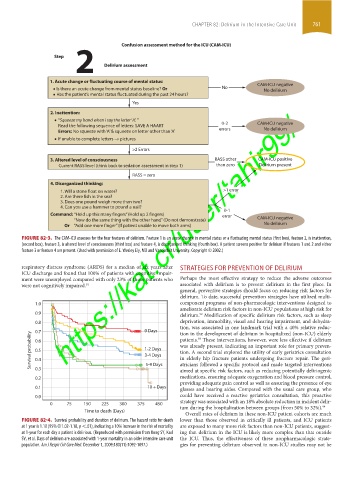
                    FIGURE 82-3.  The CAM-ICU assesses for the four features of delirium. Feature 1 is an acute change in mental status or a fluctuating mental status (first box), feature 2, is inattention,
                    (second box), feature 3, is altered level of consciousness (third box) and feature 4, is disorganized thinking (fourth box). A patient screens positive for delirium if features 1 and 2 and either
                    feature 3 or feature 4 are present. (Used with permission of E. Wesley Ely, MD and Vanderbilt University. Copyright © 2002.)


                    respiratory distress syndrome (ARDS) for a median of six years after   STRATEGIES FOR PREVENTION OF DELIRIUM
                    ICU discharge and found that 100% of patients with cognitive impair-
                    ment were unemployed compared with only 23% of those patients who   Perhaps the most effective strategy to reduce the adverse outcomes
                    were not cognitively impaired. 91                       associated with delirium is to prevent delirium in the first place. In
                                                                          general, preventive strategies should focus on reducing risk factors for
                                                                          delirium. To date, successful prevention strategies have utilized multi-
                        1.0                                               component programs of non-pharmacologic interventions designed to
                                                                          ameliorate delirium risk factors in non-ICU populations at high risk for
                        0.9                                               delirium.  Modification of specific delirium risk factors, such as sleep
                                                                                92
                        0.8                                               deprivation, immobility, visual and hearing impairment, and dehydra-
                                                                          tion, was associated in one landmark trial with a 40% relative reduc-
                        0.7                                   0 Days      tion in the development of delirium in hospitalized (non-ICU) elderly
                       Survival probability  0.5              1-2 Days    was already present, indicating an important role for primary preven-
                                                                          patients.  These interventions, however, were less effective if delirium
                                                                                93
                        0.6
                                                                          tion. A second trial explored the utility of early geriatrics consultation
                                                              3-4 Days
                                                                          in elderly hip fracture patients undergoing fracture repair. The geri-
                        0.4
                                                                          atricians followed a specific protocol and made targeted interventions
                        0.3
                                                                          medications, ensuring adequate oxygenation and blood pressure  control,
                        0.2                                   5-9 Days    aimed at specific risk factors, such as reducing potentially deliriogenic
                                                                          providing adequate pain control as well as ensuring the presence of eye
                        0.1                                   10 + Days   glasses and hearing aides. Compared with the usual care group, who
                        0.0                                               could have received a reactive geriatrics consultation, this proactive
                             0     75    150   225   300   375   450      strategy was associated with an 18% absolute reduction in incident delir-
                                                                          ium during the hospitalization between groups (from 50% to 32%).
                                                                                                                          94
                                         Time to death (Days)
                                                                           Overall rates of delirium in these non-ICU patient cohorts are much
                    FIGURE 82-4.  Survival probability and duration of delirium. The hazard ratio for death   lower than those observed in critically ill patients, and ICU patients
                    at 1 year is 1.10 (95% CI 1.02-1.18, p <.01), indicating a 10% increase in the risk of mortality   are exposed to many more risk factors than non-ICU patients, suggest-
                    at 1-year for each day a patient is delirious. (Reproduced with permission from Kong SY, Kasl   ing that delirium in the ICU is likely more complex than that outside
                    SV, et al. Days of delirium are associated with 1-year mortality in an older intensive care unit   the  ICU.  Thus,  the effectiveness  of  these  nonpharmacologic  strate-
                    population. Am J Respir Crit Care Med. December 1, 2009;180(11):1092-1097.)  gies for preventing delirium observed in non-ICU studies may not be


            section06.indd   761                                                                                       1/23/2015   12:55:28 PM

