


Page 1136 - Hall et al (2015) Principles of Critical Care-McGraw-Hill
P. 1136
CHAPTER 84: Cerebrovascular Disease  775


                    recurrence. 54,55  Studies of acute anticoagulation are not available. Acute   weeks, deteriorate due to rebleeding, hydrocephalus, or delayed isch-
                    anticoagulation of spontaneous or traumatic dissections of the carotid or   emic deficits caused by vasospasm. Management can be complicated
                    vertebral arteries is often recommended. Data to support this approach   by spontaneous volume contraction, cardiac and pulmonary dysfunc-
                    are derived only from small nonrandomized, nonblinded studies, and   tion, electrolyte abnormalities, infections, and a catabolic state. The
                    even these data are weak. 56                          treatment team should include neurosurgeons, radiologists, anesthe-
                        ■  INTRACEREBRAL HEMORRHAGE                       siologists, intensivists, and nurses experienced in the management of
                                                                          SAH patients. Because of the complicated nature of their surgical and
                    Supportive  care  of  patients  with  primary  intracerebral  hemorrhage   medical management, SAH patients are best cared for in centers that
                    (ICH) requires attention to the same basic factors as for patients   specialize in this care.
                    with cerebral infarction. Any underlying coagulopathy should be cor-  The management of patients following rupture of intracranial aneu-
                    rected as rapidly as possible. No randomized trials on management of   rysms has changed significantly over the past decades. The calcium
                    warfarin-associated ICH have been carried out. Prothrombin complex   channel blocker nimodipine is now routinely used to reduce the impact
                    concentrates, recombinant factor VIIa, and fresh frozen plasma alone   of vasospasm. Attempts at early obliteration of the ruptured aneurysm
                    or in combination have all been recommended.  Fresh frozen plasma   with surgical clipping or endovascular placement of detachable coils
                                                       57
                    administration may cause pulmonary edema.  Early use of Factor VIIa   within the aneurysm have become routine. Hemodynamic augmenta-
                                                    58
                    in patients with normal hemostasis resulted in a small reduction in clot   tion is now the cornerstone of the management of vasospasm with
                    expansion but no difference in clinical outcome.  Prophylaxis for deep   adjunctive  endovascular  treatment  employed in selected cases. New
                                                       59
                    venous thrombosis with low-dose subcutaneous heparin or heparinoids   and promising therapies that specifically target the underlying cause or
                    may be instituted safely on or after the second day posthemorrhage and   direct effects of cerebral vasospasm are currently under investigation. 77
                    reduces subsequent deep venous thrombosis if begun before day 4. 60,61    Initial Stabilization and Evaluation:  Initial evaluation should assess air-
                    Systemic blood pressure is often elevated acutely, sometimes to very   way, breathing, circulation, and neurologic function. Patients with a
                    high levels. In patients with systolic blood pressure of 150 to 220 mm Hg,   diminished level of consciousness often have impaired airway reflexes.
                    a randomized trial has demonstrated that rapid pharmacological reduc-  In general, patients with a Glasgow Coma Scale score of 8 or less should
                    tion of systolic pressure by 27 mm Hg within the first hour was safe in   be intubated. This should be performed under controlled conditions by
                    that  it  resulted in equivalent  clinical  outcomes  when  compared  to  a   experienced personnel using a rapid sequence protocol. Premedication
                    lesser decrease of 13 mm Hg.  There are insufficient data to permit des-  with short-acting agents such as propofol or etomidate should be used
                                        62
                    ignation of any target blood pressure levels as effective. 27,63  to prevent elevations in blood pressure (BP) with tracheal stimulation in
                     Clinically evident seizures are more common with lobar ICH com-  order to minimize the risk of rebleeding.
                    pared to basal ganglia hemorrhage.  Prolonged electroencephalographic   As soon as the patient is stabilized, a complete neurologic examina-
                                            64
                    monitoring shows electrical epileptiform events without motor convul-  tion, head CT, and, if indicated, lumbar puncture should be performed.
                    sions in 20% to 30% of patients with acute ICH. 65,66  The value of treating   Patients are graded on the basis of clinical and radiographic criteria. The
                    the electrographic events is under study. Prophylactic anticonvulsant   two common clinical grading scales that are predictive of outcome are
                    treatment does not prevent seizures and may worsen outcome. 67,68  the Hunt-Hess scale and the World Federation of Neurological Surgeons
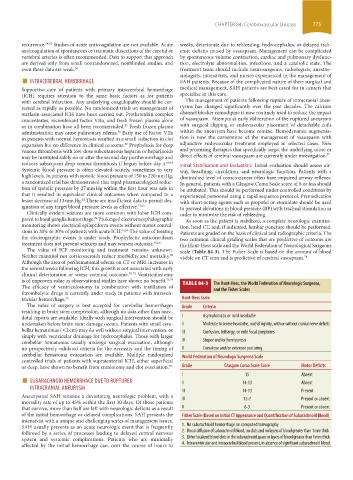
                     The value of ICP monitoring and treatment remains unknown.   scale (Table 84-3). The Fisher Scale is based on the amount of blood
                    Neither mannitol nor corticosteroids reduce morbidity and mortality.      visible on CT scan and is predictive of cerebral vasospasm. 78
                                                                      69
                    Although the area of perihematomal edema on CT or MRI increases in
                    the several weeks following ICH, this growth is not associated with early
                    clinical deterioration or worse eventual outcome. 70-72  Ventriculostomy
                    is of unproven value as observational studies have shown no benefit. 73,74
                    The efficacy of ventriculostomy in combination with instillation of     TABLE 84-3     The Hunt-Hess, the World Federation of Neurologic Surgeons,
                                                                                     and the Fisher Scales
                    thrombolytic drugs is currently under study in patients with intraven-
                    tricular hemorrhage. 75                               Hunt-Hess Scale
                     The value of surgery is best accepted for cerebellar hemorrhages   Grade  Criteria
                    resulting in brain stem compression, although no data other than anec-
                    dotal reports are available. Ideally such surgical intervention should be   I  Asymptomatic or mild headache
                    undertaken before brain stem damage occurs. Patients with small cere-  II  Moderate to severe headache, nuchal rigidity, with or without cranial nerve deficits
                    bellar hematomas (<2 cm) may do well without surgical intervention, or   III  Confusion, lethargy, or mild focal symptoms
                    simply with ventricular drainage for hydrocephalus. Those with larger
                    cerebellar  hematomas  usually  undergo  surgical  evacuation,  although   IV  Stupor and/or hemiparesis
                    no prospectively validated criteria for the necessity and the timing of   V  Comatose and/or extensor posturing
                    cerebellar hematoma evacuation are available. Multiple randomized   World Federation of Neurologic Surgeons Scale
                    controlled trials of patients with supratentorial ICH, either superficial
                    or deep, have shown no benefit from craniotomy and clot evacuation. 76  Grade  Glasgow Coma Scale Score  Motor Deficits
                        ■  SUBARACHNOID HEMORRHAGE DUE TO RUPTURED        I                     15                 Absent

                      INTRACRANIAL ANEURYSM                               II                   14-13               Absent
                                                                          III                  14-13               Present
                    Aneurysmal SAH remains a devastating neurologic problem, with a   IV       12-7                Present or absent
                    mortality rate of up to 45% within the first 30 days. Of those patients
                    that survive, more than half are left with neurologic deficits as a result   V  6-3            Present or absent
                    of the initial hemorrhage or delayed complications. SAH presents the   Fisher Scale (Based on Initial CT Appearance and Quantification of Subarachnoid Blood)
                    intensivist with a unique and challenging series of management issues.
                    SAH usually presents as an acute neurologic event that is frequently   1.  No subarachnoid hemorrhage on computed tomography
                    followed by a series of processes leading to delayed central nervous   2.  Broad diffusion of subarachnoid blood, no clots and no layers of blood greater than 1 mm thick
                    system and systemic complications. Patients who are minimally   3.  Either localized blood clots in the subarachnoid space or layers of blood greater than 1 mm thick
                    affected  by  the  initial  hemorrhage  can,  over  the  course  of  hours  to   4.  Intraventricular and intracerebral blood present, in absence of significant subarachnoid blood


            section06.indd   775                                                                                       1/23/2015   12:55:33 PM

