


Page 1140 - Hall et al (2015) Principles of Critical Care-McGraw-Hill
P. 1140
CHAPTER 85: Seizures in the Intensive Care Unit  779


                     CHAPTER    Seizures in the Intensive                 intracranial hemorrhage, sepsis, cardiac arrest, or CNS infection. 11-15  In
                                                                          one series, 8% of hospitalized comatose patients were found to be in
                                                                                                 15
                      85        Care Unit                                 electrographic status epilepticus,  up to 34% of patients in neurological
                                                                          ICUs,  and other series of patients with altered mental status found 37%
                                                                              15
                                Katharina M. Busl                         to have nonconvulsive seizures.  Of all patients with status epilepticus,
                                                                                                16
                                                                                                             17
                                Thomas P. Bleck                           about 80% have nonconvulsive status epilepticus.  Seizures are probably
                                                                          even more frequent in the pediatric ICU, as children in the first year of
                                                                          life have the highest incidence of SE of any age group studied. 8
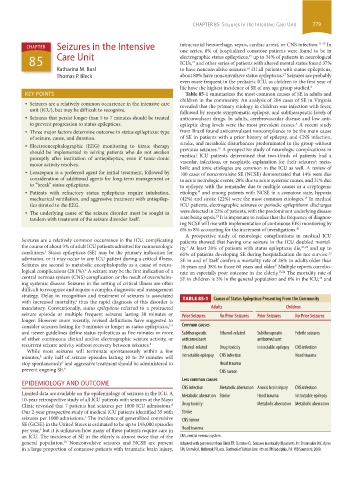
                     KEY POINTS                                            Table 85-1 summarizes the most common causes of SE in adults and
                                                                          children in the community. An analysis of 204 cases of SE in Virginia
                        •  Seizures are a relatively common occurrence in the intensive care   revealed that the primary etiology in children was infection with fever,
                      unit (ICU), but may be difficult to recognize.      followed by remote symptomatic epilepsy, and subtherapeutic levels of
                        • Seizures that persist longer than 5 to 7 minutes should be treated   anticonvulsant drugs. In adults, cerebrovascular disease and low anti-
                      to prevent progression to status epilepticus.       epileptic drug levels were the most prevalent causes.  A recent study
                                                                                                                 8
                        • Three major factors determine outcome in status epilepticus: type   from Brazil found anticonvulsant noncompliance to be the main cause
                      of seizure, cause, and duration.                    of SE in patients with a prior history of epilepsy, and CNS infection,
                        • Electroencephalographic (EEG) monitoring to titrate therapy   stroke, and metabolic disturbances predominated in the group without
                                                                                      18
                      should  be  implemented  in seizing  patients  who  do  not awaken   previous seizures.  A prospective study of neurologic complications in
                                                                          medical  ICU  patients  determined  that  two-thirds  of  patients  had  a
                      promptly after institution of antiepileptics, even if tonic-clonic                               1
                      motor activity resolves.                              vascular, infectious, or neoplastic explanation for their seizures ; meta-
                                                                          bolic and toxic etiologies are common in the ICU as well. A review of
                        •  Lorazepam is a preferred agent for initial treatment, followed by   100 cases of nonconvulsive SE (NCSE) demonstrated that 14% were due
                      consideration of additional agents for long-term management or   to acute neurologic events, 28% due to acute systemic causes, and 31% due
                      to “break” status epilepticus.                      to epilepsy, with the remainder due to multiple causes or a cryptogenic
                        • Patients with refractory status epilepticus require intubation,     etiology,  and among patients with NCSE in a comatose state, hypoxia
                                                                               19
                      mechanical ventilation, and aggressive treatment with antiepilep-  (42%) and stroke (22%) were the most common etiologies.  In medical
                                                                                                                    15
                      tics titrated to the EEG.                           ICU patients, electrographic seizures or periodic epileptiform discharges
                        • The underlying cause of the seizure disorder must be sought in   were detected in 22% of patients, with the predominant underlying disease
                                                                                      13
                      tandem with treatment of the seizure disorder itself.  state being sepsis.  It is important to realize that the frequency of diagnos-
                                                                          ing NCSE will rise with implementation of continuous EEG monitoring by
                                                                          6% to 8% accounting for the increment of investigations. 20
                                                                           A prospective study of neurologic complications in medical ICU
                    Seizures are a relatively common occurrence in the ICU, complicating   patients showed that having one seizure in the ICU doubled mortal-
                    the course of about 3% of adult ICU patients admitted for nonneurologic   ity.  At least 20% of patients with status epilepticus die, 21,22  and up to
                                                                            1
                    conditions.  Status epilepticus (SE) may be the primary indication for   61% of patients developing SE during hospitalization do not survive.
                            1
                                                                                                                            23
                    admission, or it may occur in any ICU patient during a critical illness.   SE in and of itself confers a mortality rate of 26% to adults older than
                    Seizures are second to metabolic encephalopathy as a cause of neuro-  16 years and 38% to those 60 years and older.  Multiple reports corrobo-
                                                                                                          8
                    logical complications (28.1%).  A seizure may be the first indication of a   rate an especially poor outcome in the elderly. 15,24  The mortality rate of
                                         1
                    central nervous system (CNS) complication or the result of overwhelm-  SE in children is 3% in the general population and 6% in the ICU,  and
                                                                                                                         25
                    ing systemic disease. Seizures in the setting of critical illness are often
                    difficult to recognize and require a complex diagnostic and management
                    strategy. Delay in recognition and treatment of seizures is associated
                    with increased mortality,  thus the rapid diagnosis of this disorder is     TABLE 85-1    Causes of Status Epilepticus Presenting From the Community
                                      2
                    mandatory.  Conventionally,  status epilepticus  referred  to  a  protracted   Adults     Children
                    seizure episode or multiple frequent seizures lasting 30 minutes or   Prior Seizures  No Prior Seizures  Prior Seizures  No Prior Seizures
                    longer. However more recently, revised definitions have suggested to
                    consider seizures lasting for 5 minutes or longer as status epilepticus,    Common causes
                                                                      3-5
                    and newer guidelines define status epilepticus as five minutes or more   Subtherapeutic   Ethanol-related  Subtherapeutic    Febrile seizures
                    of either continuous clinical and/or electrographic seizure activity, or     anticonvulsant  anticonvulsant
                    recurrent seizure activity without recovery between seizures. 6  Ethanol-related  Drug toxicity  Intractable epilepsy  CNS infection
                     While most seizures will terminate spontaneously within a few
                      minutes,  only half of seizure episodes lasting 10 to 29 minutes will   Intractable epilepsy  CNS infection  Head trauma
                          5
                    stop spontaneously  and aggressive treatment should be administered to   Head trauma
                                 7
                    prevent ongoing SE. 8                                              CNS tumor
                                                                          less common causes
                    EPIDEMIOLOGY AND OUTCOME
                                                                          CNS infection  Metabolic  aberration Anoxic brain injury  CNS infection
                    Limited data are available on the epidemiology of seizures in the ICU. A   Metabolic aberration Stroke  Head trauma  Intractable epilepsy
                    10-year retrospective study of all ICU patients with seizures at the Mayo
                    Clinic revealed that 7 patients had seizures per 1000 ICU admissions.    Drug toxicity  Metabolic aberration Metabolic aberration
                                                                       8
                    Our 2-year prospective study of medical ICU patients identified 35 with   Stroke
                    seizures per 1000 admissions.  The incidence of generalized convulsive   CNS tumor
                                         1
                    SE (GCSE) in the United States is estimated to be up to 195,000 episodes
                    per year,  but it is unknown how many of these patients require care in   Head trauma
                          9
                    an ICU. The incidence of SE in the elderly is almost twice that of the   CNS, central nervous system.
                    general population.  Nonconvulsive seizures and NCSE are present   Adapted with permission from Bleck TP, Dunatov CJ. Seizures in critically ill patients. In: Shoemaker WC, Ayres
                                  10
                    in a large proportion of comatose patients with traumatic brain injury,   SM, Grenvik A, Holbrook PR, eds. Textbook of Critical Care. 4th ed. Philadelphia, PA: WB Saunders; 2000.


            section06.indd   779                                                                                       1/23/2015   12:55:35 PM

