


Page 1422 - Hall et al (2015) Principles of Critical Care-McGraw-Hill
P. 1422
CHAPTER 103: Thyroid Disease  995


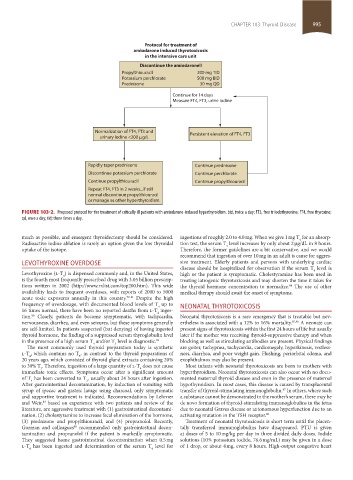
                                                              Protocol for treatment of
                                                          amiodarone induced thyrotoxicosis
                                                              in the intensive care unit
                                                            Discontinue the amiodarone!!
                                                      Propylthiouracil         200 mg TID
                                                      Potassium perchlorate    500 mg BID
                                                      Prednisone                30 mg QD
                                                                       Continue for 14 days
                                                                       Measure FT4, FT3, urine Iodine


                                             Normalization of FT4, FT3 and   Persistent elevation of FT4, FT3
                                              urinary iodine <200 mg/L


                                          Rapidly taper prednisone             Continue prednisone
                                          Discontinue potassium perchlorate    Continue perchlorate
                                          Continue propylthiouracil            Continue propylthiouracil
                                          Repeat FT4, FT3 in 2 weeks...if still
                                          normal discontinue propylthiouracil
                                          or manage as other hyperthyroidism.
                    FIGURE 103-2.  Proposed protocol for the treatment of critically ill patients with amiodarone-induced hyperthyroidism. bid, twice a day; FT3, free triiodothyronine; FT4, free thyroxine;
                    qd, once a day; tid; three times a day.


                    much as possible, and emergent thyroidectomy should be considered.   ingestions of roughly 2.0 to 4.0 mg. When we give 1 mg T  for an absorp-
                                                                                                                  4
                    Radioactive iodine ablation is rarely an option given the low thyroidal   tion test, the serum T  level increases by only about 2 µg/dL in 8 hours.
                                                                                         4
                    uptake of the isotope.                                Therefore, the former guidelines are a bit conservative, and we would
                                                                          recommend that ingestion of over 10 mg in an adult is cause for aggres-
                    LEvOTHYROXINE OvERDOSE                                sive treatment. Elderly patients and persons with underlying cardiac
                                                                          disease should be hospitalized for observation if the serum T  level is
                                                                                                                       4
                    Levothyroxine (l-T ) is dispensed commonly and, in the United States,   high or the patient is symptomatic. Cholestyramine has been used in
                                  4
                    is the fourth most frequently prescribed drug with 3.05 billion prescrip-  treating iatrogenic thyrotoxicosis and may shorten the time it takes for
                    tions written in 2002 (http://www.rxlist.com/top200.htm). This wide   the thyroid hormone concentration to normalize.  The use of other
                                                                                                               84
                    availability leads to frequent overdoses, with reports of 2000 to 5000   medical therapy should await the onset of symptoms.
                    acute toxic exposures annually in this country. 79-81  Despite the high
                    frequency of overdosage, with documented blood levels of T  up to    NEONATAL THYROTOXICOSIS
                                                                  4
                    16 times normal, there have been no reported deaths from l-T  inges-
                                                                  4
                    tion.  Clearly, patients do become symptomatic,  with tachycardia,   Neonatal thyrotoxicosis is a rare emergency that is treatable but nev-
                       80
                    nervousness, diarrhea, and even seizures, but these symptoms generally   ertheless is associated with a 12% to 16% mortality. 85,86  A neonate can
                    are self-limited. In patients suspected (but denying) of having ingested   present signs of thyrotoxicosis within the first 24 hours of life but usually
                    thyroid hormone, the finding of a suppressed serum thyroglobulin level   later if the mother was receiving thyroid-suppressive therapy and when
                    in the presence of a high serum T  and/or T  level is diagnostic. 82  blocking as well as stimulating antibodies are present. Physical findings
                                                   3
                                            4
                     The most commonly used thyroid preparation today is synthetic   are goiter, tachypnea, tachycardia, cardiomegaly, hyperkinesis, restless-
                    l-T , which contains no T , in contrast to the thyroid preparations of    ness, diarrhea, and poor weight gain. Flushing, periorbital edema, and
                      4
                                       3
                    20 years ago, which consisted of thyroid gland extracts containing 20%   exophthalmos may also be present.
                    to 30% T . Therefore, ingestion of a large quantity of l-T  does not cause   Most infants with neonatal thyrotoxicosis are born to mothers with
                                                            4
                          3
                    immediate toxic effects. Symptoms occur after a significant amount   hyperthyroidism. Neonatal thyrotoxicosis can also occur with no docu-
                    of T  has been converted to T , usually about 24 hours after ingestion.   mented maternal thyroid disease and even in the presence of maternal
                       4
                                          3
                    After gastrointestinal decontamination, by induction of vomiting with   hypothyroidism. In most cases, this disease is caused by transplacental
                    syrup of ipecac and gastric lavage using charcoal, only symptomatic   transfer of thyroid-stimulating immunoglobulin.  In others, where such
                                                                                                             87
                    and supportive treatment is indicated. Recommendations by Lehrner   a substance cannot be demonstrated in the mother’s serum, there may be
                    and Weir,  based on experience with two patients and review of the   de novo formation of thyroid-stimulating immunoglobulins in the fetus
                           83
                    literature, are aggressive treatment with (1) gastrointestinal decontami-  due to neonatal Graves disease or autonomous hyperfunction due to an
                    nation, (2) cholestyramine to increase fecal elimination of the hormone,    activating mutation in the TSH receptor. 88
                    (3) prednisone and propylthiouracil, and (4) propranolol. Recently,   Treatment of neonatal thyrotoxicosis is short term until the placen-
                    Gorman  and colleagues  recommended  only gastrointestinal  decon-  tally  transferred  immunoglobulins have disappeared. PTU  is given
                                     80
                    tamination and propranolol if the patient is markedly symptomatic.   at doses of 5 to 10 mg/kg per day in three divided daily doses. Iodide
                    They suggested home gastrointestinal decontamination when 0.5 mg   solutions (10% potassium iodide, 76.6 mg/mL) may be given in a dose
                    l-T   has  been  ingested  and  determination  of  the  serum  T   level  for   of 1 drop, or about 4 mg, every 8 hours. High-output congestive heart
                      4                                         4
            section08.indd   995                                                                                       1/14/2015   8:28:38 AM

