


Page 1418 - Hall et al (2015) Principles of Critical Care-McGraw-Hill
P. 1418
CHAPTER 103: Thyroid Disease  991


                    delirium, stupor, coma, and convulsions may be related to the direct
                    action of thyroid hormone on the brain.  Thyroid hormone can affect     TABLE 103-6    Laboratory Findings in Thyroid Storm
                                                 40
                    the concentrations and distributions of various neurotransmitters.    Elevated levels of T  and free T 4
                                                                      41
                                                                                     4
                    Hematologic manifestations of thyrotoxicosis  are rarely life threatening.    Elevated T  level
                                                   42
                                                                                3
                    It is useful for the intensivist to be aware that hyperthyroidism can cause   Hyperglycemia
                    slight anemia. Anemia may be secondary to hemodilution caused by
                    increased blood volume, but true reduction of red blood cell mass may be   Leukocytosis with left shift
                    caused by reduced iron absorption and vitamin B  deficiency  associated   Anemia
                                                       12
                    with autoimmune reduction of gastric acidity and intrinsic factor.   Hypercalcemia
                    Minimal thrombocytopenia, with rare instances of idiopathic throm-
                    bocytopenic purpura, has been reported.  Moderate eosinophilia may   Hypokalemia
                                                  43
                    occur and has been attributed to relative or absolute hypoadrenalism.    Abnormal liver function test findings
                    A variable relative or absolute lymphocytosis may be associated with   Hypercortisolemia
                    hyperthyroidism. These manifestations may cloud the picture of a
                    critically ill patient who may have other hematologic perturbations for
                    different reasons.
                     Hypercalcemia is the most common life-threatening electrolyte abnor-  TREATMENT
                    mality seen in thyrotoxicosis.  Severe hypercalcemia (11.8-19.2 mg/dL)     To prevent irreversible cardiovascular collapse, the treatment of thyroid
                                         42
                    has been reported in several patients with thyrotoxicosis. 44  storm should take a four-pronged approach: (1) therapy to reduce the
                     The most notable effect of thyrotoxicosis on the gastrointestinal system   serum thyroid hormone levels, (2) therapy to reduce the action of
                    is hypermotility with malabsorption.  The myopathy of hyperthyroidism   the thyroid hormones on peripheral tissues, (3) therapy to prevent car-
                                              45
                    may cause weakness of the striated muscles of the pharynx and, perhaps,   diovascular decompensation and to maintain normal homeostasis, and
                    the smooth muscle of the esophagus. Such patients could have dysphagia   (4) treatment of the precipitating event(s).
                    and then could aspirate and develop pneumonia.  Patients with hyper-  Therapy to Reduce Thyroid Hormone Levels:  An antithyroid drug, either
                                                       46
                    thyroidism appear to have a higher incidence of gastritis.  This associa-
                                                            47
                    tion is consistent with the hypergastrinemia seen in thyrotoxic patients.    PTU or methimazole (MMI), is given to prevent further synthesis of
                                                                      48
                                                                          thyroid hormone. These drugs are not available in parenteral form; they
                    Treatment with H  blockers or proton-pump inhibitors is indicated.
                                2
                     Rarely, fulminant hepatic necrosis or less severe hepatic injury occurs.   can only be given orally or by nasogastric tube. Instances may arise
                    Although thyroid hormone has no direct toxic effect on the liver, hyper-  in which these drugs cannot be given even by nasogastric tube—such
                    thermia can result in hepatic failure. In patients receiving propylthiouracil     as, for example, in patients  with infarcted bowel (see below).  PTU
                                                                          offers a slight advantage over MMI in that, in addition to its inhibitory
                    (PTU), drug toxicity is more likely the cause of fulminant hepatic necro-
                    sis.  Any thyrotoxic patient who presents with jaundice or other signs of   effect on hormone synthesis, it decreases the conversion of T  to T  in
                                                                                                                           3
                      49
                                                                                                                       4
                                                                          peripheral tissue. PTU should be given in a dose of 200 to 250 mg every
                    hepatic injury should have a thorough evaluation for possible alternative
                    causes of liver damage.                               6 hours, and MMI should be given in a dose of 25 mg every 6 hours.
                                                                          Some authors recommend giving an initial PTU loading dose of 600
                                                                          to 1000 mg, but this strategy has not been proved to be advantageous.
                    THYROID STORM                                         In patients in whom oral or nasogastric administration is not possible
                                                                          one 600-mg loading dose of PTU (12 tablets suspended in 90 mL of
                    Thyroid storm, or  thyrotoxic crisis, is a life-threatening though rare   water) is given as a retention enema, followed by 250 mg of PTU every
                    complication of severe thyrotoxicosis. The diagnosis is clinical, bearing   4 hours plus potassium iodide, 1 g diluted in 60 mL of water, given
                    no direct relation to the absolute levels of thyroid hormones in serum.   after the second PTU dose.  PTU has an immediate onset of action for
                                                                                             53
                    The cardinal features of thyroid storm are marked tachycardia, hyper-
                    tension, and widened pulse pressure; hyperpyrexia (usually greater than
                    38.5°C  [101°F]);  and  altered  mental  status.  In  extreme  cases,  cardio-
                    vascular collapse and shock may be seen. Some investigators contend     TABLE 103-7    Factors Precipitating Thyroid Storm
                    that abnormal mentation is the most important diagnostic component   Surgery
                    of thyroid storm.  Of course, these clinical features can occur with a   Infection
                                29
                    multitude  of  illnesses  in  the  absence  of  thyrotoxicosis.  Some  authors
                    propose a “point system” for determining whether a patient’s condi-  Acute psychiatric illness
                    tion represents true storm or severe thyrotoxicosis, but the distinction   Congestive heart failure
                    between these two entities is not useful clinically.  The key to treatment   Diabetic ketoacidosis
                                                       47
                    of this condition is to recognize severe thyrotoxicosis or storm and treat
                    immediately. Recent studies have shown a 10% mortality rate in patients   Pulmonary embolism
                    with “storm.”  A blood sample for measurement of the levels of T  or   Bowel infarction
                             50
                                                                     4
                    free T , or the free T  index (FT I), and TSH, by a sensitive method,   Parturition
                        4
                                            4
                                   4
                    should be obtained immediately in all individuals suspected of having
                    this disorder. Empirical treatment then should begin. It is prudent to   Trauma
                    obtain a blood sample for cortisol determination before “stress doses”   Vigorous palpation of thyroid gland
                    of steroids are administered for use later in deciding later whether long-  Withdrawal of antithyroid medication
                    term therapy is necessary. Laboratory findings in thyroid storm are   Drugs
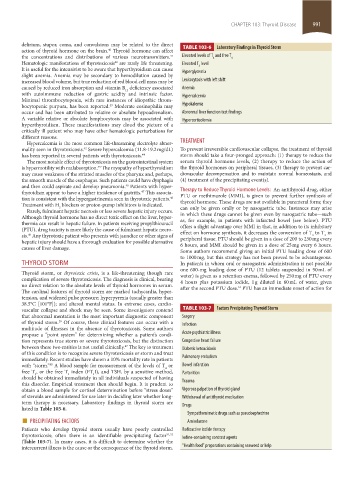
                    listed in Table 103-6.
                        ■  PRECIPITATING FACTORS                            Sympathomimetic drugs such as pseudoephedrine
                                                                            Amiodarone
                    Patients who develop thyroid storm usually have poorly controlled   Radioactive iodide therapy
                    thyrotoxicosis; often there is an identifiable precipitating factor 51,52    Iodine-containing contrast agents
                    (Table 103-7). In many cases, it is difficult to determine whether the
                    intercurrent illness is the cause or the consequence of the thyroid storm.  “Health food” preparations containing seaweed or kelp
            section08.indd   991                                                                                       1/14/2015   8:28:36 AM

