


Page 1419 - Hall et al (2015) Principles of Critical Care-McGraw-Hill
P. 1419
992     PART 8: Renal and Metabolic Disorders


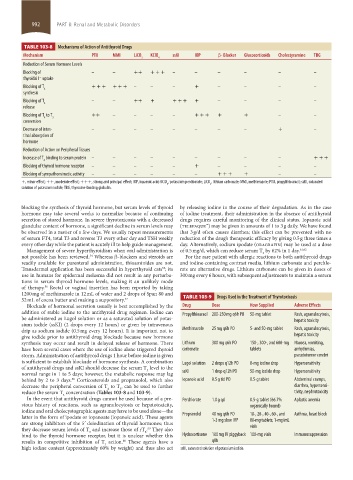
                   TABLE 103-8    Mechanisms of Action of Antithyroid Drugs
                  Mechanism              PTU    MMI    LiCO  KClO    ssKI   IOP     β- Blocker  Glucocorticoids  Cholestyramine  TBG
                                                          3     4
                  Reduction of Serum Hormone Levels
                  Blocking of            –      –      ++    + + +   –      –       –        –           –           –
                       −
                  thyroidal I  uptake
                  Blocking of T   4      + + +  + + +  –     –       –      +       –        –           –           –
                  synthesis
                  Blocking of T   4      –      –      ++    +       + + +  +       –        –           –           –
                  release
                  Blocking of T  to T   3  ++   –      –     –       –      + + +   +        +           –           –
                         4
                  conversion
                  Decrease of intes-     –      –      –     –       –      –       –        –           +           –
                  tinal absorption of
                  hormone
                  Reduction of Action on Peripheral Tissues
                  Increase of T  binding to serum protein  –  –  –  –  –    –       –        –           –           + + +
                         4
                  Blocking of thyroid hormone receptor  –  –  –  –   –      +       –        –           –           –
                  Blocking of sympathomimetic activity  –  –  –  –   –      –       + + +    +           –           –
                 +, minor effect; ++, moderate effect; +++, strong and principal effect; IOP, iopanoic acid; KClO , potassium perchlorate; LiCO , lithium carbonate; MMI, methimazole; PTU, propylthiouracil; ssKI, saturated
                                                                   4
                                                                                 3
                   solution of potassium iodide; TBG, thyroxine-binding globulin.
                 blocking the synthesis of thyroid hormone, but serum levels of thyroid   by releasing iodine in the course of their degradation. As in the case
                 hormone may take several weeks to normalize because of continuing   of iodine treatment, their administration in the absence of antithyroid
                 secretion of stored hormone. In severe thyrotoxicosis with a decreased   drugs requires careful monitoring of the clinical status. Iopanoic acid
                 glandular content of hormone, a significant decline in serum levels may   (telepaque™) may be given in amounts of 1 to 3 g daily. We have found
                 be observed in a matter of a few days. We usually repeat measurements   that 3 g/d often causes diarrhea; this effect can be prevented with no
                 of serum FT4, total T3 and reverse T3 every other day and TSH weekly   reduction of the drug’s therapeutic efficacy by giving 0.5 g three times a
                 every other day while the patient is acutely ill to help guide management.  day. Alternatively, sodium ipodate (oragrafin) may be used at a dose
                   Management of severe hyperthyroidism when oral administration is   of 0.5 mg/d, which can reduce serum T  by 62% in 1 day. 61,62
                                                                                                   3
                 not possible has been reviewed.  Whereas β-blockers and steroids are   For the rare patient with allergic reactions to both antithyroid drugs
                                        54
                 readily available for parenteral  administration,  thioaminides  are not.   and iodine-containing contrast media, lithium carbonate and perchlo-
                 Transdermal application has been successful in hyperthyroid cats ; its   rate are alternative drugs. Lithium carbonate can be given in doses of
                                                                 55
                 use in humans for epidermal melasma did not result in any perturba-  300 mg every 6 hours, with subsequent adjustments to maintain a serum
                 tions in serum thyroid hormone levels, making it an unlikely mode
                 of therapy.  Rectal or vaginal insertion has been reported by taking
                         56
                 1200 mg of methimazole in 12 mL of water and 2 drops of Span 80 and
                 52 mL of cocoa butter and making a suppository. 57      TABLE 103-9    Drugs Used in the Treatment of Thyrotoxicosis
                   Blockade of hormonal secretion usually is best accomplished by the   Drug  Dose  How Supplied  Adverse Effects
                 addition of stable iodine to the antithyroid drug regimen. Iodine can   Propylthiouracil 200-250 mg q6h PO  50-mg tablet  Rash, agranulocytosis,
                 be administered as Lugol solution or as a saturated solution of potas-                       hepatic toxicity
                 sium iodide (ssKI) (2 drops every 12 hours) or given by intravenous
                 drip as sodium iodide (0.5 mg every 12 hours). It is important not to   Methimazole  25 mg q6h PO  5- and 50-mg tablet  Rash, agranulocytosis,
                 give iodide prior to antithyroid drug blockade because new hormone                           hepatic toxicity
                 synthesis may occur and result in delayed release of hormone. There   Lithium    300 mg q6h PO  150-, 300-, and 600-mg  Nausea, vomiting,
                 have been several cases where the use of iodine alone triggered thyroid   carbonate  tablets  arrhythmias,
                 storm. Administration of antithyroid drugs 1 hour before iodine is given                     pseudotumor cerebri
                 is sufficient to establish blockade of hormone synthesis. A combination   Lugol solution  2 drops q12h PO  8-mg iodine drop  Hypersensitivity
                 of antithyroid drugs and ssKI should decrease the serum T  level to the
                                                            3
                 normal range in 1 to 5 days; however, the metabolic response may lag   ssKI  1 drop q12h PO  50-mg iodide drop  Hypersensitivity
                 behind by 2 to 3 days.  Corticosteroids and propranolol, which also   Iopanoic acid  0.5 g tid PO  0.5-g tablet  Abdominal cramps,
                                  58
                 decrease the peripheral conversion of T  to T , can be used to further                       diarrhea, hypersensi-
                                                   3
                                              4
                 reduce the serum T  concentration (Tables 103-8 and 103-9).                                  tivity, nephrotoxicity
                               3
                   In the event that antithyroid drugs cannot be used because of a pre-  Perchlorate  1.0 g qd  0.5-g tablet (66.7%   Aplastic anemia
                 vious history of reactions, such as agranulocytosis or hepatotoxicity,        organically bound)
                 iodine and oral cholecystographic agents may have to be used alone—the
                 latter in the form of ipodate or iopanoate (iopanoic acid). These agents   Propranolol  40 mg q6h PO   10-, 20-, 40-, 60-, and   Asthma, heart block
                 are strong inhibitors of the 5′ deiodination of thyroid hormones; thus   1-3 mg slow IVP  80-mg tablets; 1-mg/mL
                 they decrease serum levels of T  and increase those of rT .  They also        vials
                                                            59
                                                           3
                                        3
                 bind to the thyroid hormone receptor, but it is unclear whether this   Hydrocortisone 100 mg IV piggyback  100-mg vials  Immunosuppression
                 results in competitive inhibition of T  action.  These agents have a   q8h
                                                    60
                                              3
                 high iodine content (approximately 60% by weight) and thus also act   ssKI, saturated solution of potassium iodide.


            section08.indd   992                                                                                       1/14/2015   8:28:37 AM

