


Page 1744 - Hall et al (2015) Principles of Critical Care-McGraw-Hill
P. 1744
CHAPTER 124: Toxicology in Adults  1213


                    intravenous use produce symptoms within seconds that peak in 3 to    been associated with sinusitis and botulism. 232,233  In addition, cocaine
                    5 minutes, and have variable lengths of activity from 15 to 60 minutes. 208  increases the likelihood of violent fatal injuries. 234
                     Common central nervous system manifestations include euphoria,   Treatment of cocaine intoxication starts with the ABCDs of resuscita-
                    anxiety, agitation, psychosis, and delirium. Rarely, cocaine-induced   tion and treatment of seizures, hyperthermia, and agitation. Gut decon-
                    ischemic cerebral infarction is mistaken for a psychiatric condition.    tamination is restricted to cases of body packing. Body packers swallow
                                                                      209
                    Seizures are generally short-lived and self-limited unless there is ongo-  multiple wrapped packages of cocaine (or any other illegal substance of
                    ing drug absorption (as in body packers or body stuffers) or other central   abuse) in an attempt to smuggle the drug across borders; body stuffers
                    nervous system pathology. Several mechanisms are likely responsible for   conceal wrapped packets of the substance in various body cavities when
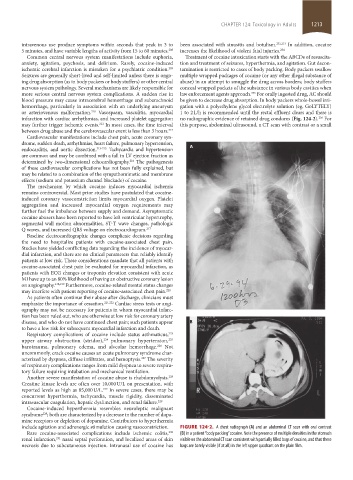
                    more serious central nervous system complications. A sudden rise in   law enforcement agents approach.  For orally ingested drug, AC should
                                                                                                  235
                    blood pressure may cause intracerebral hemorrhage and subarachnoid   be given to decrease drug absorption. In body packers whole-bowel irri-
                    hemorrhage, particularly in association with an underlying aneurysm   gation with a polyethylene glycol electrolyte solution (eg, GoLYTELY)
                    or arteriovenous malformation.  Vasospasm, vasculitis, myocardial   1 to 2 L/h is recommended until the rectal effluent clears and there is
                                           210
                    infarction with cardiac arrhythmias, and increased platelet aggregation   no radiographic evidence of retained drug condoms (Fig. 124-2).  For
                                                                                                                         236
                    may further trigger ischemic events.  In most cases, the time interval   this purpose, abdominal ultrasound, a CT scan with contrast or a small
                                              211
                    between drug abuse and the cerebrovascular event is less than 3 hours. 212
                     Cardiovascular manifestations include chest pain, acute coronary syn-
                    drome, sudden death, arrhythmias, heart failure, pulmonary hypertension,
                    endocarditis, and aortic dissection. 213-215  Tachycardia and hypertension   A
                    are common and may be combined with a fall in LV ejection fraction as
                    determined by two-dimensional echocardiography.  The pathogenesis
                                                        216
                    of these cardiovascular complications has not been fully explained, but
                    may be related to a combination of the sympathomimetic and membrane
                    effects (sodium and potassium channel blockade) of cocaine.
                     The mechanism by which cocaine induces myocardial ischemia
                    remains controversial. Most prior studies have postulated that cocaine-
                    induced coronary vasoconstriction limits myocardial oxygen. Platelet
                    aggregation and increased myocardial oxygen requirements may
                    further fuel the imbalance between supply and demand. Asymptomatic
                    cocaine abusers have been reported to have left ventricular hypertrophy,
                    segmental wall motion abnormalities, ST-T wave changes, pathologic
                    Q waves, and increased QRS voltage on electrocardiogram. 217
                     Baseline electrocardiographic changes complicate decisions regarding
                    the need to hospitalize patients with cocaine-associated chest pain.
                    Studies have yielded conflicting data regarding the incidence of myocar-
                    dial infarction, and there are no clinical parameters that reliably identify
                    patients at low risk. These considerations mandate that all patients with
                    cocaine-associated chest pain be evaluated for myocardial infarction, as
                    patients with ECG changes or troponin elevation consistent with acute
                    MI have up to an 80% likelihood of having an obstructive coronary lesion
                    on angiography. 218,219  Furthermore, cocaine-related mental status changes
                    may interfere with patient reporting of cocaine-associated chest pain. 220
                     As patients often continue their abuse after discharge, clinicians must
                    emphasize the importance of cessation. 221,222  Cardiac stress tests or angi-
                    ography may not be necessary for patients in whom myocardial infarc-
                    tion has been ruled out, who are otherwise at low risk for coronary artery
                    disease, and who do not have continued chest pain; such patients appear   B
                    to have a low risk for subsequent myocardial infarction and death.
                     Respiratory complications of cocaine include status asthmaticus,
                                                                      223
                    upper airway obstruction (stridor),  pulmonary hypertension,
                                                224
                                                                      225
                    barotrauma, pulmonary  edema,  and alveolar hemorrhage.  Not
                                                                  226
                    uncommonly, crack cocaine causes an acute pulmonary syndrome char-
                    acterized by dyspnea, diffuse infiltrates, and hemoptysis.  The severity
                                                            227
                    of respiratory complications ranges from mild dyspnea to severe respira-
                    tory failure requiring intubation and mechanical ventilation.
                     Another severe manifestation of cocaine abuse is rhabdomyolysis.
                                                                      228
                    Creatine kinase levels are often over 10,000 U/L on presentation, with
                    reported levels as high as 85,000 U/L.  In severe cases, there may be
                                               229
                    concurrent hyperthermia, tachycardia, muscle rigidity, disseminated
                    intravascular coagulation, hepatic dysfunction, and renal failure. 229
                     Cocaine-induced hyperthermia resembles neuroleptic  malignant
                    syndrome ; both are characterized by a decrease in the number of dopa-
                           228
                    mine receptors or depletion of dopamine. Contributors to hyperthermia
                    include agitation and adrenergic stimulation causing vasoconstriction.  FIGURE 124-2.  A chest radiograph (A) and an abdominal CT scan with oral contrast
                     Rare cocaine-associated complications include ischemic colitis,    (B) in a patient “body packing” cocaine. Note the presence of multiple densities in the stomach
                                                                      230
                    renal infarction,  nasal septal perforation, and localized areas of skin   visible on the abdominal CT scan consistent with partially filled bags of cocaine, and that these
                               231
                    necrosis due to subcutaneous injection. Intranasal use of cocaine has   bags are barely visible (if at all) in the left upper quadrant on the plain film.


            section11.indd   1213                                                                                      1/19/2015   10:52:02 AM

