


Page 1747 - Hall et al (2015) Principles of Critical Care-McGraw-Hill
P. 1747
1216     PART 11: Special Problems in Critical Care


                   Seizures should be treated with intravenous diazepam or lorazepam.   digitalis sensitivity. Such factors include hypokalemia, hypomagnese-
                 Phenytoin may be administered cautiously in refractory cases. Paralysis   mia, myocardial disease, old age, hypothyroidism, and a variety of other
                 with continuous EEG monitoring may be indicated when seizures are   metabolic disturbances (hypoxemia, acid-base abnormalities, hypercal-
                 refractory (as may be seen in amoxapine overdose) to control tempera-  cemia, and hypernatremia).
                 ture and limit muscle breakdown.                        The clinical manifestations of digitalis intoxication include fatigue,
                   Gastric lavage may be considered during the first hour after a life-  gastrointestinal symptoms (anorexia, nausea, vomiting, diarrhea, and
                 threatening ingestion. Single-dose AC is effective and should be consid-  abdominal pain), neurologic disturbances (blurred vision, visual color
                 ered if the airway is protected. Because these drugs are lipid soluble and   changes, headache, dizziness, and delirium), and cardiac arrhythmias
                 protein bound, dialysis and hemoperfusion are not effective.  (including many types, but classically supraventricular tachycardia with
                   There has been a single case reported in the literature on the use of intra-  AV block). Massive digoxin overdose also causes hyperkalemia, because
                 venous lipid emulsion (discussed in the section on β-blocker toxicity)    of inhibition of cellular Na-K-ATPase function. Plasma digoxin levels
                 in severe tricyclic antidepressant toxicity with hypotension that was not   correlate generally with therapeutic and toxic effects, but variability in
                 responsive to vasopressors and sodium bicarbonate. 277  response to a particular level is common. 280,281
                                                                         Digoxin levels should be measured at steady state. This occurs after
                     ■  DIGOXIN                                        approximately 1 week when renal function is normal, and to allow time
                                                                       for distribution a blood level should be obtained at least 6 hours after
                 Digitalis is a cardiac glycoside clinically used for treatment of systolic   the last dose. Based on data demonstrating benefit of low serum digoxin
                 myocardial dysfunction and supraventricular arrhythmias. The most   concentrations in heart failure,  many laboratories have lowered the
                                                                                              282
                 commonly prescribed cardiac glycoside in the United States is digoxin,   therapeutic range for digoxin to 0.5 to 1.0 ng/mL.
                 although natural glycosides (eg, oleander, lily of the valley, and foxglove)   Gastrointestinal decontamination including gastric lavage and
                 produce a similar clinical presentation in overdose. Digoxin is exten-  activated charcoal may be considered within an hour of acute inges-
                 sively tissue bound (mostly in muscle), resulting in a massive apparent   tion. Additional decontamination modalities including MDAC and
                 volume of distribution (4-7 L/kg). Many sources divide digoxin toxic-  cholestyramine, although used in the past, have insufficient evidence
                 ity into three types: acute, acute-on-chronic, and chronic. Diminished   to support their routine use if digoxin-specific Fab fragments are
                 clearance because of kidney disease, which often increases half-life to    available. Hemodialysis or hemoperfusion remove only small amounts
                 80 to 180 hours, is the most common precipitant of acute-on-chronic   of total body digitalis (because of large volume of distribution), but HD
                 episodes. Drug interactions also elevate digoxin levels by impairing renal   may still be indicated for correction of hyperkalemia or other acid-base
                 excretion (eg, verapamil, other calcium-channel blockers, quinidine,   derangements in renally impaired patients. Fortunately, immunotherapy
                 and cyclosporine) or hepatic biotransformation (eg, cyclosporine, vera-  with digoxin-specific antibody Fab fragments is widely available. These
                 pamil, other calcium-channel blockers, or amiodarone), or decreasing     sheep-derived antibodies bind intravascular digoxin, also competitively
                 digoxin tissue binding and Vd (eg, quinidine). Finally, increased oral   removing digoxin bound to cellular Na-K-ATPase sites. 283,284  Indications
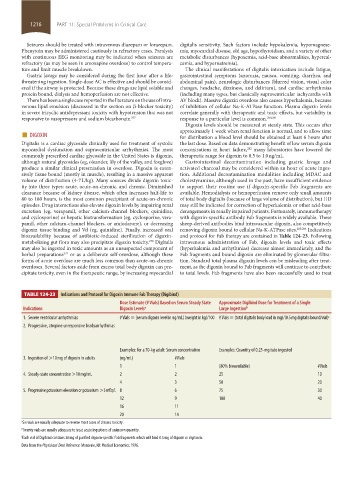
                 bioavailability because of antibiotic-induced sterilization of digoxin-  and protocol for Fab therapy are contained in Table 124-23. Following
                 metabolizing gut flora may also precipitate digoxin toxicity.  Digitalis   intravenous administration of Fab, digoxin levels and toxic effects
                                                             278
                 may also be ingested in toxic amounts as an unsuspected component of   (hyperkalemia and arrhythmias) decrease almost immediately, and the
                 herbal preparations  or as a deliberate self-overdose, although these   Fab fragments and bound digoxin are eliminated by glomerular filtra-
                                279
                 forms of acute overdose are much less common than acute-on-chronic   tion. Standard total plasma digoxin levels can be misleading after treat-
                 overdoses. Several factors aside from excess total body digoxin can pre-  ment, as the digoxin bound to Fab fragments will continue to contribute
                 cipitate toxicity, even in the therapeutic range, by increasing myocardial   to total levels. Fab fragments have also been successfully used to treat


                   TABLE 124-23    Indications and Protocol for Digoxin Immune Fab Therapy (Digibind)
                                                   Dose Estimate (# Vials) Based on Serum Steady State    Approximate Digibind Dose for Treatment of a Single
                  Indications                      Digoxin Levels a                  Large Ingestion b
                  1.  Severe ventricular arrhythmias  # Vials = (serum digoxin level in ng/mL) (weight in kg)/100 # Vials = (total digitalis body load in mg)/(0.5 mg digitalis bound/vial) c
                  2.  Progressive, atropine unresponsive bradyarrhythmias


                                                   Examples: for a 70-kg adult: Serum concentration  Examples: Quantity of 0.25-mg tabs ingested
                  3.  Ingestion of >10 mg of digoxin in adults  (ng/mL)  #Vials
                                                   1                 1               (80% bioavailable)               #Vials
                  4.  Steady-state concentration >10 mg/mL  2        2               25                               10
                                                   4                 3               50                               20
                  5.  Progressive potassium elevation or potassium >5 mEq/L 8  6     75                               30
                                                   12                9               100                              40
                                                   16                11
                                                   20                14
                 a Six vials are usually adequate to reverse most cases of chronic toxicity.
                 b Twenty vials are usually adequate to treat acute ingestions of unknown quantity.
                 c Each vial of Digibind contains 38 mg of purified digoxin-specific Fab fragments which will bind 0.5 mg of digoxin or digitoxin.
                 Data from the Physicians’ Desk Reference. Montvale, NJ: Medical Economics; 1996.


            section11.indd   1216                                                                                      1/19/2015   10:52:02 AM

