


Page 1749 - Hall et al (2015) Principles of Critical Care-McGraw-Hill
P. 1749
1218     PART 11: Special Problems in Critical Care


                 Li levels of >4.0 mEq/L in acute ingestion and >2.5 mEq/L in acute-    TABLE 124-24     Selected Drugs/Toxins Associated With Acquired
                 on-chronic or chronic toxicity are significant levels and should lead to   Methemoglobinemia
                 consideration of HD. HD is preferred to peritoneal dialysis because of
                 greater clearance. 303,311,312  Rebound increase of serum levels often occurs   Acetanilid
                 several hours after dialysis; this phenomenon is mostly attributable to   Amyl nitrite
                 slow extracellular transfer of intracellular lithium,  although delayed   Butyl nitrite
                                                      313
                 absorption from slow-release preparations may also be contributory.
                                                                   314
                 Prolonged dialysis (8-12 hours) with a large surface area dialyzer is gen-  Bromates
                 erally performed initially, with repetition as needed for levels in excess   Aniline dyes
                 of 1.0 at 6 to 8 hours after treatment. Alternatively, there are advocates   Benzocaine
                 for the use of continuous arteriovenous or venovenous hemofiltration/
                 hemodialysis to  attain both  dialytic clearance of  extracellular Li  and   Bupivacaine
                 effective mobilization and removal of intracellular stores, 93,94  but these   Chlorates
                 strategies may not be superior to standard HD. Acute HD followed by a   Chloroquine
                 period of continuous venovenous hemodialysis to prevent rebound is a   Dapsone
                 potentially useful combination.
                     ■  METHEMOGLOBINEMIA                               Flutamide
                                                                        Herbicides
                 Unlike reduced (Fe ) hemoglobin, oxidized (Fe ) hemoglobin (called   Isobutyl nitrite
                               2+
                                                    3+
                 methemoglobin) is unable to release oxygen effectively to tissue beds. In   Isosorbide dinitrate
                 health, a small amount of methemoglobin is formed by autooxidation of
                 circulating red blood cells continuously exposed to high concentrations   Lidocaine
                 of oxygen. Reduced cytochrome b5 reacts with circulating methemo-  Loxosceles gaucho venom
                 globin to restore hemoglobin and oxidized cytochrome b5. The red cell   Methyl nitrite
                 enzyme NADH-cytochrome b5 reductase (methemoglobin reductase) is
                 responsible for regenerating reduced cytochrome b5, thereby ensuring   Metoclopramide
                 insignificant concentrations of methemoglobin in circulating blood. 249,315  Nitric oxide
                   Hereditary methemoglobinemia develops when circulating methe-  Nitroethane
                 moglobin cannot be reduced (eg, hemoglobin M) or there is a defi-
                 ciency in red cell cytochrome b5 reductase. These hereditary conditions   Nitrobenzene
                 are generally of little clinical significance and usually do not require   Nitroglycerin
                 treatment-acquired methemoglobinemia, which can be life threatening,   Nitroprusside
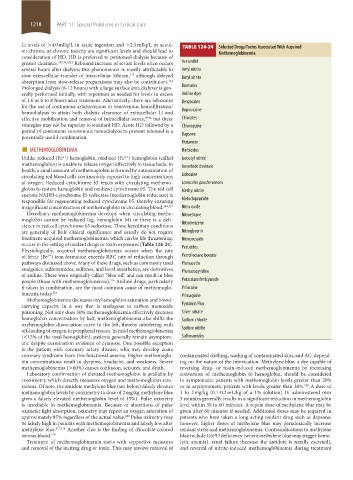
                 occurs in the setting of oxidant drugs or toxin exposures (Table 124-24).
                 Physiologically, acquired methemoglobinemia occurs when the rate   Pesticides
                 of ferric (Fe ) iron formation exceeds RBC rate of reduction through   Petrol octane booster
                          3+
                 pathways discussed above. Many of these drugs, such as commonly used   Phenacetin
                 analgesics, sulfonamides, sulfones, and local anesthetics, are derivatives   Phenazopyridine
                 of aniline. These were originally called “blue oil” and can result in blue
                 people (those with methemoglobinemia).  Aniline drugs, particularly   Potassium ferricyanide
                                               316
                 if taken in combination, are the most common cause of methemoglo-  Prilocaine
                 binemia today. 316                                     Primaquine
                   Methemoglobinemia decreases oxyhemoglobin saturation and blood-
                 carrying capacity in a way that is analogous to carbon monoxide    Pyridium Plus
                 poisoning. Not only does 50% methemoglobinemia effectively decrease   Silver nitrate
                 hemoglobin concentration by half, methemoglobinemia also shifts the   Sodium chlorite
                 oxyhemoglobin dissociation curve to the left, thereby interfering with
                 off-loading of oxygen in peripheral tissues. In mild methemoglobinemia   Sodium nitrite
                 (<15% of the total hemoglobin), patients generally remain asymptom-  Sulfonamides
                 atic despite examination evidence of cyanosis. One possible exception
                 is the patient with coronary artery disease, who may develop acute
                 coronary syndrome from this functional anemia. Higher methemoglo-  contaminated clothing, washing of contaminated skin, and AC, depend-
                 bin concentrations result in dyspnea, headache, and weakness. Severe   ing on the nature of the intoxication. Methylene blue, a dye capable of
                 methemoglobinemia (>60%) causes confusion, seizures, and death.  reversing drug- or toxin-induced methemoglobinemia by increasing
                   Laboratory confirmation of elevated methemoglobin is available by   conversion  of methemoglobin  to hemoglobin, should  be considered
                 cooximetry, which directly measures oxygen and methemoglobin satu-  in symptomatic patients with methemoglobin levels greater than 20%
                 rations. Of note, the antidote methylene blue (see below) falsely elevates   or in asymptomatic patients with levels greater than 30%.  A dose of
                                                                                                                  320
                 methemoglobin levels by cooximetry (a dose of 2 mg/kg methylene blue   1 to 2 mg/kg (0.1-0.2 mL/kg of a 1% solution) IV administered over
                 gives  a falsely elevated methemoglobin level of 15%).  Pulse oximetry   5 minutes generally results in a significant reduction in methemoglobin
                 is unreliable in methemoglobinemia. Because of alterations of pulse   level within 30 to 60 minutes. A repeat dose of methylene blue may be
                 oximeter light absorption, oximetry may report an oxygen saturation of   given after 60 minutes if needed. Additional doses may be required in
                 approximately 85% regardless of the actual value.  Pulse oximetry may   patients who have taken a long-acting oxidant drug such as dapsone;
                                                     249
                 be falsely high in patients with methemoglobinemia and falsely low after   however,  higher  doses  of  methylene  blue  may  paradoxically  increase
                 methylene blue. 317,318  Another clue is the finding of chocolate-colored   oxidant stress and methemoglobinemia. Contraindications to methylene
                 venous blood. 319                                     blue include G6PD deficiency (where methylene blue may trigger hemo-
                   Treatment of methemoglobinemia starts with supportive measures   lytic anemia), renal failure (because the antidote is renally excreted),
                 and removal of the inciting drug or toxin. This may involve removal of   and reversal of nitrite-induced methemoglobinemia during treatment


            section11.indd   1218                                                                                      1/19/2015   10:52:03 AM

