Page 589 - Clinical Hematology_ Theory _ Procedures ( PDFDrive )
P. 589
CHAPTER 28  ■  Disorders of Hemostasis and Thrombosis: Blood Coagulation Factors, Hypercoagulable State, and Anticoagulant Therapy                                                                 573


                   PS a ong with a nor  a  C4b-BP. However, a   ecrease in  ree/                                                ro     e ective   rotein synthesis rather than  ro   a  qua itative

                    unctiona  PS cause   by increase   synthesis o  C4b-BP can                                                 abnor  a ity. He  arin co actor II   e  ciency can a so be   e  -

                   occur transient y   uring acute-  hase reactions.                                                           onstrate   in   atients with DIC. In these situations, both A

                        A  PS  unctiona  assay shou    be  use   to screen  or a                                               an   he  arin co actor II  eve s are   i  inishe   in   ara  e .

                   ty  es o  PS   e  ciencies. Antigenic  eve s o  both  ree an

                   tota   or  s o    rotein, as we   as C4b-BP, wi   then be   eter-                                           Venous Thromboembolism

                    ine   to   i  erentiate ty  es I, II, an   III.
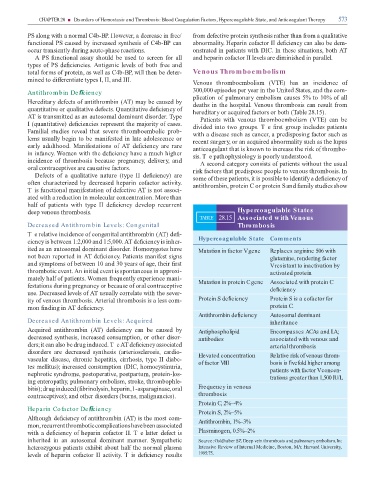
                                                                                                                               Venous  thro  boe  bo is    (V  E)  has  an  inci  ence  o


                   Antithrom bin De  ciency                                                                                    300,000 e  iso  es   er year in the Unite   States, an   the co  -
                                                                                                                                 ication o    u   onary e  bo is   causes 5% to 10% o  a
                   Here  itary   e ects o  antithro  bin (A  )   ay be cause   by                                                eaths in the hos  ita . Venous thro  bosis can resu t  ro

                   quantitative or qua itative   e ects. Quantitative   e  ciency o                                            here  itary or acquire    actors or both (  ab e 28.15).

                   A   is trans  itte   as an autoso  a    o  inant   isor  er.   y  e                                              Patients  with  venous  thro  boe  bo is    (V  E)  can  be

                   I (quantitative)   e  ciencies re  resent the   ajority o  cases.                                             ivi  e   into two grou  s. T e   rst grou   inc u  es   atients

                   Fa  i ia   stu  ies  revea   that  severe  thro  boe  bo ic    rob-                                         with a   isease such as cancer, a   re  is  osing  actor such as

                    e  s usua  y begin to be   ani este   in  ate a  o escence or                                              recent surgery, or an acquire   abnor  a ity such as the  u  us

                   ear y  a  u thoo  .  Mani estations  o   A      e  ciency  are  rare                                        anticoagu ant that is known to increase the risk o  thro  bo-

                   in in ancy. Wo  en with the   e  ciency have a   uch higher                                                 sis. T e   atho  hysio ogy is   oor y un  erstoo  .

                   inci  ence  o   thro  bosis  because    regnancy,    e ivery,  an                                                A secon   category consists o    atients without the usua

                   ora  contrace  tives are causative  actors.                                                                 risk  actors that   re  is  ose   eo   e to venous thro  bosis. In

                        De ects  o   a  qua itative  nature  (ty  e  II    e  ciency)  are                                     so  e o  these   atients, it is   ossib e to i  enti y a   e  ciency o

                   o  en characterize   by   ecrease   he  arin co actor activity.                                               antithro  bin,   rotein C or   rotein S an    a  i y stu  ies show

                   T is  unctiona    ani estation o    e ective A   is not associ-

                   ate   with a re  uction in   o ecu ar concentration. More than

                   ha    o     atients  with  ty  e  II    e  ciency    eve o    recurrent

                     ee   venous thro  bosis.                                                                                                               Hypercoagulable States

                                                                                                                                   TABLE        28.15       Associated w ith Venous
                   Decreased Antithrom bin Levels: Congenital                                                                                               Thrombosis


                   T e re ative inci  ence o  congenita  antithro  bin (A  )   e  -

                   ciency is between 1:2,000 an   1:5,000. A     e  ciency is inher-                                               Hypercoagulable State                         Comments

                   ite   as an autoso  a    o  inant   isor  er. Ho  ozygotes have                                                 Mutation in factor V gene                     Replaces arginine 506 with

                   not been re  orte   in A     e  ciency. Patients   ani est signs                                                                                              glutamine, rendering factor

                   an   sy    to  s o  between 10 an   30 years o  age, their   rst                                                                                              V resistant to inactivation by

                   thro  botic event. An initia  event is s  ontaneous in a    roxi-                                                                                             activated protein

                     ate y ha   o    atients. Wo  en  requent y ex  erience   ani-                                                 Mutation in protein C gene                    Associated with protein C

                    estations   uring   regnancy or because o  ora  contrace  tive                                                                                               de  ciency

                   use. Decrease    eve s o  A   usua  y corre ate with the sever-

                   ity o  venous thro  bosis. Arteria  thro  bosis is a  ess co  -                                                 Protein S de  ciency                          Protein S is a cofactor for

                     on   n  ing in A     e  ciency.                                                                                                                             protein C.

                                                                                                                                   Antithrombin de  ciency                       Autosomal dominant
                   Decreased Antithrom bin Levels: Acquired                                                                                                                      inheritance


                   Acquire    antithro  bin  (A  )    e  ciency  can  be  cause    by                                              Antiphospholipid                              Encompasses ACAs and LA;

                    ecrease  synthesis, increase  consu    tion, or other  isor-                                                   antibodies                                    associated with venous and

                     ers; it can a so be   rug in  uce  . T e A     e  ciency associate                                                                                          arterial thrombosis

                     isor  ers  are    ecrease    synthesis  (arteriosc erosis,  car  io-                                          Elevated concentration                        Relative risk of venous throm-

                   vascu ar   isease, chronic he  atitis, cirrhosis, ty  e II   iabe-                                              of factor VIII                                bosis is   vefold higher among

                   tes   e  itus); increase   consu    tion (DIC, ho  ocystinuria,                                                                                               patients with factor V concen-

                   ne  hrotic syn  ro  e,   osto  erative,   ost  artu  ,   rotein- os-                                                                                          trations greater than 1,500 IU/L.

                   ing entero  athy,   u   onary e  bo is  , stroke, thro  bo  h e-

                   bitis);   rug in  uce   (  brino ysin, he  arin, l -as  araginase, ora                                          Frequency in venous

                   contrace  tives); an   other   isor  ers (burns,   a ignancies).                                                thrombosis

                                                                                                                                   Protein C, 2%–4%
                   Heparin Cofactor De  ciency
                                                                                                                                   Protein S, 2%–5%
                   A though   e  ciency o  antithro  bin (A  ) is the   ost co  -                                                  Antithrombin, 1%–3%

                    on, recurrent thro  botic co     ications have been  associate

                   with a   e  ciency o  he  arin co actor II. T e  atter   e ect is                                               Plasminogen, 0.5%–2%

                   inherite    in  an  autoso  a     o  inant    anner.  Sy    athetic                                             Source: Goldhaber SZ. Deep vein thrombosis and pulmonary embolism. In:

                   heterozygous   atients exhibit about ha   the nor  a     as  a                                                  Intensive Review of Internal Medicine, Boston, MA: Harvard University,

                    eve s o  he  arin co actor II activity. T is   e  ciency resu ts                                               1995:75.
   584   585   586   587   588   589   590   591   592   593   594