


Page 627 - Clinical Hematology_ Theory _ Procedures ( PDFDrive )
P. 627
CHAPTER 29 ■ Body Fluid Analysis 611
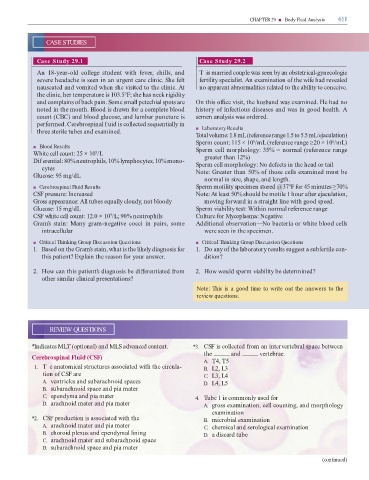
CASE STUDIES
Case Study 29.1 Case Study 29.2
An 18-year-old college student with ever, chills, and T is married couple was seen by an obstetrical-gynecologic
severe headache is seen in an urgent care clinic. She elt ertility specialist. An examination o the wi e had revealed
nauseated and vomited when she visited to the clinic. At no apparent abnormalities related to the ability to conceive.
the clinic, her temperature is 103.5°F; she has neck rigidity
and complains o back pain. Some small petechial spots are On this o ce visit, the husband was examined. He had no
noted in the mouth. Blood is drawn or a complete blood history o in ectious diseases and was in good health. A
count (CBC) and blood glucose, and lumbar puncture is semen analysis was ordered.
per ormed. Cerebrospinal f uid is collected sequentially in
three sterile tubes and examined. ■ Laboratory Results
otal volume: 1.8 mL (re erence range 1.5 to 5.5 mL/ejaculation)
Sperm count: 115 × 10 /mL (re erence range ≥20 × 10 /mL)
6
6
■ Blood Results Sperm cell morphology: 35% = normal (re erence range
White cell count: 25 × 10 /L greater than 12%)
9
Dif erential: 80% neutrophils, 10% lymphocytes, 10% mono- Sperm cell morphology: No de ects in the head or tail
cytes
Glucose: 95 mg/dL Note: Greater than 50% o those cells examined must be
normal in size, shape, and length.
■ Cerebrospinal Fluid Results Sperm motility specimen stored @ 37°F or 45 minutes ≥70%
CSF pressure: Increased Note: At least 50% should be motile 1 hour a er ejaculation,
Gross appearance: All tubes equally cloudy, not bloody moving orward in a straight line with good speed.
Glucose: 15 mg/dL Sperm viability test: Within normal re erence range
CSF white cell count: 12.0 × 10 /L; 90% neutrophils Culture or Mycoplasma: Negative
9
Gram’s stain: Many gram-negative cocci in pairs, some Additional observation—No bacteria or white blood cells
intracellular were seen in the specimen.
■ Critical Thinking Group Discussion Questions ■ Critical Thinking Group Discussion Questions
1. Based on the Gram’s stain, what is the likely diagnosis or 1. Do any o the laboratory results suggest a sub ertile con-
this patient? Explain the reason or your answer. dition?
2. How can this patient’s diagnosis be di erentiated rom 2. How would sperm viability be determined?
other similar clinical presentations?
Note: This is a good time to write out the answers to the
review questions.
REVIEW QUESTIONS
*Indicates ML (optional) and MLS advanced content. *3. CSF is collected rom an intervertebral space between
the and vertebrae.
Cerebrospinal Fluid (CSF)
A. 4, 5
1. Te anatomical structures associated with the circula- B. L2, L3
tion o CSF are C. L3, L4
A. ventricles and subarachnoid spaces D. L4, L5
B. subarachnoid space and pia mater
C. ependyma and pia mater 4. ube 1 is commonly used or
D. arachnoid mater and pia mater A. gross examination, cell counting, and morphology
examination
*2. CSF production is associated with the B. microbial examination
A. arachnoid mater and pia mater C. chemical and serological examination
B. choroid plexus and ependymal lining D. a discard tube
C. arachnoid mater and subarachnoid space
D. subarachnoid space and pia mater
(continued)

