


Page 135 - Review of Medical Microbiology and Immunology ( PDFDrive )
P. 135
mebooksfree.com
                                                                            mebooksfree.com
 mebooksfree.com

            mebooksfree.com
                                                                            mebooksfree.com
                                            mebooksfree.com
                                                                                                            mebooksfree.com
 mebooksfree.com  mebooksfree.com           mebooksfree.com          to be a better predictor of heart attack risk than an elevated        mebooksfree.com
                                                                                                                                           mebooksfree.com
                       PART II  Clinical Bacteriology
                 124
                                                                     cholesterol level.
                                                                     Transmission
                                                                     Humans are the natural hosts for pneumococci; there is no
                                                                     animal reservoir. Because a proportion (5%–50%) of the
                                                                     healthy population harbors virulent organisms in the oro-
                                                                     pharynx, pneumococcal infections are not considered to be
                                                                     communicable. Resistance is high in healthy young people,
 mebooksfree.com  mebooksfree.com           mebooksfree.com          Pathogenesis                           mebooksfree.com                mebooksfree.com
                                                                            mebooksfree.com
                                                                     and disease results most often when predisposing factors
                                                                     (see following discussion) are present.


                                                                     The most important virulence factor is the capsular poly-
                                                                     saccharide, and anticapsular antibody is protective. Lipo-
                                                                     teichoic acid, which activates complement and induces
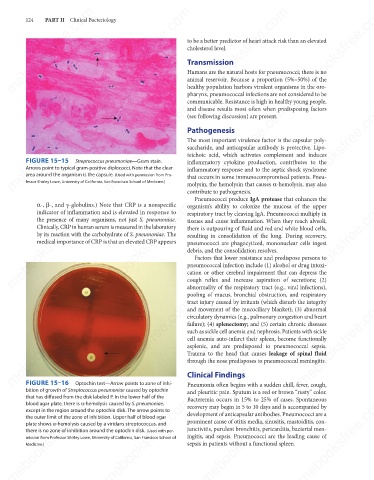
                 FIGURE 15–15
                                 Streptococcus pneumoniae—Gram stain.
                                                                     inflammatory  cytokine  production,  contributes  to  the
                 Arrows point to typical gram-positive diplococci. Note that the clear
                                                                     inflammatory response and to the septic shock syndrome
                 area around the organism is the capsule. (Used with permission from Pro-
                                                                     that occurs in some immunocompromised patients. Pneu-
                 fessor Shirley Lowe, University of California, San Francisco School of Medicine.)
                                                                     molysin, the hemolysin that causes α-hemolysis, may also
                                                                     contribute to pathogenesis.
                                                                        Pneumococci produce IgA protease that enhances the
                                                                                                            mebooksfree.com
 mebooksfree.com  mebooksfree.com           mebooksfree.com          there is outpouring of fluid and red and white blood cells,           mebooksfree.com
                                                                            mebooksfree.com
                    α-, β-, and γ-globulins.) Note that CRP is a nonspecific
                                                                     organism’s ability to colonize the mucosa of the upper
                    indicator of inflammation and is elevated in response to
                                                                     respiratory tract by cleaving IgA. Pneumococci multiply in
                    the presence of many organisms, not just  S. pneumoniae.
                                                                     tissues and cause inflammation. When they reach alveoli,
                    Clinically, CRP in human serum is measured in the laboratory
                    by its reaction with the carbohydrate of S. pneumoniae. The
                                                                     resulting in consolidation of the lung. During recovery,
                    medical importance of CRP is that an elevated CRP appears
                                                                     pneumococci are phagocytized, mononuclear cells ingest
                                                                     debris, and the consolidation resolves.
                                                                        Factors that lower resistance and predispose persons to
                                                                     pneumococcal infection include (1) alcohol or drug intoxi-
                                                                     cation  or other cerebral impairment  that can  depress  the
                                                                     cough reflex and increase aspiration of secretions; (2)
                                                                     abnormality of the respiratory tract (e.g., viral infections),
                                                                     pooling of mucus, bronchial obstruction, and respiratory
                                                                                                            mebooksfree.com
                                                                            mebooksfree.com
 mebooksfree.com  mebooksfree.com           mebooksfree.com          failure); (4) splenectomy; and (5) certain chronic diseases           mebooksfree.com
                                                                     tract injury caused by irritants (which disturb the integrity
                                                                     and movement of the mucociliary blanket); (3) abnormal
                                                                     circulatory dynamics (e.g., pulmonary congestion and heart
                                                                     such as sickle cell anemia and nephrosis. Patients with sickle
                                                                     cell anemia auto-infarct their spleen, become functionally
                                                                     asplenic, and are predisposed to pneumococcal sepsis.
                                                                     Trauma to the head that causes  leakage of spinal fluid
                                                                     through the nose predisposes to pneumococcal meningitis.


                 FIGURE 15–16
                                 Optochin test—Arrow points to zone of inhi-
                                                                     Pneumonia often begins with a sudden chill, fever, cough,
                 bition of growth of Streptococcus pneumoniae caused by optochin   Clinical Findings
                                                                     and pleuritic pain. Sputum is a red or brown “rusty” color.
                 that has diffused from the disk labeled P. In the lower half of the
                                                                            mebooksfree.com
 mebooksfree.com  mebooksfree.com           mebooksfree.com          prominent cause of otitis media, sinusitis, mastoiditis, con-         mebooksfree.com
                                                                                                            mebooksfree.com
                                                                     Bacteremia occurs in 15% to 25% of cases. Spontaneous
                 blood agar plate, there is α-hemolysis caused by S. pneumoniae,
                                                                     recovery may begin in 5 to 10 days and is accompanied by
                 except in the region around the optochin disk. The arrow points to
                                                                     development of anticapsular antibodies. Pneumococci are a
                 the outer limit of the zone of inhibition. Upper half of blood agar
                 plate shows α-hemolysis caused by a viridans streptococcus, and
                                                                     junctivitis, purulent bronchitis, pericarditis, bacterial men-
                 there is no zone of inhibition around the optochin disk. (Used with per-
                                                                     ingitis, and sepsis. Pneumococci are the leading cause of
                 mission from Professor Shirley Lowe, University of California, San Francisco School of
                                                                     sepsis in patients without a functional spleen.
                 Medicine.)
 mebooksfree.com  mebooksfree.com           mebooksfree.com                 mebooksfree.com                 mebooksfree.com                mebooksfree.com

