Page 132 - Review of Medical Microbiology and Immunology ( PDFDrive )
P. 132
mebooksfree.com
                                                                            mebooksfree.com
 mebooksfree.com

            mebooksfree.com
                                                                            mebooksfree.com
                                                                                                            mebooksfree.com
                                            mebooksfree.com
 mebooksfree.com  mebooksfree.com           mebooksfree.com              (see Figure 15–10). It is 100% fatal unless effectively treated   121  mebooksfree.com
                                                                                                                                           mebooksfree.com
                                                                                        CHAPTER 15  Gram-Positive Cocci
                        sepsis. Immune-mediated poststreptococcal AGN can also
                        occur, especially following skin infections caused by certain
                                                                         with antimicrobial agents. About 10% of endocarditis cases
                                                                         are caused by enterococci, but any organism causing bacte-
                        M protein types of S. pyogenes.
                          Group B streptococci cause neonatal sepsis and menin-
                                                                         remia may settle on deformed valves. At least three blood
                        gitis. The main predisposing factor is prolonged (longer
                                                                         cultures are necessary to ensure recovery of the organism in
                        than 18 hours) rupture of the membranes in women who
                                                                           Viridans streptococci, especially S. anginosus, S. milleri,
                        are colonized with the organism. Children born prior to
                                                                         and  S.  intermedius, also cause brain abscesses, often in
                        37 weeks’ gestation have a greatly increased risk of disease.
                        Also,  children whose  mothers  lack  antibody  to group B   more than 90% of cases.
                                                                         combination with  mouth anaerobes  (a mixed aerobic–
 mebooksfree.com  mebooksfree.com           mebooksfree.com              the mouth to enter the bloodstream (bacteremia) and               mebooksfree.com
                                                                                                            mebooksfree.com
                                                                            mebooksfree.com
                        streptococci and who consequently are born without trans-
                                                                         anaerobic infection). Dental surgery is an important pre-
                                                                         disposing factor to brain abscess because it provides a
                        placentally acquired IgG have a high rate of neonatal sepsis
                        caused by this organism. Group B streptococci are an
                                                                         portal for the viridans streptococci and the anaerobes in
                        important cause of neonatal pneumonia as well.
                          Although most group B streptococcal infections are in
                                                                         spread to the brain. Viridans streptococci are involved in
                        neonates, this organism also causes such infections as
                                                                         mixed aerobic–anaerobic infections in other areas of the
                        pneumonia, endocarditis, arthritis, cellulitis, and osteomy-
                                                                         body as well (e.g., lung abscesses and abdominal abscesses,
                        elitis in adults. Postpartum endometritis also occurs. Dia-
                                                                         including liver abscesses).
                                                                           Enterococci cause  urinary  tract  infections, especially
                        betes is the main predisposing factor for adult group B
                        streptococcal infections.
                          Viridans streptococci (e.g.,  S. mutans, S. sanguinis, S.
                                                                         urinary tract instrumentation are important predisposing
                                                                         factors. Enterococci also cause endocarditis, particularly in
                        salivarius, and  S. mitis) are the most common cause of
                        infective endocarditis. They enter the bloodstream (bacte-  in hospitalized patients. Indwelling urinary catheters and
                                                                         patients who have undergone gastrointestinal or urinary
                                                                         tract surgery or instrumentation. They also cause intra-
                        remia) from the oropharynx, typically after dental surgery.
                                                                            mebooksfree.com
 mebooksfree.com  mebooksfree.com           mebooksfree.com              group D streptococcus, causes endocarditis, especially in         mebooksfree.com
                                                                                                            mebooksfree.com
                                                                         abdominal and pelvic infections, typically in combination
                        Signs of endocarditis are fever, heart murmur, anemia, and
                        embolic events such as splinter hemorrhages, subconjunc-
                                                                         with  anaerobes.  Streptococuss bovis,  a nonenterococcal
                        tival petechial hemorrhages, and Janeway lesions. The
                                                                         patients with carcinoma of the colon. This association is so
                        heart murmur is caused by vegetations on the heart valve
                                                                         strong that patients with S. bovis, bacteremia, or endocardi-
                                                                         tis should be investigated for the presence of colonic
                                                                         carcinoma.
                                                                           Peptostreptococci are one of the most common bacteria
                                                                         found in brain, lung, abdominal, and pelvic abscesses.
                                                                         Poststreptococcal (Nonsuppurative)
                                                                         Diseases
                                                                            mebooksfree.com
 mebooksfree.com  mebooksfree.com           mebooksfree.com              organ that was not infected by the streptococci. The inflam-      mebooksfree.com
                                                                                                            mebooksfree.com
                                                                         These are disorders in which a local infection with group A
                                                                         streptococci is followed weeks later by inflammation in an
                                                                         mation is caused by an immunologic (antibody) response
                                                                         to streptococcal M proteins that cross-react with human
                                                                         tissues. Some strains of S. pyogenes bearing certain M pro-
                                                                         teins are nephritogenic and cause AGN, and other strains
                                                                         bearing different M proteins are rheumatogenic and cause
                                                                         acute rheumatic fever. Note that these diseases appear sev-
                                                                         eral weeks after the actual infection because that is the
                                                                         length of time it takes to produce sufficient antibodies.
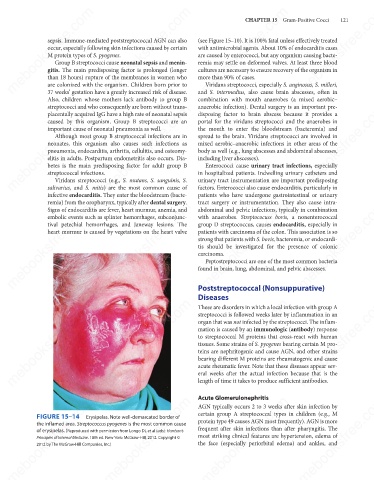
 mebooksfree.com  mebooksfree.com   Erysipelas. Note well-demarcated border of   Acute Glomerulonephritis   mebooksfree.com                mebooksfree.com
                                                                            mebooksfree.com
                                            mebooksfree.com
                                                                         AGN typically occurs 2 to 3 weeks after skin infection by
                                                                         certain group A streptococcal types in children (e.g., M
                    FIGURE 15–14
                                                                         protein type 49 causes AGN most frequently). AGN is more
                    the inflamed area. Streptococcus pyogenes is the most common cause
                                                                         frequent after skin infections than after pharyngitis. The
                    of erysipelas. (Reproduced with permission from Longo DL et al (eds): Harrison’s
                                                                         most striking clinical features are hypertension, edema of
                    Principles of Internal Medicine. 18th ed. New York: McGraw-Hill, 2012. Copyright ©
                                                                         the face (especially periorbital edema) and ankles, and
                    2012 by The McGraw-Hill Companies, Inc.)


 mebooksfree.com  mebooksfree.com           mebooksfree.com                 mebooksfree.com                 mebooksfree.com                mebooksfree.com
   127   128   129   130   131   132   133   134   135   136   137