


Page 212 - Review of Medical Microbiology and Immunology ( PDFDrive )
P. 212
mebooksfree.com


                                            mebooksfree.com
            mebooksfree.com
                                                                                                            mebooksfree.com
                                                                                                                                           mebooksfree.com
 mebooksfree.com  mebooksfree.com           mebooksfree.com                 mebooksfree.com                 mebooksfree.com                mebooksfree.com
                                                                            mebooksfree.com
                                                                                                                        201
                                                                                               CHAPTER 24  Spirochetes


 mebooksfree.com  mebooksfree.com           mebooksfree.com                 mebooksfree.com                 mebooksfree.com                mebooksfree.com


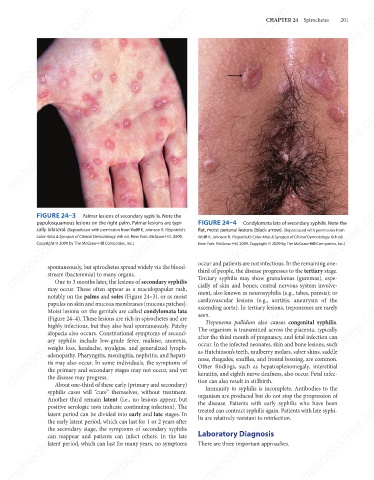
 mebooksfree.com  mebooksfree.com           mebooksfree.com              FIGURE 24–4    Condylomata lata of secondary syphilis. Note the   mebooksfree.com
                                                                                                            mebooksfree.com
                                                                            mebooksfree.com
                    FIGURE 24–3
                                   Palmar lesions of secondary syphilis. Note the
                    papulosquamous lesions on the right palm. Palmar lesions are typi-
                    cally bilateral. (Reproduced with permission from Wolff K, Johnson R. Fitzpatrick’s
                                                                         flat, moist perianal lesions (black arrow). (Reproduced with permission from
                    Color Atlas & Synopsis of Clinical Dermatology. 6th ed. New York: McGraw-Hill, 2009.
                                                                         Wolff K, Johnson R. Fitzpatrick’s Color Atlas & Synopsis of Clinical Dermatology. 6th ed.
                    Copyright © 2009 by The McGraw-Hill Companies, Inc.)
                                                                         New York: McGraw-Hill, 2009. Copyright © 2009 by The McGraw-Hill Companies, Inc.)
                                                                         occur and patients are not infectious. In the remaining one-
                        spontaneously, but spirochetes spread widely via the blood-
                                                                         third of people, the disease progresses to the tertiary stage.
                        stream (bacteremia) to many organs.
                          One to 3 months later, the lesions of secondary syphilis
                                                                         cially of skin and bones; central nervous system involve-
                        may occur. These often appear as a maculopapular rash,
                                                                         ment, also known as neurosyphilis (e.g., tabes, paresis); or
                        notably on the palms and soles (Figure 24–3), or as moist   Tertiary syphilis may show granulomas (gummas), espe-
                                                                         cardiovascular lesions (e.g., aortitis, aneurysm of the
 mebooksfree.com  mebooksfree.com           mebooksfree.com              The organism is transmitted across the placenta, typically        mebooksfree.com
                                                                            mebooksfree.com
                                                                                                            mebooksfree.com
                        papules on skin and mucous membranes (mucous patches).
                                                                         ascending aorta). In tertiary lesions, treponemes are rarely
                        Moist lesions on the genitals are called condylomata lata
                                                                         seen.
                        (Figure 24–4). These lesions are rich in spirochetes and are
                                                                           Treponema pallidum also causes  congenital syphilis.
                        highly infectious, but they also heal spontaneously. Patchy
                        alopecia also occurs. Constitutional symptoms of second-
                                                                         after the third month of pregnancy, and fetal infection can
                        ary syphilis include low-grade fever, malaise, anorexia,
                                                                         occur. In the infected neonates, skin and bone lesions, such
                        weight loss, headache, myalgias, and generalized lymph-
                                                                         as Hutchinson’s teeth, mulberry molars, saber shins, saddle
                        adenopathy. Pharyngitis, meningitis, nephritis, and hepati-
                                                                         nose, rhagades, snuffles, and frontal bossing, are common.
                        tis may also occur. In some individuals, the symptoms of
                                                                         Other findings, such as hepatosplenomegaly, interstitial
                        the primary and secondary stages may not occur, and yet
                        the disease may progress.
                                                                         tion can also result in stillbirth.
                          About one-third of these early (primary and secondary)
                                                                           Immunity to syphilis is incomplete. Antibodies to the
                        syphilis cases will “cure” themselves, without treatment.   keratitis, and eighth nerve deafness, also occur. Fetal infec-
                                                                         organism are produced but do not stop the progression of
                                                                            mebooksfree.com
 mebooksfree.com  mebooksfree.com           mebooksfree.com              lis are relatively resistant to reinfection. mebooksfree.com      mebooksfree.com
                        Another third remain  latent (i.e., no lesions appear, but
                                                                         the disease. Patients with early syphilis who have been
                        positive serologic tests indicate continuing infection). The
                                                                         treated can contract syphilis again. Patients with late syphi-
                        latent period can be divided into early and late stages. In
                        the early latent period, which can last for 1 or 2 years after
                        the secondary stage, the symptoms of secondary syphilis
                                                                         Laboratory Diagnosis
                        can reappear and patients can infect others. In the late
                        latent period, which can last for many years, no symptoms
                                                                         There are three important approaches.
 mebooksfree.com  mebooksfree.com           mebooksfree.com                 mebooksfree.com                 mebooksfree.com                mebooksfree.com

