


Page 214 - Review of Medical Microbiology and Immunology ( PDFDrive )
P. 214
mebooksfree.com


                                                                            mebooksfree.com
                                                                                                                                           mebooksfree.com
            mebooksfree.com
 mebooksfree.com  mebooksfree.com           mebooksfree.com                 mebooksfree.com                 mebooksfree.com                mebooksfree.com
                                            mebooksfree.com
                                                                                                            mebooksfree.com
                                                                                               CHAPTER 24  Spirochetes
                                                                                                                        203
                        suspected exposure, and serologic follow-up of infected
                        individuals and their contacts. The presence of any sexually
                        transmitted disease makes testing for syphilis mandatory,
                        because several different infections are often transmitted
                        simultaneously. There is no vaccine against syphilis.

                        2.  Nonvenereal Treponematoses
                        These are infections caused by spirochetes that are virtually
                        indistinguishable from those caused by T. pallidum. They
 mebooksfree.com  mebooksfree.com           mebooksfree.com                 mebooksfree.com                 mebooksfree.com                mebooksfree.com
                        are endemic in populations and are transmitted by direct
                        contact. All these infections result in positive (nontrepone-
                        mal and treponemal) results on serologic tests for syphilis.
                        None of these spirochetes have been grown on bacterio-
                        logic media. The diseases include bejel in Africa, yaws
                        (caused by T. pallidum subspecies pertenue) in many humid
                        tropical countries, and pinta (caused by Treponema cara-
                        teum) in Central and South America. All can be cured by
                        penicillin.


                        BORRELIA

                        Borrelia species are irregular, loosely coiled spirochetes that
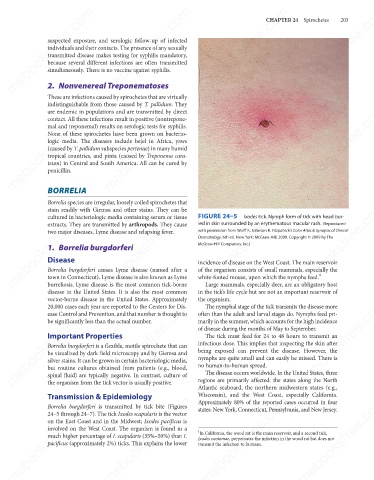
 mebooksfree.com  mebooksfree.com           mebooksfree.com              FIGURE 24–5    Ixodes tick. Nymph form of tick with head bur-     mebooksfree.com
                                                                                                            mebooksfree.com
                                                                            mebooksfree.com
                        stain readily with Giemsa and other stains. They can  be
                        cultured in bacteriologic media containing serum or tissue
                        extracts. They are transmitted by arthropods. They cause
                                                                         ied in skin surrounded by an erythematous macular rash. (Reproduced
                        two major diseases, Lyme disease and relapsing fever.
                                                                         with permission from Wolff K, Johnson R. Fitzpatrick’s Color Atlas & Synopsis of Clinical
                                                                         Dermatology. 6th ed. New York: McGraw-Hill, 2009. Copyright © 2009 by The
                                                                         McGraw-Hill Companies, Inc.)
                        1.  Borrelia burgdorferi
                        Disease
                                                                         incidence of disease on the West Coast. The main reservoir
                        Borrelia burgdorferi causes Lyme disease (named after a
                                                                                                                 4
                        town in Connecticut). Lyme disease is also known as Lyme
                                                                         white-footed mouse, upon which the nymphs feed.
                        borreliosis. Lyme disease is the most common tick-borne
                                                                           Large mammals, especially deer, are an obligatory host
                                                                         in the tick’s life cycle but are not an important reservoir of
                        disease in the United States. It is also the most common   of the organism consists of small mammals, especially the
                        vector-borne disease in the United States. Approximately
                                                                         the organism.
                                                                            mebooksfree.com
                                                                                                            mebooksfree.com
 mebooksfree.com  mebooksfree.com           mebooksfree.com              marily in the summer, which accounts for the high incidence       mebooksfree.com
                        20,000 cases each year are reported to the Centers for Dis-
                                                                           The nymphal stage of the tick transmits the disease more
                                                                         often than the adult and larval stages do. Nymphs feed pri-
                        ease Control and Prevention, and that number is thought to
                        be significantly less than the actual number.
                                                                         of disease during the months of May to September.
                        Important Properties
                                                                           The tick must feed for 24 to 48 hours to transmit an
                                                                         infectious dose. This implies that inspecting the skin after
                        Borrelia burgdorferi is a flexible, motile spirochete that can
                                                                         being exposed can prevent the disease. However, the
                        be visualized by dark field microscopy and by Giemsa and
                                                                         nymphs are quite small and can easily be missed. There is
                        silver stains. It can be grown in certain bacteriologic media,
                                                                         no human-to-human spread.
                        but routine cultures obtained from patients (e.g., blood,
                                                                           The disease occurs worldwide. In the United States, three
                        spinal fluid) are typically negative. In contrast, culture of
                                                                         regions are primarily affected: the states along the North
                        the organism from the tick vector is usually positive.
                                                                         Atlantic seaboard, the northern midwestern states (e.g.,
                        Transmission & Epidemiology
                                                                                                            mebooksfree.com
                                                                            mebooksfree.com
 mebooksfree.com  mebooksfree.com           mebooksfree.com              Wisconsin), and the West Coast, especially California.            mebooksfree.com
                                                                         Approximately 80% of the reported cases occurred in four
                        Borrelia burgdorferi is transmitted by  tick bite  (Figures
                                                                         states: New York, Connecticut, Pennsylvania, and New Jersey.
                        24–5 through 24–7). The tick Ixodes scapularis is the vector
                        on the East Coast and in the Midwest; Ixodes pacificus is
                        involved on the West Coast. The organism is found in a
                                                                         4
                                                                         In California, the wood rat is the main reservoir, and a second tick,
                        much higher percentage of I. scapularis (35%–50%) than I.
                                                                         Ixodes neotomae, perpetuates the infection in the wood rat but does not
                        pacificus (approximately 2%) ticks. This explains the lower
                                                                         transmit the infection to humans.
 mebooksfree.com  mebooksfree.com           mebooksfree.com                 mebooksfree.com                 mebooksfree.com                mebooksfree.com

