


Page 215 - Review of Medical Microbiology and Immunology ( PDFDrive )
P. 215
mebooksfree.com
                                                                                                            mebooksfree.com
 mebooksfree.com

            mebooksfree.com
                                                                            mebooksfree.com
                                                                                                            mebooksfree.com
                                            mebooksfree.com
                                                                                                                                           mebooksfree.com
 mebooksfree.com  mebooksfree.com           mebooksfree.com          in the United States. The major bacterial diseases transmit-          mebooksfree.com
                       PART II  Clinical Bacteriology
                 204
                                                                        Lyme disease is the most common vector-borne disease
                                                                     ted by ticks in the United States are Lyme disease, Rocky
                                                                     Mountain spotted fever, ehrlichiosis, anaplasmosis, relaps-
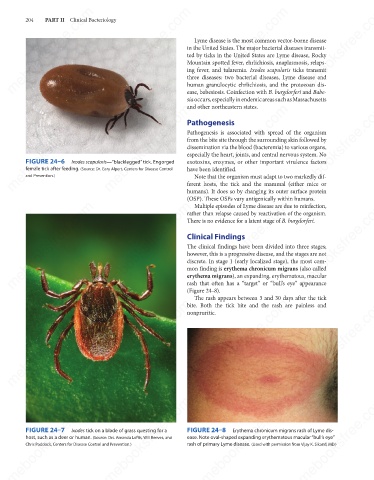
                                                                     ing fever, and tularemia.  Ixodes scapularis ticks transmit
                                                                     three diseases: two bacterial diseases, Lyme disease and
                                                                     human granulocytic ehrlichiosis, and the protozoan dis-
                                                                     ease, babesiosis. Coinfection with B. burgdorferi and Babe-
                                                                     sia occurs, especially in endemic areas such as Massachusetts
                                                                            mebooksfree.com
                                                                     and other northeastern states.
                                                                                                            mebooksfree.com
 mebooksfree.com  mebooksfree.com           mebooksfree.com          Pathogenesis is associated with spread of the organism                mebooksfree.com
                                                                     Pathogenesis

                                                                     from the bite site through the surrounding skin followed by
                                                                     dissemination via the blood (bacteremia) to various organs,
                                                                     especially the heart, joints, and central nervous system. No
                 FIGURE 24–6
                                                                     exotoxins, enzymes, or other important virulence factors
                                Ixodes scapularis—”blacklegged” tick. Engorged
                                                                     have been identified.
                 female tick after feeding. (Source: Dr. Gary Alpert, Centers for Disease Control
                                                                        Note that the organism must adapt to two markedly dif-
                 and Prevention.)
                                                                     ferent hosts, the tick and the mammal (either mice or
                                                                     humans). It does so by changing its outer surface protein
                                                                     (OSP). These OSPs vary antigenically within humans.
 mebooksfree.com  mebooksfree.com           mebooksfree.com          Clinical Findings                      mebooksfree.com                mebooksfree.com
                                                                            mebooksfree.com
                                                                        Multiple episodes of Lyme disease are due to reinfection,
                                                                     rather than relapse caused by reactivation of the organism.
                                                                     There is no evidence for a latent stage of B. burgdorferi.


                                                                     The clinical findings have been divided into three stages;
                                                                     however, this is a progressive disease, and the stages are not
                                                                     discrete. In stage 1 (early localized stage), the most com-
                                                                     mon finding is erythema chronicum migrans (also called
                                                                     erythema migrans), an expanding, erythematous, macular
                                                                     rash that often has a “target” or “bull’s eye” appearance
                                                                     (Figure 24–8).
                                                                        The rash appears between 3 and 30 days after the tick
 mebooksfree.com  mebooksfree.com           mebooksfree.com                 mebooksfree.com                 mebooksfree.com                mebooksfree.com
                                                                     bite. Both the tick bite and the rash are painless and
                                                                     nonpruritic.


                                                                            mebooksfree.com
                                                                                                            mebooksfree.com
 mebooksfree.com  mebooksfree.com           mebooksfree.com          FIGURE 24–8    Erythema chronicum migrans rash of Lyme dis-           mebooksfree.com


                 FIGURE 24–7
                                Ixodes tick on a blade of grass questing for a
                                                                     ease. Note oval-shaped expanding erythematous macular “bull’s eye”
                 host, such as a deer or human. (Source: Drs. Amanda Loftis, Will Reeves, and
                                                                     rash of primary Lyme disease. (Used with permission from Vijay K. Sikand, MD.)
                 Chris Paddock, Centers for Disease Control and Prevention.)


 mebooksfree.com  mebooksfree.com           mebooksfree.com                 mebooksfree.com                 mebooksfree.com                mebooksfree.com

