


Page 229 - Review of Medical Microbiology and Immunology ( PDFDrive )
P. 229
mebooksfree.com
 mebooksfree.com


                                            mebooksfree.com
 mebooksfree.com  mebooksfree.com        Genus or Species                   mebooksfree.com                 mebooksfree.com                mebooksfree.com
            mebooksfree.com
                                                                                                                                           mebooksfree.com
                                                                                                            mebooksfree.com
                                                                            mebooksfree.com
                       PART II  Clinical Bacteriology
                 218
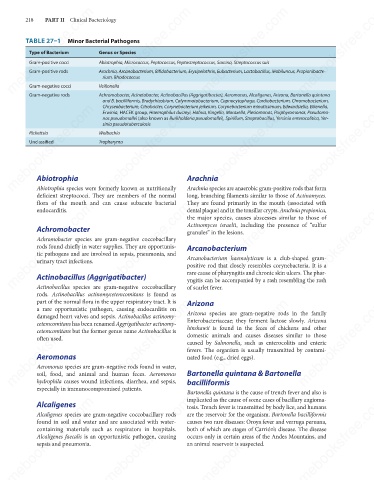
                 TABLE 27–1  Minor Bacterial Pathogens
                  Type of Bacterium
                                         Abiotrophia, Micrococcus, Peptococcus, Peptostreptococcus, Sarcina, Streptococcus suis
                  Gram-positive cocci
                                         Arachnia, Arcanobacterium, Bifidobacterium, Erysipelothrix, Eubacterium, Lactobacillus, Mobiluncus, Propionibacte-
                  Gram-positive rods
                                          rium, Rhodococcus
                                         Veillonella
                  Gram-negative cocci
                                         Achromobacter, Acinetobacter, Actinobacillus (Aggrigatibacter), Aeromonas, Alcaligenes, Arizona, Bartonella quintana
                  Gram-negative rods
                                          and B. bacilliformis, Bradyrhizobium, Calymmatobacterium, Capnocytophaga, Cardiobacterium, Chromobacterium,
                                            mebooksfree.com
 mebooksfree.com  mebooksfree.com        Wolbachia                          mebooksfree.com                 mebooksfree.com                mebooksfree.com
                                          Chryseobacterium, Citrobacter, Corynebacterium jeikeium, Corynebacterium minutissimum, Edwardsiella, Eikenella,
                                          Erwinia, HACEK group, Haemophilus ducreyi, Hafnia, Kingella, Moraxella, Plesiomonas, Porphyromonas, Pseudomo-
                                          nas pseudomallei (also known as Burkholderia pseudomallei), Spirillum, Streptobacillus, Yersinia enterocolitica, Yer-
                                          sinia pseudotuberculosis
                  Rickettsia
                                         Tropheryma
                  Unclassified


                    Abiotrophia
                    Abiotrophia species were formerly known as nutritionally
                                                                     Arachnia species are anaerobic gram-positive rods that form
                                                                     long, branching filaments similar to those of Actinomyces.
                    deficient  streptococci.  They  are  members  of  the  normal   Arachnia
                    flora of the mouth and can cause subacute bacterial
                                                                     They are found primarily in the mouth (associated with
                                                                            mebooksfree.com
 mebooksfree.com  mebooksfree.com           mebooksfree.com          Actinomyces israelii, including the presence of “sulfur               mebooksfree.com
                                                                                                            mebooksfree.com
                                                                     dental plaque) and in the tonsillar crypts. Arachnia propionica,
                    endocarditis.
                                                                     the  major  species,  causes  abscesses  similar  to  those  of
                    Achromobacter
                                                                     granules” in the lesions.
                    Achromobacter species are gram-negative coccobacillary
                    rods found chiefly in water supplies. They are opportunis-
                                                                     Arcanobacterium
                    tic pathogens and are involved in sepsis, pneumonia, and
                                                                     Arcanobacterium haemolyticum is a club-shaped gram-
                    urinary tract infections.
                                                                     positive rod that closely resembles corynebacteria. It is a
                    Actinobacillus (Aggrigatibacter)
                                                                     yngitis can be accompanied by a rash resembling the rash
                    Actinobacillus species are gram-negative coccobacillary
                                                                     of scarlet fever.
                    rods.  Actinobacillus actinomycetemcomitans is found as   rare cause of pharyngitis and chronic skin ulcers. The phar-
 mebooksfree.com  mebooksfree.com           mebooksfree.com          Enterobacteriaceae; they ferment lactose slowly.  Arizona             mebooksfree.com
                    part of the normal flora in the upper respiratory tract. It is
                                                                                                            mebooksfree.com
                                                                            mebooksfree.com
                                                                     Arizona
                    a rare  opportunistic pathogen, causing endocarditis on
                                                                     Arizona  species  are  gram-negative  rods  in  the  family
                    damaged heart valves and sepsis. Actinobacillus actinomy-
                    cetemcomitans has been renamed Aggrigatibacter actinomy-
                                                                     hinshawii is found in the feces of chickens and other
                    cetemcomitans but the former genus name Actinobacillus is
                                                                     domestic animals and causes diseases similar to those
                    often used.
                                                                     caused by  Salmonella, such as enterocolitis and enteric
                                                                     fevers. The organism is usually transmitted by contami-
                    Aeromonas
                                                                     nated food (e.g., dried eggs).
                    Aeromonas species are gram-negative rods found in water,
                                                                     Bartonella quintana & Bartonella
                    soil, food, and animal and human feces.  Aeromonas
                                                                     bacilliformis
                    hydrophila causes wound infections, diarrhea, and sepsis,
                    especially in immunocompromised patients.
                                                                     Bartonella quintana is the cause of trench fever and also is
 mebooksfree.com  mebooksfree.com           mebooksfree.com          causes two rare diseases: Oroya fever and verruga peruana,            mebooksfree.com
                                                                                                            mebooksfree.com
                                                                            mebooksfree.com
                                                                     implicated as the cause of some cases of bacillary angioma-
                    Alcaligenes
                                                                     tosis. Trench fever is transmitted by body lice, and humans
                                                                     are the reservoir for the organism. Bartonella bacilliformis
                    Alcaligenes species are gram-negative coccobacillary rods
                    found in soil and water and are associated with water-
                                                                     both of which are stages of Carrión’s disease. The disease
                    containing materials such as respirators in hospitals.
                    Alcaligenes faecalis is an opportunistic pathogen, causing
                                                                     occurs only in certain areas of the Andes Mountains, and
                                                                     an animal reservoir is suspected.
                    sepsis and pneumonia.
 mebooksfree.com  mebooksfree.com           mebooksfree.com                 mebooksfree.com                 mebooksfree.com                mebooksfree.com

