


Page 224 - Review of Medical Microbiology and Immunology ( PDFDrive )
P. 224
mebooksfree.com
mebooksfree.com
mebooksfree.com
mebooksfree.com
mebooksfree.com
mebooksfree.com mebooksfree.com Organism Arthropod Vector mebooksfree.com mebooksfree.com mebooksfree.com
mebooksfree.com
mebooksfree.com
CHAPTER 26 Rickettsiae
213
TABLE 26–1 Summary of Selected Rickettsial Diseases
Important in the United States
Disease
Mammalian Reservoir
Spotted fevers
Rocky Mountain
Ticks
Yes (especially in southeastern
Dogs, rodents
R. rickettsii
spotted fever
Rickettsialpox
Typhus group
R. prowazekii
Humans
Lice
No
Epidemic R. akari Mites Mice No states such as North Carolina)
mebooksfree.com mebooksfree.com C. burnetii None The name of the disease is misleading, because it occurs mebooksfree.com
Fleas
R. typhi
mebooksfree.com
mebooksfree.com
Endemic
No
mebooksfree.com
Rodents
No
Scrub
R. tsutsugamushi
Rodents
Mites
Others
Q fever
Cattle, sheep, goats
Yes
Ticks
Dogs, rodents
A. phagocytophilum
Yes
Anaplasmosis
Ehrlichiosis
Ticks
E .chaffeensis
Dogs
Yes
vectors and reservoirs for selected rickettsial diseases is
presented in Table 26–1.
The incidence of the disease depends on the geographic
southeastern states of Virginia, North Carolina, and
Georgia), where the dog tick, Dermacentor variabilis, is
distribution of the arthropod vector and on the risk of
exposure, which is enhanced by such things as poor primarily along the East Coast of the United States (in the
located. The name “Rocky Mountain spotted fever” is
mebooksfree.com
mebooksfree.com mebooksfree.com mebooksfree.com as the vector; the organism is passed by the transovarian mebooksfree.com
mebooksfree.com
derived from the region in which the disease was first
hygienic conditions and camping in wooded areas. These
found. In the western United States, it is transmitted by the
factors are discussed later with the individual diseases.
wood tick, Dermacentor andersoni.
Pathogenesis
The tick is an important reservoir of R. rickettsii as well
The typical lesion caused by these rickettsiae is a vasculitis,
route from tick to tick, and a lifetime infection results. Cer-
particularly in the endothelial lining of the vessel wall where
tain mammals, such as dogs and rodents, are also reservoirs
the organism is found. Damage to the vessels of the skin
of the organism. Humans are accidental hosts and are not
results in the characteristic rash and in edema and hemor-
required for the perpetuation of the organism in nature;
rhage caused by increased capillary permeability. Vasculitis
of the vessels in the brain leads to the prominent headache.
occur in children during spring and early summer, when
The basis for pathogenesis by these organisms is unclear.
the ticks are active. Rocky Mountain spotted fever accounts
There is some evidence that endotoxin is involved, which is there is no person-to-person transmission. Most cases
for 95% of the rickettsial disease in the United States; there
in accord with the nature of some of the lesions such as
mebooksfree.com mebooksfree.com mebooksfree.com mebooksfree.com mebooksfree.com mebooksfree.com
are about 1000 cases per year. It can be fatal if untreated,
fever, petechiae and thrombocytopenia, but its role has not
but if it is diagnosed and treated, a prompt cure results.
been confirmed. No exotoxins or cytolytic enzymes have
been found.
Clinical Findings & Epidemiology
Rocky Mountain Spotted Fever
This disease is characterized by the acute onset of nonspe-
cific symptoms (e.g., fever, severe headache, myalgias, and
prostration). The typical rash, which appears 2 to 6 days
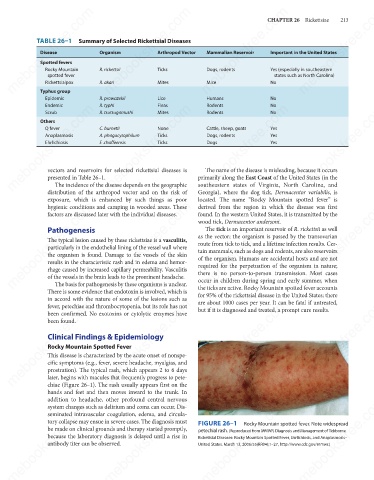
later, begins with macules that frequently progress to pete-
chiae (Figure 26–1). The rash usually appears first on the
hands and feet and then moves inward to the trunk. In
mebooksfree.com
mebooksfree.com mebooksfree.com mebooksfree.com FIGURE 26–1 Rocky Mountain spotted fever. Note widespread mebooksfree.com
mebooksfree.com
addition to headache, other profound central nervous
system changes such as delirium and coma can occur. Dis-
seminated intravascular coagulation, edema, and circula-
tory collapse may ensue in severe cases. The diagnosis must
be made on clinical grounds and therapy started promptly,
petechial rash. (Reproduced from MMWR, Diagnosis and Management of Tickborne
because the laboratory diagnosis is delayed until a rise in
Rickettsial Diseases: Rocky Mountain Spotted Fever, Ehrlichiosis, and Anaplasmosis–
antibody titer can be observed.
United States. March 13, 2006/55(RR04);1–27, http://www.cdc.gov/mmwr.)
mebooksfree.com mebooksfree.com mebooksfree.com mebooksfree.com mebooksfree.com mebooksfree.com

