


Page 236 - Review of Medical Microbiology and Immunology ( PDFDrive )
P. 236
mebooksfree.com


                                                                                                            mebooksfree.com
            mebooksfree.com
                                            mebooksfree.com
                                                                            mebooksfree.com
                                                                                                                                           mebooksfree.com
 mebooksfree.com  mebooksfree.com           mebooksfree.com                 mebooksfree.com                 mebooksfree.com                mebooksfree.com


                      PART III  BASIC VIROLOGY


                                                                            mebooksfree.com
 mebooksfree.com  mebooksfree.com           mebooksfree.com              mitochondria, and ribosomes. Prokaryotic cells, such as           mebooksfree.com
                                                                                                            mebooksfree.com


                        The other infectious agents described in this book, namely,
                        bacteria, fungi, protozoa, and worms, are either single cells
                                                                         do not have mitochondria but do have ribosomes; there-
                        or composed of many cells. Cells are capable of indepen-
                        dent replication, can synthesize their own energy and pro-
                                                                         fore, they can synthesize their own proteins.
                        teins, and can be seen in the light microscope. In contrast,   bacteria, are not divided into nucleus and cytoplasm and
                                                                           (2) Viruses must reproduce (replicate) within cells,
                                                                            mebooksfree.com
                                                                                                            mebooksfree.com
 mebooksfree.com  mebooksfree.com           mebooksfree.com              obligate intracellular parasites are chlamydiae and rickett-      mebooksfree.com
                        viruses are not cells; they are not capable of independent
                                                                         because they cannot generate energy or synthesize proteins.
                        replication, can synthesize neither their own energy nor
                                                                         Because they can reproduce only within cells, viruses are
                        their own proteins, and are too small to be seen in the light
                                                                         obligate intracellular parasites. (The only bacteria that are
                        microscope.
                          Viruses are characterized by the following features:
                                                                         siae. They cannot synthesize sufficient energy to replicate
                                                                         independently.)
                          (1) Viruses are particles composed of an internal core
                                                                           (3) Viruses replicate in a manner different from that of
                        containing either DNA or RNA (but not both) covered by a
                                                                         cells (i.e., viruses do not undergo binary fission or mitosis).
                        protective protein coat. Some viruses have an outer lipo-
                                                                         One virus can replicate to produce hundreds of progeny
                        protein membrane, called an envelope, external to the coat.
                        Viruses do not have a nucleus, cytoplasm, mitochondria, or
                                                                         daughter cells.
                        ribosomes. Cells, both prokaryotic and eukaryotic, have
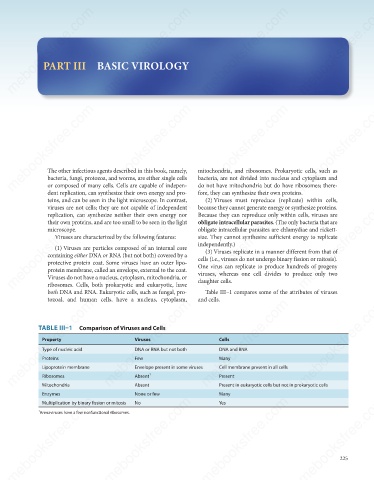
                                                                           Table III–1 compares some of the attributes of viruses
                        both DNA and RNA. Eukaryotic cells, such as fungal, pro-  viruses, whereas one cell divides to produce only two
                        tozoal, and human cells, have a nucleus, cytoplasm,
                                                                         and cells.
 mebooksfree.com  mebooksfree.com           mebooksfree.com                 mebooksfree.com                 mebooksfree.com                mebooksfree.com
                     TABLE III–1  Comparison of Viruses and Cells
                                                    Viruses
                                                                                Cells
                      Property
                                                                                DNA and RNA
                                                    DNA or RNA but not both
                      Type of nucleic acid
                                                    Few
                                                                                Many
                      Proteins
                                                                                Cell membrane present in all cells
                                                    Envelope present in some viruses
                      Lipoprotein membrane
                      Ribosomes
                                                    Absent
                                                                                Present in eukaryotic cells but not in prokaryotic cells
                      Mitochondria
                                                                                Many
                      Enzymes                       Absent 1                    Present
                                                    None or few
 mebooksfree.com  mebooksfree.com           mebooksfree.com                 mebooksfree.com                 mebooksfree.com                mebooksfree.com
                                                                                Yes
                      Multiplication by binary fission or mitosis
                                                    No
                     1
                     Arenaviruses have a few nonfunctional ribosomes.
                                                                                                                       225

 mebooksfree.com  mebooksfree.com           mebooksfree.com                 mebooksfree.com                 mebooksfree.com                mebooksfree.com

