


Page 239 - Review of Medical Microbiology and Immunology ( PDFDrive )
P. 239
mebooksfree.com
mebooksfree.com
mebooksfree.com
mebooksfree.com
mebooksfree.com
mebooksfree.com
mebooksfree.com mebooksfree.com Capsomer Nucleocapsid tegument. mebooksfree.com mebooksfree.com mebooksfree.com
mebooksfree.com
228
PART III Basic Virology
Some viruses contain regulatory proteins in the virion
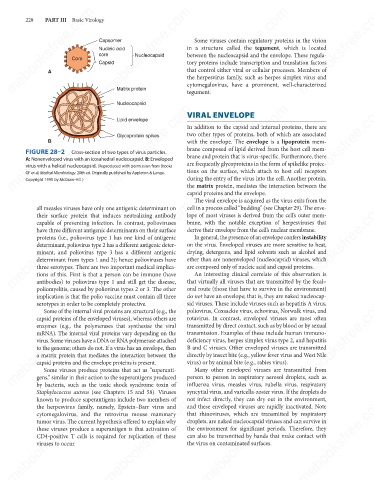
in a structure called the tegument, which is located
Nucleic acid
between the nucleocapsid and the envelope. These regula-
core
Core
tory proteins include transcription and translation factors
Capsid
that control either viral or cellular processes. Members of
A
the herpesvirus family, such as herpes simplex virus and
cytomegalovirus, have a prominent, well-characterized
Matrix protein
Nucleocapsid
mebooksfree.com
mebooksfree.com mebooksfree.com mebooksfree.com VIRAL ENVELOPE mebooksfree.com mebooksfree.com
Lipid envelope
In addition to the capsid and internal proteins, there are
two other types of proteins, both of which are associated
Glycoprotein spikes
with the envelope. The envelope is a lipoprotein mem-
B
brane composed of lipid derived from the host cell mem-
FIGURE 28–2
Cross-section of two types of virus particles.
brane and protein that is virus-specific. Furthermore, there
A: Nonenveloped virus with an icosahedral nucleocapsid. B: Enveloped
are frequently glycoproteins in the form of spikelike projec-
virus with a helical nucleocapsid. (Reproduced with permission from Brooks
tions on the surface, which attach to host cell receptors
GF et al. Medical Microbiology. 20th ed. Originally published by Appleton & Lange.
during the entry of the virus into the cell. Another protein,
Copyright 1995 by McGraw-Hill.)
the matrix protein, mediates the interaction between the
capsid proteins and the envelope.
The viral envelope is acquired as the virus exits from the
mebooksfree.com
mebooksfree.com mebooksfree.com mebooksfree.com derive their envelope from the cell’s nuclear membrane. mebooksfree.com
mebooksfree.com
cell in a process called “budding” (see Chapter 29). The enve-
all measles viruses have only one antigenic determinant on
lope of most viruses is derived from the cell’s outer mem-
their surface protein that induces neutralizing antibody
brane, with the notable exception of herpesviruses that
capable of preventing infection. In contrast, polioviruses
have three different antigenic determinants on their surface
In general, the presence of an envelope confers instability
proteins (i.e., poliovirus type 1 has one kind of antigenic
on the virus. Enveloped viruses are more sensitive to heat,
determinant, poliovirus type 2 has a different antigenic deter-
drying, detergents, and lipid solvents such as alcohol and
minant, and poliovirus type 3 has a different antigenic
ether than are nonenveloped (nucleocapsid) viruses, which
determinant from types 1 and 2); hence polioviruses have
are composed only of nucleic acid and capsid proteins.
three serotypes. There are two important medical implica-
An interesting clinical correlate of this observation is
tions of this. First is that a person can be immune (have
antibodies) to poliovirus type 1 and still get the disease,
oral route (those that have to survive in the environment)
poliomyelitis, caused by poliovirus types 2 or 3. The other
do not have an envelope; that is, they are naked nucleocap-
implication is that the polio vaccine must contain all three that virtually all viruses that are transmitted by the fecal–
mebooksfree.com
mebooksfree.com mebooksfree.com mebooksfree.com transmitted by direct contact, such as by blood or by sexual mebooksfree.com
mebooksfree.com
sid viruses. These include viruses such as hepatitis A virus,
serotypes in order to be completely protective.
poliovirus, Coxsackie virus, echovirus, Norwalk virus, and
Some of the internal viral proteins are structural (e.g., the
rotavirus. In contrast, enveloped viruses are most often
capsid proteins of the enveloped viruses), whereas others are
enzymes (e.g., the polymerases that synthesize the viral
transmission. Examples of these include human immuno-
mRNA). The internal viral proteins vary depending on the
deficiency virus, herpes simplex virus type 2, and hepatitis
virus. Some viruses have a DNA or RNA polymerase attached
B and C viruses. Other enveloped viruses are transmitted
to the genome; others do not. If a virus has an envelope, then
directly by insect bite (e.g., yellow fever virus and West Nile
a matrix protein that mediates the interaction between the
virus) or by animal bite (e.g., rabies virus).
capsid proteins and the envelope proteins is present.
Many other enveloped viruses are transmitted from
Some viruses produce proteins that act as “superanti-
gens,” similar in their action to the superantigens produced
influenza virus, measles virus, rubella virus, respiratory
by bacteria, such as the toxic shock syndrome toxin of
syncytial virus, and varicella-zoster virus. If the droplets do
Staphylococcus aureus (see Chapters 15 and 58). Viruses person to person in respiratory aerosol droplets, such as
not infect directly, they can dry out in the environment,
mebooksfree.com
mebooksfree.com
mebooksfree.com mebooksfree.com mebooksfree.com droplets, are naked nucleocapsid viruses and can survive in mebooksfree.com
known to produce superantigens include two members of
and these enveloped viruses are rapidly inactivated. Note
the herpesvirus family, namely, Epstein–Barr virus and
that rhinoviruses, which are transmitted by respiratory
cytomegalovirus, and the retrovirus mouse mammary
tumor virus. The current hypothesis offered to explain why
the environment for significant periods. Therefore, they
these viruses produce a superantigen is that activation of
can also be transmitted by hands that make contact with
CD4-positive T cells is required for replication of these
the virus on contaminated surfaces.
viruses to occur.
mebooksfree.com mebooksfree.com mebooksfree.com mebooksfree.com mebooksfree.com mebooksfree.com

