


Page 282 - Review of Medical Microbiology and Immunology ( PDFDrive )
P. 282
mebooksfree.com
immunodeficiency virus (HIV) mebooksfree.com
mebooksfree.com
mebooksfree.com
mebooksfree.com mebooksfree.com mebooksfree.com mebooksfree.com mebooksfree.com mebooksfree.com
mebooksfree.com
mebooksfree.com
CHAPTER 35 Antiviral Drugs
271
TABLE 35–3 Antiviral Drugs That Block Viral Nucleic Acid Synthesis
Mode of Action
Antiviral Drugs
1. Nucleoside inhibitors: acyclovir, ganciclovir, valacyclovir, valganciclovir,
Inhibition of DNA polymerase of herpesviruses
penciclovir, famciclovir, cidofovir, trifluridine
2. Nonnucleoside inhibitors: foscarnet
1. Nucleoside inhibitors: zidovudine, lamivudine, emtricitabine, didanosine,
Inhibition of reverse transcriptase of human
stavudine, abacavir, tenofovir
2. Nonnucleoside inhibitors: nevirapine, delavirdine, efavirenz, etravirine, rilpivirine
mebooksfree.com mebooksfree.com mebooksfree.com is active primarily against these viruses. It has no activity mebooksfree.com
mebooksfree.com
mebooksfree.com
Inhibition of reverse transcriptase of hepatitis B virus
Adefovir, entecavir, lamivudine, telbivudine
Sofosbuvir, dasabuvir
Inhibition of RNA polymerase of hepatitis C virus
Inhibition of NS5A protein of hepatitis C virus
Ledipasvir, ombitsavir
Ribavirin
Inhibition of nucleic acid synthesis by other viruses
Acyclovir is active primarily against HSV-1 and -2
and varicella-zoster virus (VZV). It is relatively non-
toxic, because it is activated preferentially within virus-
clovir monophosphate by the viral thymidine kinase,
infected cells. This is due to the virus-encoded
cellular kinases synthesize acyclovir triphosphate, which
inhibits viral DNA polymerase much more effectively
thymidine kinase, which phosphorylates acyclovir against CMV. Once the drug is phosphorylated to acy-
than it inhibits cellular DNA polymerase. Acyclovir
much more effectively than does the cellular thymidine
mebooksfree.com mebooksfree.com Attachment mebooksfree.com mebooksfree.com mebooksfree.com mebooksfree.com
causes chain termination because it lacks a hydroxyl
kinase. Because only HSV-1, HSV-2, and VZV encode a
kinase that efficiently phosphorylates acyclovir, the drug
group in the 3′ position.
inhibited by
palivizumab (RSV)
Virion
Receptor
Uncoating Nucleus
inhibited by
mebooksfree.com mebooksfree.com mebooksfree.com Translation polyproteins Release of virus mebooksfree.com mebooksfree.com
mebooksfree.com
amantadine
(influenza)
Progeny
genomes
mRNAs
Precursor
Assembly into
nucleocapsid
Nucleic acid
inhibited by
synthesis
oseltamivir and
inhibited by
Protein synthesis
(influenza)
inhibited by
1. Acyclovir - (HSV, VZV)
2. Ganciclovir - (CMV) 1. Interferon α and β Precursor zanamivir
(Interferon α used
3. Foscarnet - (HSV, CMV)
protein processing
mebooksfree.com mebooksfree.com mebooksfree.com mebooksfree.com mebooksfree.com mebooksfree.com
clinically against
4. Cidofovir - (CMV)
inhibited by
HBV and HCV)
5. Ribavirin - (RSV)
boceprevir and
2. Fomivirsen (CMV)
6. Adefovir, entecavir,
telaprevir (HCV)
telbivudine (HBV)
7. Sofosbuvir (HCV)
8. Ledipasvir (HCV)
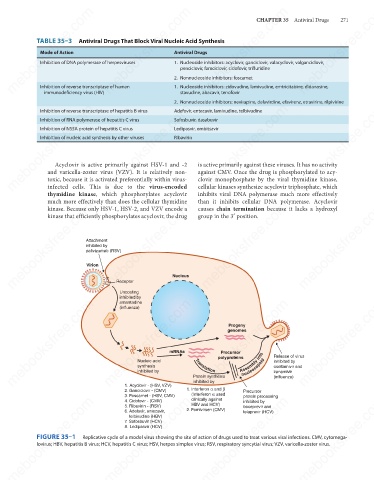
FIGURE 35–1
Replicative cycle of a model virus showing the site of action of drugs used to treat various viral infections. CMV, cytomega-
lovirus; HBV, hepatitis B virus; HCV, hepatitis C virus; HSV, herpes simplex virus; RSV, respiratory syncytial virus; VZV, varicella-zoster virus.
mebooksfree.com mebooksfree.com mebooksfree.com mebooksfree.com mebooksfree.com mebooksfree.com

