


Page 284 - Review of Medical Microbiology and Immunology ( PDFDrive )
P. 284
mebooksfree.com
 mebooksfree.com


            mebooksfree.com
                                                                            mebooksfree.com
                                            mebooksfree.com
                                                                                                            mebooksfree.com
                                                                                                                                           mebooksfree.com
 mebooksfree.com  mebooksfree.com        Herpesvirus-encoded          ACV-MP   Cellular mebooksfree.com   ACV-TP mebooksfree.com           mebooksfree.com
                                                                                                                        273
                                                                                            CHAPTER 35  Antiviral Drugs
                                   In Herpesvirus-Infected Cells
                                                                                           Cellular
                                           thymidine kinase
                                                                        kinase
                                                                                            kinase
                                   ACV
                                                                                    ACV-DP
                                   ACV-TP is incorporated into the growing herpesvirus DNA chain and, acting as a chain terminator,
                                   inhibits viral DNA polymerase.
                                            mebooksfree.com
 mebooksfree.com  mebooksfree.com         thymidine kinase        No ACV-MP  mebooksfree.com                mebooksfree.com                mebooksfree.com
                                   In Uninfected Cells
                                            Cell-encoded


                                   ACV
                                   Because no ACV-MP is made, no ACV-DP or ACV-TP can be made either.

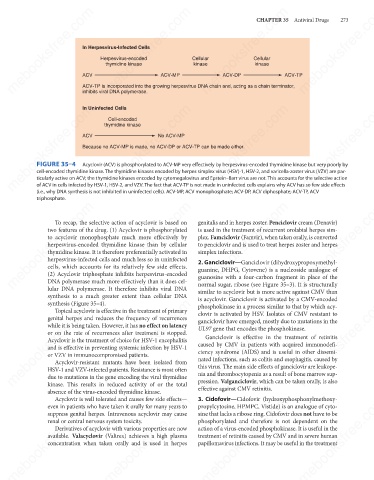
                    FIGURE 35–4
                                   Acyclovir (ACV) is phosphorylated to ACV-MP very effectively by herpesvirus-encoded thymidine kinase but very poorly by
                    cell-encoded thymidine kinase. The thymidine kinases encoded by herpes simplex virus (HSV)-1, HSV-2, and varicella-zoster virus (VZV) are par-
                    ticularly active on ACV; the thymidine kinases encoded by cytomegalovirus and Epstein–Barr virus are not. This accounts for the selective action
                    of ACV in cells infected by HSV-1, HSV-2, and VZV. The fact that ACV-TP is not made in uninfected cells explains why ACV has so few side effects
                    (i.e., why DNA synthesis is not inhibited in uninfected cells). ACV-MP, ACV monophosphate; ACV-DP, ACV diphosphate; ACV-TP, ACV
                    triphosphate.
                                                                            mebooksfree.com
 mebooksfree.com  mebooksfree.com           mebooksfree.com              genitalis and in herpes zoster. Penciclovir cream (Denavir)       mebooksfree.com
                                                                                                            mebooksfree.com
                          To recap, the selective action of acyclovir is based on
                        two features of the drug. (1) Acyclovir is phosphorylated
                                                                         is used in the treatment of recurrent orolabial herpes sim-
                        to acyclovir monophosphate much more effectively by
                                                                         plex. Famciclovir (Famvir), when taken orally, is converted
                        herpesvirus-encoded thymidine kinase than by cellular
                                                                         to penciclovir and is used to treat herpes zoster and herpes
                                                                         simplex infections.
                        thymidine kinase. It is therefore preferentially activated in
                        herpesvirus-infected cells and much less so in uninfected
                                                                         2. Ganciclovir—Ganciclovir (dihydroxypropoxymethyl-
                        cells, which accounts for its relatively few side effects.
                                                                         guanine, DHPG, Cytovene) is a nucleoside analogue of
                        (2) Acyclovir triphosphate inhibits herpesvirus-encoded
                        DNA polymerase much more effectively than it does cel-
                                                                         normal sugar, ribose (see Figure 35–3). It is structurally
                        lular DNA polymerase. It therefore inhibits viral DNA
                                                                         similar to acyclovir but is more active against CMV than
                        synthesis to a much greater extent than cellular DNA   guanosine with a four-carbon fragment in place of the
                                                                         is acyclovir. Ganciclovir is activated by a CMV-encoded
                                                                            mebooksfree.com
 mebooksfree.com  mebooksfree.com           mebooksfree.com              ganciclovir have emerged, mostly due to mutations in the          mebooksfree.com
                                                                                                            mebooksfree.com
                        synthesis (Figure 35–4).
                                                                         phosphokinase in a process similar to that by which acy-
                          Topical acyclovir is effective in the treatment of primary
                                                                         clovir is activated by HSV. Isolates of CMV resistant to
                        genital herpes and reduces the frequency of recurrences
                        while it is being taken. However, it has no effect on latency
                                                                         UL97 gene that encodes the phosphokinase.
                        or on the rate of recurrences after treatment is stopped.
                                                                           Ganciclovir  is  effective  in  the  treatment  of  retinitis
                        Acyclovir is the treatment of choice for HSV-1 encephalitis
                                                                         caused by CMV in patients with acquired immunodefi-
                        and is effective in preventing systemic infection by HSV-1
                                                                         ciency syndrome (AIDS) and is useful in other dissemi-
                        or VZV in immunocompromised patients.
                                                                         nated infections, such as colitis and esophagitis, caused by
                          Acyclovir-resistant mutants have been isolated from
                                                                         this virus. The main side effects of ganciclovir are leukope-
                        HSV-1 and VZV-infected patients. Resistance is most often
                        due to mutations in the gene encoding the viral thymidine
                                                                         pression. Valganciclovir, which can be taken orally, is also
                        kinase. This results in reduced activity of or the total
                                                                         effective against CMV retinitis.
                        absence of the virus-encoded thymidine kinase.   nia and thrombocytopenia as a result of bone marrow sup-
 mebooksfree.com  mebooksfree.com           mebooksfree.com              phosphorylated  and therefore is not dependent on the             mebooksfree.com
                                                                         3. Cidofovir—Cidofovir (hydroxyphosphonylmethoxy-
                                                                            mebooksfree.com
                          Acyclovir is well tolerated and causes few side effects—
                                                                                                            mebooksfree.com
                        even in patients who have taken it orally for many years to
                                                                         propylcytosine, HPMPC, Vistide) is an analogue of cyto-
                        suppress genital herpes. Intravenous acyclovir may cause
                                                                         sine that lacks a ribose ring. Cidofovir does not have to be
                        renal or central nervous system toxicity.
                                                                         action of a virus-encoded phosphokinase. It is useful in the
                          Derivatives of acyclovir with various properties are now
                                                                         treatment of retinitis caused by CMV and in severe human
                        available.  Valacyclovir (Valtrex) achieves a high plasma
                        concentration  when  taken  orally  and  is  used  in  herpes
                                                                         papillomavirus infections. It may be useful in the treatment
 mebooksfree.com  mebooksfree.com           mebooksfree.com                 mebooksfree.com                 mebooksfree.com                mebooksfree.com

