


Page 324 - Review of Medical Microbiology and Immunology ( PDFDrive )
P. 324
mebooksfree.com
mebooksfree.com
mebooksfree.com
mebooksfree.com
mebooksfree.com
mebooksfree.com
mebooksfree.com mebooksfree.com Rash Occurs Giant Cells Formed mebooksfree.com Immune Globulins 313 mebooksfree.com
mebooksfree.com
mebooksfree.com
CHAPTER 39 RNA Enveloped Viruses
TABLE 39–3 Clinical Features of Certain RNA Enveloped Viruses
Commonly Used
Virus
Type of Vaccine
No
No
Killed
Influenza
No
No
None
Yes
No
Respiratory syncytial
Yes
Live
Measles
Yes
No
Live
Yes
Rubella
No
No
Rabies
Yes
Killed
mebooksfree.com
mebooksfree.com mebooksfree.com No No tains an RNA-dependent RNA polymerase, which tran- mebooksfree.com
mebooksfree.com
mebooksfree.com
The pandemics caused by influenza A virus occur infre-
quently (the last one was in 1968), but major outbreaks
scribes the negative-polarity genome into mRNA.
caused by this virus occur virtually every year in many
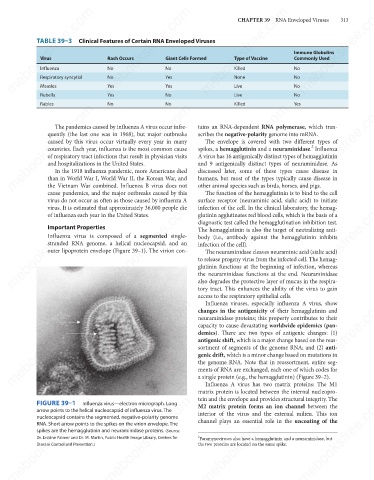
The envelope is covered with two different types of
2
countries. Each year, influenza is the most common cause
spikes, a hemagglutinin and a neuraminidase. Influenza
of respiratory tract infections that result in physician visits
A virus has 16 antigenically distinct types of hemagglutinin
and hospitalizations in the United States.
and 9 antigenically distinct types of neuraminidase. As
discussed later, some of these types cause disease in
In the 1918 influenza pandemic, more Americans died
than in World War I, World War II, the Korean War, and
other animal species such as birds, horses, and pigs.
the Vietnam War combined. Influenza B virus does not
The function of the hemagglutinin is to bind to the cell
cause pandemics, and the major outbreaks caused by this
virus do not occur as often as those caused by influenza A humans, but most of the types typically cause disease in
surface receptor (neuraminic acid, sialic acid) to initiate
mebooksfree.com
mebooksfree.com
mebooksfree.com mebooksfree.com mebooksfree.com The hemagglutinin is also the target of neutralizing anti- mebooksfree.com
virus. It is estimated that approximately 36,000 people die
infection of the cell. In the clinical laboratory, the hemag-
glutinin agglutinates red blood cells, which is the basis of a
of influenza each year in the United States.
diagnostic test called the hemagglutination inhibition test.
Important Properties
Influenza virus is composed of a segmented single-
body (i.e., antibody against the hemagglutinin inhibits
stranded RNA genome, a helical nucleocapsid, and an
infection of the cell).
outer lipoprotein envelope (Figure 39–1). The virion con-
The neuraminidase cleaves neuraminic acid (sialic acid)
to release progeny virus from the infected cell. The hemag-
glutinin functions at the beginning of infection, whereas
the neuraminidase functions at the end. Neuraminidase
also degrades the protective layer of mucus in the respira-
tory tract. This enhances the ability of the virus to gain
access to the respiratory epithelial cells.
mebooksfree.com
mebooksfree.com
mebooksfree.com mebooksfree.com mebooksfree.com capacity to cause devastating worldwide epidemics (pan- mebooksfree.com
Influenza viruses, especially influenza A virus, show
changes in the antigenicity of their hemagglutinin and
neuraminidase proteins; this property contributes to their
demics). There are two types of antigenic changes: (1)
antigenic shift, which is a major change based on the reas-
sortment of segments of the genome RNA; and (2) anti-
genic drift, which is a minor change based on mutations in
the genome RNA. Note that in reassortment, entire seg-
ments of RNA are exchanged, each one of which codes for
a single protein (e.g., the hemagglutinin) (Figure 39–2).
Influenza A virus has two matrix proteins: The M1
matrix protein is located between the internal nucleopro-
mebooksfree.com mebooksfree.com mebooksfree.com channel plays an essential role in the uncoating of the mebooksfree.com
tein and the envelope and provides structural integrity. The
mebooksfree.com
mebooksfree.com
FIGURE 39–1
Influenza virus—electron micrograph. Long
M2 matrix protein forms an ion channel between the
arrow points to the helical nucleocapsid of influenza virus. The
interior of the virus and the external milieu. This ion
nucleocapsid contains the segmented, negative-polarity genome
RNA. Short arrow points to the spikes on the virion envelope. The
spikes are the hemagglutinin and neuraminidase proteins. (Source:
2
Dr. Erskine Palmer and Dr. M. Martin, Public Health Image Library, Centers for
Paramyxoviruses also have a hemagglutinin and a neuraminidase, but
the two proteins are located on the same spike.
Disease Control and Prevention.)
mebooksfree.com mebooksfree.com mebooksfree.com mebooksfree.com mebooksfree.com mebooksfree.com

