


Page 384 - Review of Medical Microbiology and Immunology ( PDFDrive )
P. 384
mebooksfree.com
mebooksfree.com
mebooksfree.com
mebooksfree.com
mebooksfree.com
mebooksfree.com
mebooksfree.com mebooksfree.com mebooksfree.com analogues inhibit the formation of the pathologic PrP 373 mebooksfree.com
mebooksfree.com
mebooksfree.com
CHAPTER 44 Slow Viruses & Prions
There is evidence that quinacrine and other acridine
SC
form in cell culture. These drugs are currently being tested
in animal models for their ability to treat or prevent prion
diseases.
Prion-caused diseases can be classified into three cate-
gories: some are clearly transmissible (infectious), such as
kuru; some are clearly hereditary (genetic), such as fatal
familial insomnia; and others are sporadic (neither infec-
tious nor hereditary), such as most cases of CJD. The spo-
mebooksfree.com
mebooksfree.com
mebooksfree.com mebooksfree.com mebooksfree.com SLOW DISEASES CAUSED BY mebooksfree.com
radic cases seem likely to be due to spontaneous somatic
mutations in the affected individual.
CONVENTIONAL VIRUSES
Progressive Multifocal
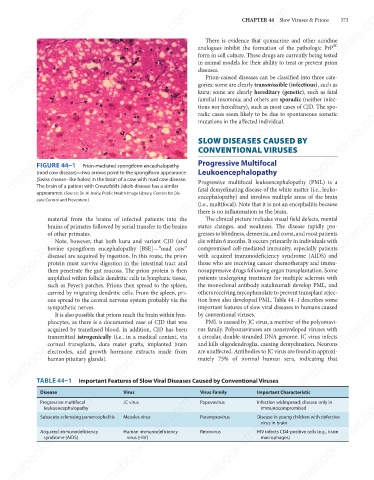
FIGURE 44–1
Prion-mediated spongiform encephalopathy
Leukoencephalopathy
(mad cow disease)—two arrows point to the spongiform appearance
(Swiss cheese–like holes) in the brain of a cow with mad cow disease.
The brain of a patient with Creutzfeldt-Jakob disease has a similar
fatal demyelinating disease of the white matter (i.e., leuko-
appearance. (Source: Dr. Al Jenny, Public Health Image Library, Centers for Dis-
encephalopathy) and involves multiple areas of the brain
ease Control and Prevention.) Progressive multifocal leukoencephalopathy (PML) is a
(i.e., multifocal). Note that it is not an encephalitis because
mebooksfree.com
mebooksfree.com mebooksfree.com mebooksfree.com status changes, and weakness. The disease rapidly pro- mebooksfree.com
mebooksfree.com
there is no inflammation in the brain.
The clinical picture includes visual field defects, mental
material from the brains of infected patients into the
brains of primates followed by serial transfer to the brains
gresses to blindness, dementia, and coma, and most patients
of other primates.
die within 6 months. It occurs primarily in individuals with
Note, however, that both kuru and variant CJD (and
compromised cell-mediated immunity, especially patients
bovine spongiform encephalopathy [BSE]—“mad cow”
with acquired immunodeficiency syndrome (AIDS) and
disease) are acquired by ingestion. In this route, the prion
those who are receiving cancer chemotherapy and immu-
protein must survive digestion in the intestinal tract and
then penetrate the gut mucosa. The prion protein is then
patients undergoing treatment for multiple sclerosis with
amplified within follicle dendritic cells in lymphatic tissue,
the monoclonal antibody natalizumab develop PML, and
such as Peyer’s patches. Prions then spread to the spleen,
others receiving mycophenolate to prevent transplant rejec-
carried by migrating dendritic cells. From the spleen, pri- nosuppressive drugs following organ transplantation. Some
tion have also developed PML. Table 44–1 describes some
ons spread to the central nervous system probably via the
mebooksfree.com
mebooksfree.com mebooksfree.com mebooksfree.com rus family. Polyomaviruses are nonenveloped viruses with mebooksfree.com
mebooksfree.com
important features of slow viral diseases in humans caused
sympathetic nerves.
by conventional viruses.
It is also possible that prions reach the brain within lym-
PML is caused by JC virus, a member of the polyomavi-
phocytes, as there is a documented case of CJD that was
acquired by transfused blood. In addition, CJD has been
a circular, double-stranded DNA genome. JC virus infects
transmitted iatrogenically (i.e., in a medical context, via
and kills oligodendroglia, causing demyelination. Neurons
corneal transplants, dura mater grafts, implanted brain
are unaffected. Antibodies to JC virus are found in approxi-
electrodes, and growth hormone extracts made from
mately 75% of normal human sera, indicating that
human pituitary glands).
TABLE 44–1 Important Features of Slow Viral Diseases Caused by Conventional Viruses
Disease Virus Virus Family Important Characteristic
mebooksfree.com
mebooksfree.com mebooksfree.com mebooksfree.com Paramyxovirus Disease in young children with defective mebooksfree.com
mebooksfree.com
Infection widespread; disease only in
Progressive multifocal
JC virus
Papovavirus
immunocompromised
leukoencephalopathy
Measles virus
Subacute sclerosing panencephalitis
virus in brain
Acquired immunodeficiency
Human immunodeficiency
HIV infects CD4-positive cells (e.g., brain
Retrovirus
virus (HIV)
syndrome (AIDS)
macrophages)
mebooksfree.com mebooksfree.com mebooksfree.com mebooksfree.com mebooksfree.com mebooksfree.com

