


Page 389 - Review of Medical Microbiology and Immunology ( PDFDrive )
P. 389
mebooksfree.com


                                                                                                            mebooksfree.com
                                                                                                                                           mebooksfree.com
            mebooksfree.com
                                            mebooksfree.com
 mebooksfree.com  mebooksfree.com           mebooksfree.com                 mebooksfree.com         H   A  P mebooksfree.com               mebooksfree.com
                                                                            mebooksfree.com
                                                                                                45
                                                                                                 C
                                                                                                                  E
                                                                                                               T
                                                                                                                     R


                 Human


                 Immunodeficiency Virus
                       Pathogenesis & Immunity mebooksfree.com
                                                                            mebooksfree.com
 mebooksfree.com  mebooksfree.com                                        Laboratory Diagnosis               mebooksfree.com                mebooksfree.com


                   CHAPTER  C ONTENT S

                       Disease
                       Important Properties
                                                                         Treatment
                                                                         Prevention
                       Summary of Replicative Cycle
                       Transmission & Epidemiology
                                                                     Summaries of Organisms
                       Clinical Findings                             Self-Assessment Questions
                                                                     Practice Questions: USMLE & Course Examinations
                                                                                                            mebooksfree.com
 mebooksfree.com  mebooksfree.com                                    required for replication, and the other four, nef, vif, vpr, and      mebooksfree.com
                    Important Propertiesmebooksfree.com
                                                                            mebooksfree.com
                    Disease
                                                                     vpu, are not required for replication and are termed “acces-
                    Human immunodeficiency virus (HIV) is the cause of
                                                                     sory” genes.
                    acquired immunodeficiency syndrome (AIDS).
                                                                        The gag gene encodes the internal “core” proteins, the
                       Both HIV-1 and HIV-2 cause AIDS, but HIV-1 is found
                                                                     most important of which is the p24 protein. It is important
                    worldwide, whereas HIV-2 is found primarily in West
                    Africa. This chapter refers to HIV-1 unless otherwise noted.


 mebooksfree.com  mebooksfree.com           mebooksfree.com                 mebooksfree.com                 mebooksfree.com                mebooksfree.com
                    HIV is one of the two important human T-cell lympho-
                    tropic retroviruses (human T-cell leukemia virus is the
                    other). HIV preferentially infects and kills helper (CD4)
                    T lymphocytes, resulting in the loss of cell-mediated
                    immunity and a high probability that the host will develop
                    opportunistic infections. Other cells (e.g., macrophages
                    and monocytes) that have CD4 proteins on their surfaces
                    can be infected also.
                       HIV belongs to the lentivirus subgroup of retroviruses,
                    which cause “slow” infections with long incubation periods
                    (see Chapter 44). HIV has a cylinder-shaped (type D) core
                    surrounded by an envelope containing virus-specific glyco-
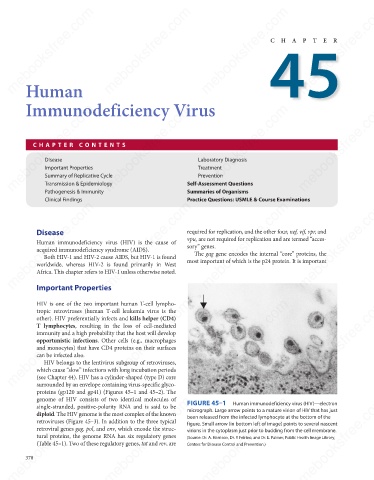
                    proteins (gp120 and gp41) (Figures 45–1 and 45–2). The   FIGURE 45–1   Human immunodeficiency virus (HIV)—electron
 mebooksfree.com  mebooksfree.com           mebooksfree.com          been released from the infected lymphocyte at the bottom of the       mebooksfree.com
                                                                            mebooksfree.com
                                                                                                            mebooksfree.com
                    genome of HIV consists of two identical molecules of
                    single-stranded, positive-polarity RNA and is said to be
                                                                     micrograph. Large arrow points to a mature virion of HIV that has just
                    diploid. The HIV genome is the most complex of the known
                    retroviruses (Figure 45–3). In addition to the three typical
                                                                     figure. Small arrow (in bottom left of image) points to several nascent
                    retroviral genes gag, pol, and env, which encode the struc-
                                                                     virions in the cytoplasm just prior to budding from the cell membrane.
                    tural proteins, the genome RNA has six regulatory genes
                                                                     (Source: Dr. A. Harrison, Dr. P. Feirino, and Dr. E. Palmer, Public Health Image Library,
                    (Table 45–1). Two of these regulatory genes, tat and rev, are
                                                                     Centers for Disease Control and Prevention.)
                 378


 mebooksfree.com  mebooksfree.com           mebooksfree.com                 mebooksfree.com                 mebooksfree.com                mebooksfree.com

