


Page 448 - Review of Medical Microbiology and Immunology ( PDFDrive )
P. 448
mebooksfree.com
mebooksfree.com
mebooksfree.com
mebooksfree.com
mebooksfree.com
mebooksfree.com
mebooksfree.com
mebooksfree.com mebooksfree.com mebooksfree.com merase chain reaction (PCR)-based test for Plasmodium 437 mebooksfree.com
mebooksfree.com
CHAPTER 52 Blood & Tissue Protozoa
If blood smears do not reveal the diagnosis, then a poly-
Clinical Findings
Malaria presents with abrupt onset of fever and chills,
nucleic acids or an enzyme-linked immunosorbent assay
accompanied by headache, myalgias, and arthralgias, about
(ELISA) test for a protein specific for P. falciparum can be
2 weeks after the mosquito bite. Fever may be continuous
useful.
early in the disease; the typical periodic cycle does not
develop for several days after onset. The fever spike, which
can reach 41°C, is frequently accompanied by shaking
chills, nausea, vomiting, and abdominal pain. The fever is
The treatment of malaria is complicated, and the details are
followed by drenching sweats. Patients usually feel well Treatment
mebooksfree.com mebooksfree.com mebooksfree.com disease and whether the organism is resistant to chloro- mebooksfree.com
mebooksfree.com
mebooksfree.com
beyond the scope of this book. Table 52–2 presents the
between the febrile episodes. Splenomegaly is seen in most
drugs commonly used in the United States. The main crite-
patients, and hepatomegaly occurs in roughly one-third.
ria used for choosing specific drugs are the severity of the
Anemia is prominent.
Untreated malaria caused by P. falciparum is potentially
quine. Chloroquine resistance is determined by the geo-
life-threatening as a result of extensive brain (cerebral
graphical location where the infection was acquired rather
malaria) and kidney (blackwater fever) damage. Malaria
than by laboratory testing.
caused by the other three plasmodia is usually self-limited,
Chloroquine is the drug of choice for treatment of
with a low mortality rate. However, relapses of P. vivax and
uncomplicated malaria caused by non-falciparum species
P. ovale malaria can occur up to several years after the ini-
in areas without chloroquine resistance. Chloroquine kills
tial illness as a result of hypnozoites latent in the liver.
the merozoites, thereby reducing the parasitemia, but does
not affect the hypnozoites of P. vivax and P. ovale in the
Laboratory Diagnosis
liver. These are killed by primaquine, which must be used
Diagnosis rests on microscopic examination of blood,
mebooksfree.com mebooksfree.com mebooksfree.com to prevent relapses. Primaquine may induce severe hemo- mebooksfree.com
mebooksfree.com
mebooksfree.com
using both thick and thin Giemsa-stained smears. The
lysis in those with G6PD deficiency, so testing for this
enzyme should be done before the drug is given. Prima-
thick smear is used to screen for the presence of organisms,
quine should not be given if the patient is severely G6PD
and the thin smear is used for species identification. It is
important to identify the species because the treatment of
deficient. If primaquine is not given, one approach is to
wait to see whether symptoms recur and then treat with
different species can differ. Ring-shaped trophozoites can
be seen within infected red blood cells (see Figure 52–3).
chloroquine.
The gametocytes of P. falciparum are crescent-shaped
Uncomplicated, chloroquine-resistant P. falciparum
(“banana-shaped”), whereas those of the other plasmodia
infection is treated with either Coartem (artemether plus
are spherical (Figure 52–2F). If more than 5% of red blood
lumefantrine) or Malarone (atovaquone and proguanil). In
cells are parasitized, the diagnosis is usually P. falciparum
parum malaria, intravenous administration of either arte-
malaria.
Plasmodium species typically produce hemozoin pig-
sunate or quinidine is used.
Outside the United States, the artemisinins, such as arte-
ment in infected red blood cells whereas Babesia species severe complicated cases of chloroquine-resistant falci-
mebooksfree.com
mebooksfree.com mebooksfree.com mebooksfree.com oped resistance to artemisinins in mainland Southeast Asia mebooksfree.com
mebooksfree.com
(see Chapter 53) do not. Plasmodia metabolize heme in the
sunate or artemether, are widely used in combination with
red cells to produce hemozoin. Also found within P. vivax
other antimalarial drugs. The artemisinins are inexpensive
and P. ovale-infected red cells are Schüffner’s dots. These
and have few side effects. However, P. falciparum has devel-
are intracytoplasmic granules that stain red using the
(e.g., Vietnam, Cambodia, Myanmar, and Thailand).
Romanovsky stain.
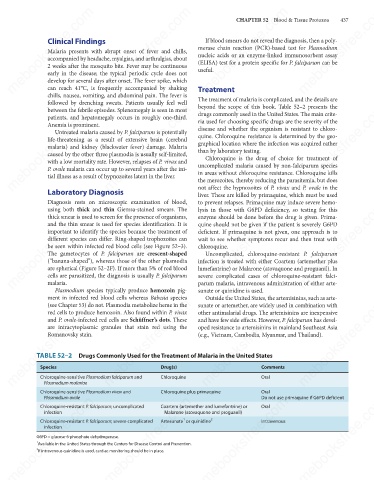
TABLE 52–2 Drugs Commonly Used for the Treatment of Malaria in the United States
Species
Comments
Drug(s)
Chloroquine-sensitive Plasmodium falciparum and
Plasmodium malariae
Chloroquine-sensitive Plasmodium vivax and Chloroquine Oral
Chloroquine plus primaquine
Oral
Do not use primaquine if G6PD deficient
Plasmodium ovale
mebooksfree.com mebooksfree.com mebooksfree.com 1 mebooksfree.com mebooksfree.com mebooksfree.com
Oral
Coartem (artemether and lumefantrine) or
Chloroquine-resistant P. falciparum; uncomplicated
infection
Malarone (atovaquone and proguanil)
2
Intravenous
Artesunate or quinidine
Chloroquine-resistant P. falciparum; severe complicated
infection
G6PD = glucose-6-phosphate dehydrogenase.
1
Available in the United States through the Centers for Disease Control and Prevention.
2
If intravenous quinidine is used, cardiac monitoring should be in place.
mebooksfree.com mebooksfree.com mebooksfree.com mebooksfree.com mebooksfree.com mebooksfree.com

