


Page 462 - Review of Medical Microbiology and Immunology ( PDFDrive )
P. 462
mebooksfree.com
mebooksfree.com
mebooksfree.com
mebooksfree.com
mebooksfree.com
mebooksfree.com
mebooksfree.com mebooksfree.com mebooksfree.com BALANTIDIUM mebooksfree.com mebooksfree.com
mebooksfree.com
CHAPTER 53 Minor Protozoan Pathogens
451
wear contact lenses. With increasing use of contact lenses,
keratitis has become the most common disease associated
Balantidium coli is the only ciliated protozoan that
with Acanthamoeba infection. The amebas have been
causes human disease (i.e., diarrhea). It is found world-
recovered from contact lenses, lens cases, and lens disinfec-
wide but only infrequently in the United States. Domestic
tant solutions. Tap water contaminated with amebas is the
animals, especially pigs, are the main reservoir for the
source of infection for lens users.
cysts in food or water contaminated with animal or
human feces. The trophozoites excyst in the small intes-
BABESIA organism, and humans are infected after ingesting the
tine, travel to the colon, and, by burrowing into the wall,
mebooksfree.com mebooksfree.com mebooksfree.com nal lesions do not occur. mebooksfree.com mebooksfree.com
mebooksfree.com
cause an ulcer similar to that of Entamoeba histolytica.
Babesia microti causes babesiosis—a zoonosis acquired
However, unlike the case with E. histolytica, extraintesti-
chiefly in the coastal areas and islands off the northeastern
coast of the United States (e.g., Nantucket Island). The
Most infected individuals are asymptomatic; diarrhea
sporozoan organism is endemic in rodents and is trans-
rarely occurs. Diagnosis is made by finding large ciliated
mitted by the bite of the tick Ixodes dammini (renamed
trophozoites or large cysts with a characteristic V-shaped
I. scapularis), the same species of tick that transmits Borrelia
nucleus in the stool. There are no serologic tests. The treat-
burgdorferi, the agent of Lyme disease. Babesia infects red
ment of choice is tetracycline. Prevention consists of
blood cells, causing them to lyse, but unlike plasmodia, it
avoiding contamination of food and water by domestic
has no exoerythrocytic phase. Asplenic patients are affected
more severely.
The influenzalike symptoms begin gradually and may
last for several weeks. Hepatosplenomegaly and anemia animal feces.
CYCLOSPORA
occur. Diagnosis is made by seeing intraerythrocytic ring-
mebooksfree.com
mebooksfree.com mebooksfree.com mebooksfree.com immunocompromised individuals. It is classified as a mebooksfree.com
mebooksfree.com
shaped parasites on Giemsa-stained blood smears. The
Cyclospora cayetanensis is an intestinal protozoan that
intraerythrocytic ring-shaped trophozoites are often in
causes watery diarrhea in both immunocompetent and
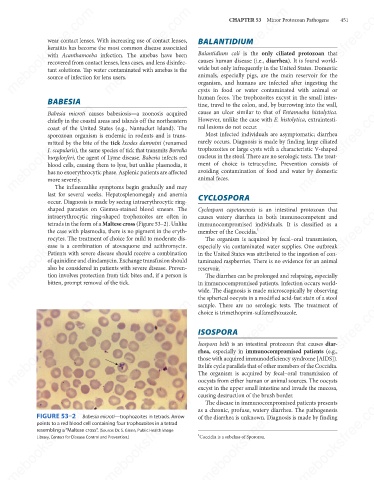
tetrads in the form of a Maltese cross (Figure 53–2). Unlike
1
the case with plasmodia, there is no pigment in the eryth-
member of the Coccidia.
rocytes. The treatment of choice for mild to moderate dis-
The organism is acquired by fecal–oral transmission,
ease is a combination of atovaquone and azithromycin.
especially via contaminated water supplies. One outbreak
Patients with severe disease should receive a combination
in the United States was attributed to the ingestion of con-
of quinidine and clindamycin. Exchange transfusion should
taminated raspberries. There is no evidence for an animal
also be considered in patients with severe disease. Preven-
reservoir.
tion involves protection from tick bites and, if a person is
The diarrhea can be prolonged and relapsing, especially
bitten, prompt removal of the tick.
in immunocompromised patients. Infection occurs world-
wide. The diagnosis is made microscopically by observing
the spherical oocysts in a modified acid-fast stain of a stool
mebooksfree.com mebooksfree.com mebooksfree.com ISOSPORA mebooksfree.com mebooksfree.com
mebooksfree.com
sample. There are no serologic tests. The treatment of
choice is trimethoprim-sulfamethoxazole.
Isospora belli is an intestinal protozoan that causes diar-
rhea, especially in immunocompromised patients (e.g.,
those with acquired immunodeficiency syndrome [AIDS]).
Its life cycle parallels that of other members of the Coccidia.
The organism is acquired by fecal–oral transmission of
oocysts from either human or animal sources. The oocysts
excyst in the upper small intestine and invade the mucosa,
causing destruction of the brush border.
mebooksfree.com mebooksfree.com mebooksfree.com 1 Coccidia is a subclass of Sporozoa. mebooksfree.com mebooksfree.com
mebooksfree.com
The disease in immunocompromised patients presents
as a chronic, profuse, watery diarrhea. The pathogenesis
FIGURE 53–2
of the diarrhea is unknown. Diagnosis is made by finding
Babesia microti—trophozoites in tetrads. Arrow
points to a red blood cell containing four trophozoites in a tetrad
resembling a “Maltese cross”. (Source: Dr. S. Glenn, Public Health Image
Library, Centers for Disease Control and Prevention.)
mebooksfree.com mebooksfree.com mebooksfree.com mebooksfree.com mebooksfree.com mebooksfree.com

