


Page 471 - Review of Medical Microbiology and Immunology ( PDFDrive )
P. 471
mebooksfree.com


                                                                                                            mebooksfree.com
                                                                                                                                           mebooksfree.com
            mebooksfree.com
                                                                            mebooksfree.com
 mebooksfree.com  mebooksfree.com           mebooksfree.com                 mebooksfree.com                 mebooksfree.com                mebooksfree.com
                                            mebooksfree.com
                 460
                       PART VI  Parasitology


 mebooksfree.com  mebooksfree.com           mebooksfree.com                 mebooksfree.com                 mebooksfree.com                mebooksfree.com


 mebooksfree.com  mebooksfree.com           mebooksfree.com                 mebooksfree.com                 mebooksfree.com                mebooksfree.com


                                                                                                            mebooksfree.com
                                                                            mebooksfree.com
 mebooksfree.com  mebooksfree.com           mebooksfree.com          by other tapeworms, where only one adult worm is present,             mebooksfree.com
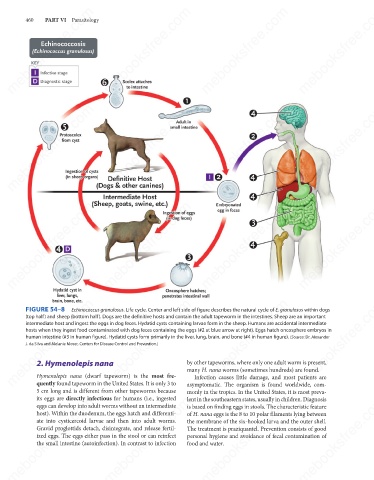
                 FIGURE 54–8
                                Echinococcus granulosus. Life cycle. Center and left side of figure describes the natural cycle of E. granulosus within dogs
                 (top half) and sheep (bottom half). Dogs are the definitive hosts and contain the adult tapeworm in the intestines. Sheep are an important
                 intermediate host and ingest the eggs in dog feces. Hydatid cysts containing larvae form in the sheep. Humans are accidental intermediate
                 hosts when they ingest food contaminated with dog feces containing the eggs (#2 at blue arrow at right). Eggs hatch oncosphere embryos in
                 human intestine (#3 in human figure). Hydatid cysts form primarily in the liver, lung, brain, and bone (#4 in human figure). (Source: Dr. Alexander
                 J. da Silva and Melanie Moser, Centers for Disease Control and Prevention.)


                    2. Hymenolepis nana
                    Hymenolepis nana (dwarf tapeworm) is the  most fre-
                                                                        Infection causes little damage, and most patients are
                    quently found tapeworm in the United States. It is only 3 to
                                                                     asymptomatic. The organism is found worldwide, com-
                    5 cm long and is different from other tapeworms because   many H. nana worms (sometimes hundreds) are found.
                                                                     monly in the tropics. In the United States, it is most preva-
                    its eggs are directly infectious for humans (i.e., ingested
                                                                            mebooksfree.com
                                                                                                            mebooksfree.com
 mebooksfree.com  mebooksfree.com           mebooksfree.com          the membrane of the six-hooked larva and the outer shell.             mebooksfree.com
                                                                     lent in the southeastern states, usually in children. Diagnosis
                    eggs can develop into adult worms without an intermediate
                                                                     is based on finding eggs in stools. The characteristic feature
                    host). Within the duodenum, the eggs hatch and differenti-
                                                                     of H. nana eggs is the 8 to 10 polar filaments lying between
                    ate into cysticercoid  larvae and then  into adult worms.
                    Gravid proglottids detach, disintegrate, and release fertil-
                                                                     The treatment is praziquantel. Prevention consists of good
                    ized eggs. The eggs either pass in the stool or can reinfect
                                                                     personal hygiene and avoidance of fecal contamination of
                    the small intestine (autoinfection). In contrast to infection
                                                                     food and water.


 mebooksfree.com  mebooksfree.com           mebooksfree.com                 mebooksfree.com                 mebooksfree.com                mebooksfree.com

