


Page 496 - Review of Medical Microbiology and Immunology ( PDFDrive )
P. 496
mebooksfree.com
                                                                            mebooksfree.com
 mebooksfree.com

            mebooksfree.com
                                            mebooksfree.com
                                                                            mebooksfree.com
 mebooksfree.com  mebooksfree.com           mebooksfree.com              Treatment             CHAPTER 56  Nematodes    485                mebooksfree.com
                                                                                                            mebooksfree.com
                                                                                                                                           mebooksfree.com
                        countries (Chad, Ethiopia, Mali, and South Sudan). Prior to
                        the  campaign,  the disease occurred over large areas  of
                                                                         The time-honored treatment consists of gradually extract-
                        tropical Africa, the Middle East, and India, where tens of
                                                                         ing the worm by winding it up on a stick over a period of
                        millions of people were infected.
                                                                         days.
                        Laboratory Diagnosis
                                                                         Prevention
                        The laboratory usually does not play a role in diagnosis.
                                                                         Prevention consists of filtering or boiling drinking water.
 mebooksfree.com  mebooksfree.com           mebooksfree.com              Prevention                         mebooksfree.com                mebooksfree.com
                                                                            mebooksfree.com
                        NEMATODES WHOSE LARVAE CAUSE DISEASE


                        TOXOCARA
                                                                         Dogs should be dewormed, and children should be pre-
                        Disease
                                                                         vented from eating soil.
                        Toxocara canis is the major cause of visceral larva migrans.
                        Toxocara  cati and several other related nematodes also
                        cause this disease.
                                                                         Cutaneous larva migrans is caused by the filariform larvae of
                        Important Properties                             ANCYLOSTOMA
                                                                         A. caninum (dog hookworm) and Ancylostoma braziliense
                                                                         (cat hookworm), as well as other nematodes. The organism
 mebooksfree.com  mebooksfree.com           mebooksfree.com              causing an inflammatory response. The lesions (“creeping          mebooksfree.com
                                                                                                            mebooksfree.com
                                                                            mebooksfree.com
                        The definitive host for T. canis is the dog. The adult T. canis
                                                                         cannot complete its life cycle in humans. The larvae pene-
                        female in the dog intestine produces eggs that are passed in
                                                                         trate the skin and  migrate  through  subcutaneous tissue,
                        the feces into the soil. Humans ingest soil containing the
                        eggs, which hatch into larvae in the small intestine. The
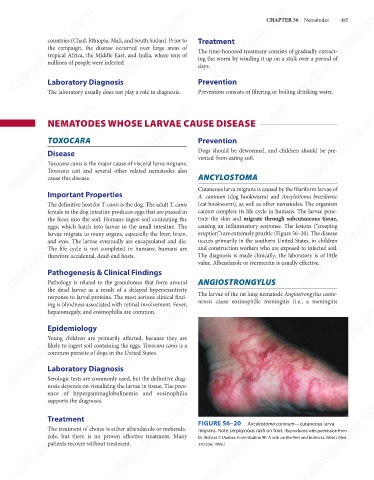
                                                                         eruption”) are extremely pruritic (Figure 56–20). The disease
                        larvae migrate to many organs, especially the liver, brain,
                                                                         occurs primarily in the southern United States, in children
                        and eyes. The larvae eventually are encapsulated and die.
                                                                         and construction workers who are exposed to infected soil.
                        The life cycle is not completed in humans; humans are
                                                                         The diagnosis is made clinically; the laboratory is of little
                        therefore accidental, dead-end hosts.
                                                                         value. Albendazole or ivermectin is usually effective.
                        Pathogenesis & Clinical Findings
                        Pathology is related to the granulomas that form around
                        the dead larvae as a result of a delayed hypersensitivity
                                                                         The larvae of the rat lung nematode Angiostrongylus canto-
                        response to larval proteins. The most serious clinical find-  ANGIOSTRONGYLUS
                                                                         nensis cause eosinophilic meningitis (i.e., a meningitis
 mebooksfree.com  mebooksfree.com           mebooksfree.com                 mebooksfree.com                 mebooksfree.com                mebooksfree.com
                        ing is blindness associated with retinal involvement. Fever,
                        hepatomegaly, and eosinophilia are common.
                        Epidemiology
                        Young children are primarily affected, because they are
                        likely to ingest soil containing the eggs. Toxocara canis is a
                        common parasite of dogs in the United States.

                        Laboratory Diagnosis
                        Serologic tests are commonly used, but the definitive diag-
                        nosis depends on visualizing the larvae in tissue. The pres-
                        ence of hypergammaglobulinemia and eosinophilia
                                                                            mebooksfree.com
                                                                                                            mebooksfree.com
 mebooksfree.com  mebooksfree.com           mebooksfree.com              FIGURE 56–20    Ancylostoma caninum—cutaneous larva               mebooksfree.com
                        supports the diagnosis.
                        Treatment
                        The treatment of choice is either albendazole or mebenda-
                                                                         migrans. Note serpiginous rash on foot. (Reproduced with permission from
                        zole, but there is no proven effective treatment. Many
                                                                         Dr. Richard P. Usatine. From Usatine RP: A rash on the feet and buttocks. West J Med.
                        patients recover without treatment.
                                                                         170:334, 1999.)


 mebooksfree.com  mebooksfree.com           mebooksfree.com                 mebooksfree.com                 mebooksfree.com                mebooksfree.com

