


Page 500 - Review of Medical Microbiology and Immunology ( PDFDrive )
P. 500
mebooksfree.com


                                                                                                                                           mebooksfree.com
                                                                            mebooksfree.com
            mebooksfree.com
                                            mebooksfree.com
 mebooksfree.com  mebooksfree.com           mebooksfree.com                 mebooksfree.com                 mebooksfree.com                mebooksfree.com
                                                                                                            mebooksfree.com


                      PART VII  IMMUNOLOGY


                                                                                                            mebooksfree.com
 mebooksfree.com  mebooksfree.com           mebooksfree.com                 mebooksfree.com         C   H  A   P  T  E   R                 mebooksfree.com

                                                                                                 57


                    Immunity


                                                                            mebooksfree.com
 mebooksfree.com  mebooksfree.com           mebooksfree.com              2. Adaptive (Acquired) Immunity    mebooksfree.com                mebooksfree.com
                       CHAPTER  C ONTENT S
                       Function of the Immune System
                                                                         Active & Passive Immunity
                       Specificity of the Immune Response
                                                                         Antigens
                       1. Cell-Mediated Immunity
                                                                         Age & The Immune Response
                       2. Antibody-Mediated Immunity
                                                                         Self-Assessment Questions
                       Innate & Adaptive Immunity
                                                                         Practice Questions: USMLE & Course Examinations
                       1. Innate Immunity


                        FUNCTION OF THE IMMUNE                           microorganisms. The ability of the innate  arm to  kill
                                                                            mebooksfree.com
                                                                                                            mebooksfree.com
 mebooksfree.com  mebooksfree.com           mebooksfree.com              (acquired) arm of the immune system (third line of                mebooksfree.com
                                                                         microorganisms is not specific. For example, a neutrophil
                        SYSTEM
                                                                         can ingest and destroy many different kinds of bacteria.
                        The main function of the immune system is to prevent or
                                                                           Highly specific protection is provided by the adaptive
                        limit infections, fungi, and parasites, such as protozoa and
                        worms. The first line of defense against microorganisms is
                                                                         defense), but it takes several days for this arm to become
                        the intact skin and mucous membranes. If microorgan-
                                                                         fully functional. The two components of the adaptive arm
                                                                         are  cell-mediated immunity and  antibody-mediated
                        isms breach this line and enter the body, then the innate
                                                                         (humoral) immunity. An overview of the functions and
                        arm of the immune system (second line of defense) is avail-
                        able to destroy the invaders. Because the components of the
                                                                         interactions between many of the important members of
                        innate arm (Table 57–1) are preformed and fully active,
                                                                         the innate and adaptive arms of the immune response is
                                                                         provided in Figure 57–1. (The features of the innate and the
                        they can function immediately upon entry of the
                                            mebooksfree.com
 mebooksfree.com  mebooksfree.com       Humoral Immunity                    mebooksfree.com                 mebooksfree.com                mebooksfree.com
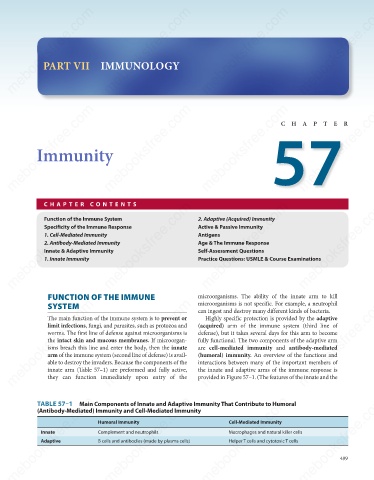
                    TABLE 57–1  Main Components of Innate and Adaptive Immunity That Contribute to Humoral
                    (Antibody-Mediated) Immunity and Cell-Mediated Immunity
                                                                                   Cell-Mediated Immunity
                      Innate
                                        Complement and neutrophils
                                                                                   Macrophages and natural killer cells
                                        B cells and antibodies (made by plasma cells)
                                                                                   Helper T cells and cytotoxic T cells
                      Adaptive
                                                                                                                       489


 mebooksfree.com  mebooksfree.com           mebooksfree.com                 mebooksfree.com                 mebooksfree.com                mebooksfree.com

