Page 501 - Review of Medical Microbiology and Immunology ( PDFDrive )
P. 501
mebooksfree.com


                                            mebooksfree.com
            mebooksfree.com
                                                                            mebooksfree.com
                                                                                                                                           mebooksfree.com
                                                                                                            mebooksfree.com
 mebooksfree.com  mebooksfree.com           mebooksfree.com                 mebooksfree.com                 mebooksfree.com                mebooksfree.com
                       PART VII  Immunology
                 490
                                                                                        T cells
                                 B cells

                                              Cytokines (IL-4, IL-5)
                                                                            Helper (CD4)
                                                                                              Cytotoxic (CD8)
                                                                                                  cells
                                                                               cells
                               Plasma cells
                                                                                                IL-2
                                                                             IL-2
                                                                              Activated        cytotoxic cells
                                                                                                 Activated
                                                                            mebooksfree.com
 mebooksfree.com  mebooksfree.com               toxins and viruses        Inhibit intracellular  virus-infected cells mebooksfree.com      mebooksfree.com
                               Kill bacteria mebooksfree.com
                                                                           helper cells and
                                                                            macrophages
                               Antibodies
                                   +
                                                                                                   Kill
                                                   Neutralize
                                                                          bacteria and fungi
                               Complement
                                   +
                               Neutrophils


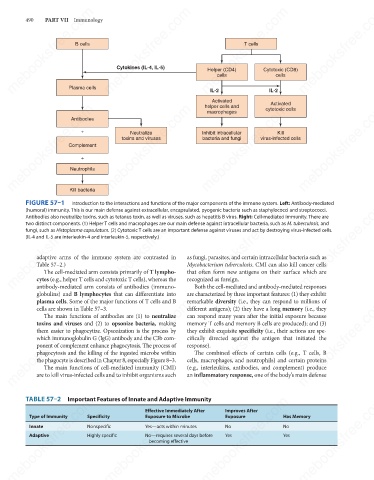
                 FIGURE 57–1
 mebooksfree.com  mebooksfree.com           mebooksfree.com          as fungi, parasites, and certain intracellular bacteria such as       mebooksfree.com
                                Introduction to the interactions and functions of the major components of the immune system. Left: Antibody-mediated
                                                                                                            mebooksfree.com
                                                                            mebooksfree.com
                 (humoral) immunity. This is our main defense against extracellular, encapsulated, pyogenic bacteria such as staphylococci and streptococci.
                 Antibodies also neutralize toxins, such as tetanus toxin, as well as viruses, such as hepatitis B virus. Right: Cell-mediated immunity. There are
                 two distinct components. (1) Helper T cells and macrophages are our main defense against intracellular bacteria, such as M. tuberculosis, and
                 fungi, such as Histoplasma capsulatum. (2) Cytotoxic T cells are an important defense against viruses and act by destroying virus-infected cells.
                 (IL-4 and IL-5 are interleukin-4 and interleukin-5, respectively.)
                    adaptive arms of the immune system are contrasted in
                    Table 57–2.)
                                                                     Mycobacterium tuberculosis. CMI can also kill cancer cells
                       The cell-mediated arm consists primarily of T lympho-
                    cytes (e.g., helper T cells and cytotoxic T cells), whereas the
                                                                     recognized as foreign.
                                                                        Both the cell-mediated and antibody-mediated responses
                    antibody-mediated arm consists of antibodies (immuno-
                                                                     are characterized by three important features: (1) they exhibit
                    globulins) and B lymphocytes that can differentiate into   that often form new antigens on their surface which are
                                                                            mebooksfree.com
                                                                     remarkable diversity (i.e., they can respond to millions of
                                                                                                            mebooksfree.com
                    plasma cells. Some of the major functions of T cells and B
 mebooksfree.com  mebooksfree.com           mebooksfree.com          memory T cells and memory B cells are produced); and (3)              mebooksfree.com
                                                                     different antigens); (2) they have a long memory (i.e., they
                    cells are shown in Table 57–3.
                                                                     can respond many years after the initial exposure because
                       The main functions of antibodies are (1) to  neutralize
                    toxins and viruses and (2) to  opsonize bacteria, making
                    them easier to phagocytize. Opsonization is the process by
                                                                     they exhibit exquisite specificity (i.e., their actions are spe-
                                                                     cifically directed against the antigen that initiated the
                    which immunoglobulin G (IgG) antibody and the C3b com-
                                                                     response).
                    ponent of complement enhance phagocytosis. The process of
                    phagocytosis and the killing of the ingested microbe within
                                                                        The combined effects of certain cells (e.g., T cells, B
                    the phagocyte is described in Chapter 8, especially Figure 8–3.
                                                                     cells, macrophages, and neutrophils) and certain proteins
                                                                     (e.g., interleukins, antibodies, and complement) produce
                       The main functions of cell-mediated immunity (CMI)
                    are to kill virus-infected cells and to inhibit organisms such
                                                                     an inflammatory response, one of the body’s main defense
 mebooksfree.com  mebooksfree.com    Specificity mebooksfree.com            mebooksfree.com          Has Memory                            mebooksfree.com
                                                                                                            mebooksfree.com
                 TABLE 57–2  Important Features of Innate and Adaptive Immunity
                                                                                  Improves After
                                                        Effective Immediately After
                                                                                  Exposure
                  Type of Immunity
                                                        Exposure to Microbe
                  Innate
                                                                                                     No
                                     Nonspecific
                                                                                  No
                                                        Yes—acts within minutes
                  Adaptive
                                                                                                     Yes
                                                                                  Yes
                                                        No—requires several days before
                                     Highly specific
                                                         becoming effective
 mebooksfree.com  mebooksfree.com           mebooksfree.com                 mebooksfree.com                 mebooksfree.com                mebooksfree.com
   496   497   498   499   500   501   502   503   504   505   506