Page 548 - Review of Medical Microbiology and Immunology ( PDFDrive )
P. 548
mebooksfree.com
 mebooksfree.com


                                                                            mebooksfree.com
            mebooksfree.com
                                            mebooksfree.com
                                                                                                            mebooksfree.com
                                                                                                                                           mebooksfree.com
 mebooksfree.com  mebooksfree.com           mebooksfree.com                 mebooksfree.com            Class II MHC Proteins  537          mebooksfree.com
                                                                 CHAPTER 62  Major Histocompatibility Complex & Transplantation
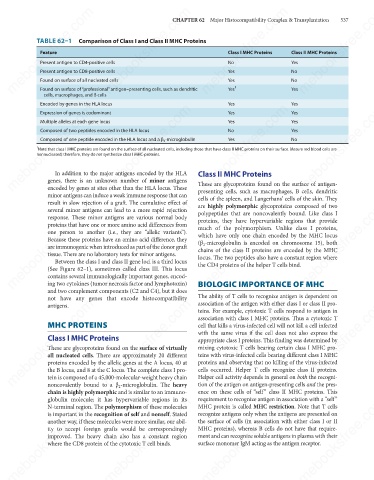
                    TABLE 62–1  Comparison of Class I and Class II MHC Proteins
                     Feature
                                                                                   Class I MHC Proteins
                                                                                                       Yes
                     Present antigen to CD4-positive cells
                                                                                   No
                                                                                   Yes
                                                                                                       No
                     Present antigen to CD8-positive cells
                                                                                   Yes
                                                                                                       No
                     Found on surface of all nucleated cells
                                                                                     1
                     Found on surface of “professional” antigen–presenting cells, such as dendritic
                                                                                   Yes
                                                                                                       Yes
                       cells, macrophages, and B cells
                     Encoded by genes in the HLA locus
                                                                                   Yes
 mebooksfree.com  mebooksfree.com           mebooksfree.com                 mebooksfree.com            Yes  mebooksfree.com                mebooksfree.com
                                                                                                       Yes
                     Expression of genes is codominant
                                                                                   Yes
                                                                                   Yes
                                                                                                       Yes
                     Multiple alleles at each gene locus
                                                                                   No
                     Composed of two peptides encoded in the HLA locus
                                                                                                       Yes
                                                                                   Yes
                     Composed of one peptide encoded in the HLA locus and a β 2 -microglobulin
                                                                                                       No
                    1
                     Note that class I MHC proteins are found on the surface of all nucleated cells, including those that have class II MHC proteins on their surface. Mature red blood cells are
                    nonnucleated; therefore, they do not synthesize class I MHC-proteins.
                          In addition to the major antigens encoded by the HLA
                        genes, there is an unknown number of  minor antigens
                                                                         These are glycoproteins found on the surface of antigen-
                        encoded by genes at sites other than the HLA locus. These
                                                                         presenting  cells,  such  as  macrophages,  B  cells,  dendritic
                        minor antigens can induce a weak immune response that can   Class II MHC Proteins
                                                                         cells of the spleen, and Langerhans’ cells of the skin. They
                        result in slow rejection of a graft. The cumulative effect of
 mebooksfree.com  mebooksfree.com           mebooksfree.com              much of the polymorphism. Unlike class I proteins,                mebooksfree.com
                                                                                                            mebooksfree.com
                                                                            mebooksfree.com
                                                                         are  highly polymorphic glycoproteins composed of two
                        several minor antigens can lead to a more rapid rejection
                                                                         polypeptides  that  are  noncovalently  bound.  Like  class  I
                        response. These minor antigens are various normal body
                                                                         proteins, they have hypervariable regions that provide
                        proteins that have one or more amino acid differences from
                        one person to another (i.e., they are “allelic variants”).
                                                                         which  have only one chain encoded by the MHC locus
                        Because these proteins have an amino acid difference, they
                                                                         (β -microglobulin is encoded on chromosome 15), both
                                                                           2
                        are immunogenic when introduced as part of the donor graft
                                                                         chains of the class II proteins are encoded by the MHC
                        tissue. There are no laboratory tests for minor antigens.
                                                                         locus. The two peptides also have a constant region where
                          Between the class I and class II gene loci is a third locus
                                                                         the CD4 proteins of the helper T cells bind.
                        (See Figure 62–1), sometimes called class III. This locus
                        contains several immunologically important genes, encod-
                                                                         BIOLOGIC IMPORTANCE OF MHC
                        ing two cytokines (tumor necrosis factor and lymphotoxin)
                        and two complement components (C2 and C4), but it does
                        not have any genes that encode histocompatibility
                                                                            mebooksfree.com
 mebooksfree.com  mebooksfree.com              2 mebooksfree.com         The ability of T cells to recognize antigen is dependent on       mebooksfree.com
                                                                                                            mebooksfree.com
                                                                         association of the antigen with either class I or class II pro-
                        antigens.
                                                                         teins. For example, cytotoxic T cells respond to antigen in
                                                                         association with class I MHC proteins. Thus a cytotoxic T
                        MHC PROTEINS
                                                                         cell that kills a virus-infected cell will not kill a cell infected
                                                                         with the same virus if the cell does not also express the
                        Class I MHC Proteins
                                                                         appropriate class I proteins. This finding was determined by
                                                                         mixing cytotoxic T cells bearing certain class I MHC pro-
                        These are glycoproteins found on the surface of virtually
                                                                         teins with virus-infected cells bearing different class I MHC
                        all nucleated cells. There are approximately 20 different
                                                                         proteins and observing that no killing of the virus-infected
                        proteins encoded by the allelic genes at the A locus, 40 at
                        the B locus, and 8 at the C locus. The complete class I pro-
                                                                         Helper cell activity depends in general on both the recogni-
                        tein is composed of a 45,000-molecular-weight heavy chain
                                                                         tion of the antigen on antigen-presenting cells and the pres-
                        noncovalently bound to a β -microglobulin. The  heavy
                                                                         ence on these cells of “self” class II MHC proteins. This
                        chain is highly polymorphic and is similar to an immuno-  cells  occurred.  Helper  T  cells  recognize  class  II  proteins.
                                                                         requirement to recognize antigen in association with a “self”
                                                                                                            mebooksfree.com
 mebooksfree.com  mebooksfree.com           mebooksfree.com              the surface of cells (in association with either class I or II    mebooksfree.com
                                                                            mebooksfree.com
                        globulin molecule; it has hypervariable regions in its
                                                                         MHC protein is called MHC restriction. Note that T cells
                        N-terminal region. The polymorphism of these molecules
                                                                         recognize antigens only when the antigens are presented on
                        is important in the recognition of self and nonself. Stated
                        another way, if these molecules were more similar, our abil-
                                                                         MHC proteins), whereas B cells do not have that require-
                        ity  to  accept  foreign  grafts  would  be  correspondingly
                                                                         ment and can recognize soluble antigens in plasma with their
                        improved. The heavy chain also has a constant region
                                                                         surface monomer IgM acting as the antigen receptor.
                        where the CD8 protein of the cytotoxic T cell binds.
 mebooksfree.com  mebooksfree.com           mebooksfree.com                 mebooksfree.com                 mebooksfree.com                mebooksfree.com
   543   544   545   546   547   548   549   550   551   552   553