


Page 551 - Review of Medical Microbiology and Immunology ( PDFDrive )
P. 551
mebooksfree.com
mebooksfree.com
mebooksfree.com
mebooksfree.com
mebooksfree.com
mebooksfree.com
mebooksfree.com mebooksfree.com mebooksfree.com preventing the rejection of transplants. Cyclosporine and mebooksfree.com
mebooksfree.com
mebooksfree.com
PART VII Immunology
540
resulting in severe organ dysfunction. The donor’s cytotoxic
tacrolimus have the same mode of action; tacrolimus is
T cells play a major role in destroying the recipient’s cells.
Among the main symptoms are maculopapular rash, jaun-
more immunosuppressive but causes more side effects.
dice, hepatosplenomegaly, and diarrhea. Many GVH reac-
Rapamycin also inhibits signal transduction but at a site
different from that of cyclosporine and tacrolimus.
tions end in overwhelming infections and death.
Corticosteroids act primarily by inhibiting cytokine
There are three requirements for a GVH reaction to
occur: (1) the graft must contain immunocompetent
phages and by lysing certain types of T cells. Corticoste-
T cells, (2) the host must be immunocompromised, and
roids inhibit cytokine production by blocking transcription
(3) the recipient must express antigens (e.g., MHC pro- (e.g., IL-1 and tumor necrosis factor) production by macro-
teins) foreign to the donor (i.e., the donor T cells recognize
mebooksfree.com
mebooksfree.com mebooksfree.com mebooksfree.com T cells. Mycophenolate mofetil also inhibits DNA synthesis mebooksfree.com
mebooksfree.com
factors, such as NFκB and AP-1, which prevents the mRNA
for these cytokines from being synthesized. Azathioprine is
the recipient cells as foreign). Note that even when donor
an inhibitor of DNA synthesis and blocks the growth of
and recipient have identical class I and class II MHC pro-
teins (i.e., identical haplotypes), a GVH reaction can occur
because it can be elicited by differences in minor antigens.
and has fewer side effects than azathioprine. However,
The GVH reaction can be reduced by treating the donor
some recipients of mycophenolate have contracted progres-
sive multifocal leukoencephalopathy—an often fatal dis-
tissue with antithymocyte globulin or monoclonal antibod-
ies before grafting; this eliminates mature T cells from the
ease (see Chapter 44).
graft. Cyclosporine (see later) is also used to reduce the
Monoclonal antibodies are used in immunosuppressive
GVH reaction.
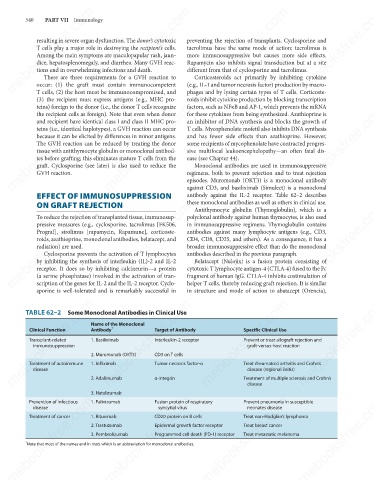
episodes. Muromonab (OKT3) is a monoclonal antibody
against CD3, and basiliximab (Simulect) is a monoclonal
EFFECT OF IMMUNOSUPPRESSION regimens, both to prevent rejection and to treat rejection
antibody against the IL-2 receptor. Table 62–2 describes
these monoclonal antibodies as well as others in clinical use.
mebooksfree.com
ON GRAFT REJECTION
mebooksfree.com mebooksfree.com mebooksfree.com in immunosuppressive regimens. Thymoglobulin contains mebooksfree.com
mebooksfree.com
Antithymocyte globulin (Thymoglobulin), which is a
polyclonal antibody against human thymocytes, is also used
To reduce the rejection of transplanted tissue, immunosup-
pressive measures (e.g., cyclosporine, tacrolimus [FK506,
antibodies against many lymphocyte antigens (e.g., CD3,
Prograf], sirolimus [rapamycin, Rapamune], corticoste-
CD4, CD8, CD25, and others). As a consequence, it has a
roids, azathioprine, monoclonal antibodies, belatacept, and
radiation) are used.
broader immunosuppressive effect than do the monoclonal
Cyclosporine prevents the activation of T lymphocytes
antibodies described in the previous paragraph.
by inhibiting the synthesis of interleukin (IL)-2 and IL-2
Belatacept (Nulojix) is a fusion protein consisting of
receptor. It does so by inhibiting calcineurin—a protein
cytotoxic T lymphocyte antigen-4 (CTLA-4) fused to the Fc
fragment of human IgG. CTLA-4 inhibits costimulation of
(a serine phosphatase) involved in the activation of tran-
helper T cells, thereby reducing graft rejection. It is similar
scription of the genes for IL-2 and the IL-2 receptor. Cyclo-
sporine is well-tolerated and is remarkably successful in
in structure and mode of action to abatacept (Orencia),
mebooksfree.com mebooksfree.com Name of the Monoclonal Target of Antibody mebooksfree.com mebooksfree.com mebooksfree.com
mebooksfree.com
TABLE 62–2 Some Monoclonal Antibodies in Clinical Use
1
Antibody
Clinical Function
Specific Clinical Use
Transplant-related
Prevent or treat allograft rejection and
Interleukin-2 receptor
1. Basiliximab
immunosuppression
graft-versus-host reaction
2. Muromonab (OKT3)
CD3 on T cells
Treatment of autoimmune
Treat rheumatoid arthritis and Crohn’s
Tumor necrosis factor-α
1. Infliximab
disease (regional ileitis)
disease
disease
3. Natalizumab
Prevention of infectious 2. Adalimumab α-integrin Treatment of multiple sclerosis and Crohn’s
mebooksfree.com
mebooksfree.com
mebooksfree.com mebooksfree.com 2. Trastuzumab Epidermal growth factor receptor Treat breast cancer mebooksfree.com mebooksfree.com
1. Palivizumab
Prevent pneumonia in susceptible
Fusion protein of respiratory
neonates disease
disease
syncytial virus
Treatment of cancer
Treat non-Hodgkin’s lymphoma
1. Rituximab
CD20 protein on B cells
3. Pembrolizumab
Treat metastatic melanoma
Programmed cell death (PD-1) receptor
1
Note that most of the names end in mab, which is an abbreviation for monoclonal antibodies.
mebooksfree.com mebooksfree.com mebooksfree.com mebooksfree.com mebooksfree.com mebooksfree.com

