


Page 221 - 9780077418427.pdf
P. 221
/Users/user-f465/Desktop
          tiL12214_ch07_177-202.indd Page 198  9/1/10  9:44 PM user-f465
          tiL12214_ch07_177-202.indd Page 198  9/1/10  9:44 PM user-f465                                                /Users/user-f465/Desktop


                     RELATIVITY THEORY APPLIED
                   You use the Global Positioning System (GPS) when you use the
                   locator in your cell phone or trace your route on a car navi-
                   gation system. The GPS consists of a worldwide network of
                     24 satellites, each with an atomic clock that keeps accurate time
                   to within 3 nanoseconds (0.000000003 of a second). Th e satel-
                   lites broadcast a radio signal with the position and time of trans-
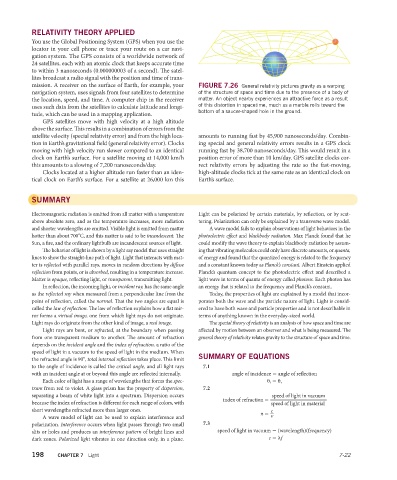
                   mission. A receiver on the surface of Earth, for example, your   FIGURE 7.26  General relativity pictures gravity as a warping
                   navigation system, uses signals from four satellites to determine   of the structure of space and time due to the presence of a body of
                   the location, speed, and time. A computer chip in the receiver   matter. An object nearby experiences an attractive force as a result
                   uses such data from the satellites to calculate latitude and longi-  of this distortion in spacetime, much as a marble rolls toward the
                   tude, which can be used in a mapping application.      bottom of a saucer-shaped hole in the ground.
                      GPS satellites move with high velocity at a high altitude

                   above the surface. This results in a combination of errors from the
                   satellite velocity (special relativity error) and from the high loca-  amounts to running fast by 45,900 nanoseconds/day. Combin-
                   tion in Earth’s gravitational field (general relativity error). Clocks   ing special and general relativity errors results in a GPS clock


                   moving with high velocity run slower compared to an identical   running fast by 38,700 nanoseconds/day. This would result in a
                   clock on Earth’s surface. For a satellite moving at  14,000 km/h   position error of more than 10 km/day. GPS satellite clocks cor-
                   this amounts to a slowing of 7,200 nanoseconds/day.    rect relativity errors by adjusting the rate so the fast-moving,
                      Clocks located at a higher altitude run faster than an iden-  high-altitude clocks tick at the same rate as an identical clock on
                   tical clock on Earth’s surface. For a satellite at 26,000 km this   Earth’s surface.


                   SUMMARY

                   Electromagnetic radiation is emitted from all matter with a temperature   Light can be polarized by certain materials, by reflection, or by scat-

                   above absolute zero, and as the temperature increases, more radiation   tering. Polarization can only be explained by a transverse wave model.
                   and shorter wavelengths are emitted. Visible light is emitted from matter   A wave model fails to explain observations of light behaviors in the
                   hotter than about 700°C, and this matter is said to be incandescent. Th e   photoelectric eff ect and blackbody radiation. Max Planck found that he

                   Sun, a fire, and the ordinary lightbulb are incandescent sources of light.  could modify the wave theory to explain blackbody radiation by assum-
                      The behavior of light is shown by a light ray model that uses straight   ing that vibrating molecules could only have discrete amounts, or quanta,

                   lines to show the straight-line path of light. Light that interacts with mat-  of energy and found that the quantized energy is related to the frequency
                   ter is refl ected with parallel rays, moves in random directions by diff use   and a constant known today as Planck’s constant. Albert Einstein applied

                   refl ection from points, or is absorbed, resulting in a temperature increase.   Planck’s quantum concept to the photoelectric effect and described a

                   Matter is opaque, reflecting light, or transparent, transmitting light.  light wave in terms of quanta of energy called photons. Each photon has
                      In reflection, the incoming light, or incident ray, has the same angle   an energy that is related to the frequency and Planck’s constant.

                   as the refl ected ray when measured  from a perpendicular line from the   Today, the properties of light are explained by a model that incor-
                   point of reflection, called the normal. That the two angles are equal is   porates both the wave and the particle nature of light. Light is consid-


                   called the law of refl ection. The law of reflection explains how a fl at mir-  ered to have both wave and particle properties and is not describable in


                   ror forms a virtual image, one from which light rays do not originate.   terms of anything known in the everyday-sized world.
                   Light rays do originate from the other kind of image, a real image.  Th e special theory of relativity is an analysis of how space and time are

                      Light rays are bent, or refracted, at the boundary when passing   affected by motion between an observer and what is being measured. Th e

                   from one transparent medium to another. The amount of refraction   general theory of relativity relates gravity to the structure of space and time.
                   depends on the incident angle and the index of refraction, a ratio of the
                   speed of light in a vacuum to the speed of light in the medium. When
                                                                          SUMMARY OF EQUATIONS
                   the refracted angle is 90°, total internal refl ection takes place. Th is limit
                   to the angle of incidence is called the critical angle, and all light rays    7.1
                   with an incident angle at or beyond this angle are refl ected internally.  angle of incidence = angle of refl ection
                      Each color of light has a range of wavelengths that forms the spec-        θ i  = θ r
                   trum from red to violet. A glass prism has the property of dispersion,     7.2
                   separating a beam of white light into a spectrum. Dispersion occurs            ___
                                                                                                  speed of light in vacuum
                                                                                  index of refraction =


                   because the index of refraction is different for each range of colors, with    speed of light in material
                   short wavelengths refracted more than larger ones.                             c _
                                                                                              n =
                      A wave model of light can be used to explain interference and               v
                   polarization. Interference occurs when light passes through two small    7.3
                   slits or holes and produces an interference pattern of bright lines and   speed of light in vacuum = (wavelength)(frequency)
                   dark zones. Polarized light vibrates in one direction only, in a plane.         c = λf
                   198     CHAPTER 7 Light                                                                              7-22

