


Page 216 - 9780077418427.pdf
P. 216
/Users/user-f465/Desktop
          tiL12214_ch07_177-202.indd Page 193  9/1/10  9:44 PM user-f465
          tiL12214_ch07_177-202.indd Page 193  9/1/10  9:44 PM user-f465                                                /Users/user-f465/Desktop


                              CONCEPTS Applied                                                         Light

                              Polarization
                          1.  Describe how you could test two pairs of polarizing                 –           +
                               sunglasses to make sure they are polarized.
                          2.  Look through the glass of a car windshield while
                             rotating a lens of a pair of polarizing sunglasses. What                  e
                             evidence do you find that the windshield is or is not
                             polarized? If it is  polarized, can you determine the
                             direction of polarization and a reason for this?
                          3.  Look at the sky through one lens of a pair of
                             polarizing  sunglasses as you rotate the lens. What
                             evidence do you find that light from the sky is or is
                             not polarized? Is there any  relationship between the
                             direction of polarization and the position of the Sun?
                          4.  Position yourself with a wet street or puddle of water
                             between you and the Sun when it is low in the sky.
                             Rotate the lens of a pair of polarizing sunglasses as you
                             look at the glare reflected off the water. Explain how
                             these sunglasses are able to eliminate reflected glare.
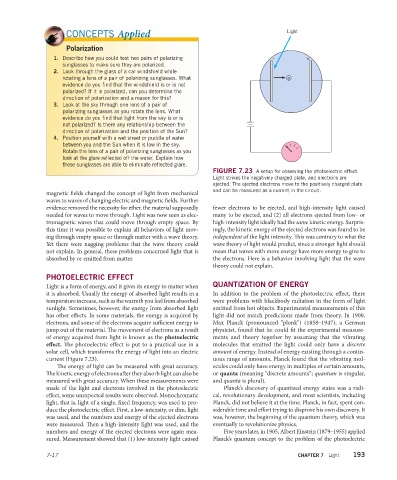
                                                                               FIGURE 7.23  A setup for observing the photoelectric effect.
                                                                               Light strikes the negatively charged plate, and electrons are
                                                                               ejected. The ejected electrons move to the positively charged plate
                                                                               and can be measured as a current in the circuit.
                       magnetic fields changed the concept of light from mechanical

                       waves to waves of changing electric and magnetic fi elds. Further
                       evidence removed the necessity for ether, the material supposedly   fewer electrons to be ejected, and high-intensity light caused
                       needed for waves to move through. Light was now seen as elec-  many to be ejected, and (2) all electrons ejected from low- or
                       tromagnetic waves that could move through empty space. By   high-intensity light ideally had the same kinetic energy. Surpris-
                       this time it was possible to explain all behaviors of light mov-  ingly, the kinetic energy of the ejected electrons was found to be
                       ing through empty space or through matter with a wave theory.   independent of the light intensity. This was contrary to what the

                       Yet there were nagging problems that the wave theory could   wave theory of light would predict, since a stronger light should
                       not explain. In general, these problems concerned light that is   mean that waves with more energy have more energy to give to
                       absorbed by or emitted from matter.                     the electrons. Here is a behavior involving light that the wave
                                                                               theory could not explain.
                       PHOTOELECTRIC EFFECT
                       Light is a form of energy, and it gives its energy to matter when   QUANTIZATION OF ENERGY
                       it is absorbed. Usually the energy of absorbed light results in a   In addition to the problem of the photoelectric eff ect, there
                       temperature increase, such as the warmth you feel from absorbed   were problems with blackbody radiation in the form of light
                       sunlight. Sometimes, however, the energy from absorbed light   emitted from hot objects. Experimental measurements of this
                       has other effects. In some materials, the energy is acquired by   light did not match predictions made from theory. In 1900,

                       electrons, and some of the electrons acquire suffi  cient energy to   Max Planck (pronounced “plonk”) (1858–1947), a German


                       jump out of the material. The movement of electrons as a result   physicist, found that he could fit the experimental measure-
                       of energy acquired from light is known as the photo electric   ments and theory together by assuming that the vibrating

                       eff ect. The photoelectric effect is put to a practical use in a   molecules that emitted the light could only have a  discrete

                        solar cell, which transforms the energy of light into an electric   amount of energy. Instead of energy existing through a contin-
                        current (Figure 7.23).                                 uous range of amounts, Planck found that the  vibrating mol-
                           The energy of light can be measured with great accuracy.   ecules could only have energy in multiples of  certain amounts,


                        The kinetic energy of electrons after they absorb light can also be   or quanta (meaning “discrete amounts”; quantum is singular,
                        measured with great accuracy. When these measurements were   and quanta is plural).
                        made of the light and electrons involved in the photoelectric   Planck’s discovery of quantized energy states was a radi-
                        effect, some unexpected results were observed. Monochromatic   cal, revolutionary development, and most scientists, including

                        light, that is, light of a single, fixed frequency, was used to pro-  Planck, did not believe it at the time. Planck, in fact, spent con-

                        duce the photoelectric effect. First, a low-intensity, or dim, light   siderable time and effort trying to disprove his own discovery. It


                        was used, and the numbers and energy of the ejected electrons   was, however, the beginning of the quantum theory, which was

                        were measured. Then a high-intensity light was used, and the   eventually to revolutionize physics.
                        numbers and energy of the ejected electrons were again mea-  Five years later, in 1905, Albert Einstein (1879–1955) applied
                        sured. Measurement showed that (1) low-intensity light caused   Planck’s quantum concept to the problem of the photoelectric
                       7-17                                                                                CHAPTER 7  Light   193

