


Page 219 - 9780077418427.pdf
P. 219
/Users/user-f465/Desktop
          tiL12214_ch07_177-202.indd Page 196  9/1/10  9:44 PM user-f465
          tiL12214_ch07_177-202.indd Page 196  9/1/10  9:44 PM user-f465                                                /Users/user-f465/Desktop


                                                                             Einstein’s special theory is based on two principles. Th e
                                                                          first concerns frames of reference and the fact that all motion is


                                                                          relative to a chosen frame of reference. This principle could be
                                                                          called the consistent law principle:
                                                                            The laws of physics are the same in all reference frames that
                                                                            are moving at a constant velocity with respect to one another.
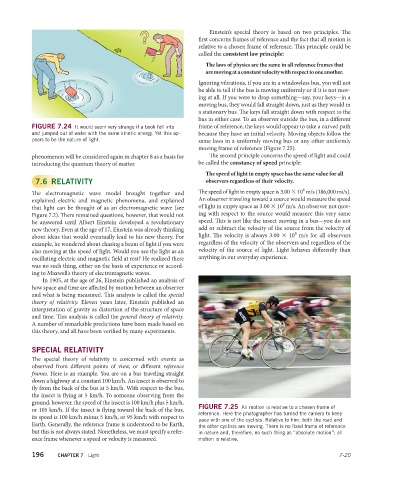
                                                                          Ignoring vibrations, if you are in a windowless bus, you will not
                                                                          be able to tell if the bus is moving uniformly or if it is not mov-
                                                                          ing at all. If you were to drop something—say, your keys—in a
                                                                          moving bus, they would fall straight down, just as they would in
                                                                          a stationary bus. The keys fall straight down with respect to the

                                                                          bus in either case. To an observer outside the bus, in a diff erent
                   FIGURE 7.24  It would seem very strange if a book fell into   frame of reference, the keys would appear to take a curved path
                   and jumped out of water with the same kinetic energy. Yet this ap-  because they have an initial velocity. Moving objects follow the
                   pears to be the nature of light.                       same laws in a uniformly moving bus or any other uniformly
                                                                          moving frame of reference (Figure 7.25).

                   phenomenon will be considered again in chapter 8 as a basis for   The second principle concerns the speed of light and could
                   introducing the quantum theory of matter.              be called the constancy of speed principle:
                                                                            The speed of light in empty space has the same value for all
                    7.6 RELATIVITY                                          observers regardless of their velocity.
                                                                                                            8

                   The electromagnetic wave model brought together and    The speed of light in empty space is 3.00 × 10  m/s ( 186,000 mi/s).

                   explained electric and magnetic phenomena, and explained   An observer traveling toward a source would measure the speed
                                                                                                      8
                   that light can be thought of as an electromagnetic wave (see   of light in empty space as 3.00 × 10  m/s. An observer not mov-

                   Figure 7.2). There remained questions, however, that would not   ing with respect to the source would measure this very same

                   be answered until Albert Einstein developed a revolutionary   speed. This is not like the insect moving in a bus—you do not
                   new theory. Even at the age of 17, Einstein was already thinking   add or subtract the velocity of the source from the velocity of
                                                                                                          8

                   about ideas that would eventually lead to his new theory. For   light. The velocity is always 3.00 × 10  m/s for all observers
                   example, he wondered about chasing a beam of light if you were   regardless of the velocity of the observers and regardless of the
                   also moving at the speed of light. Would you see the light as an   velocity of the source of light. Light behaves diff erently  than
                   oscillating electric and magnetic field at rest? He realized there   anything in our everyday experience.

                   was no such thing, either on the basis of experience or accord-
                   ing to Maxwell’s theory of electromagnetic waves.
                      In 1905, at the age of 26, Einstein published an analysis of

                   how space and time are affected by motion between an observer
                   and what is being measured. This analysis is called the special

                   theory of relativity. Eleven years later, Einstein published an
                   interpretation of gravity as distortion of the structure of space

                   and time. This analysis is called the general theory of relativity.
                   A number of remarkable predictions have been made based on
                   this theory, and all have been verified by many experiments.

                   SPECIAL RELATIVITY
                   The special theory of relativity is concerned with events as

                   observed from different points of view, or diff erent  reference

                   frames. Here is an example. You are on a bus traveling straight
                   down a highway at a constant 100 km/h. An insect is observed to

                   fly from the back of the bus at 5 km/h. With respect to the bus,
                   the insect is flying at 5 km/h. To someone observing from the

                   ground, however, the speed of the insect is 100 km/h plus 5 km/h,

                   or 105 km/h. If the insect is flying toward the back of the bus,   FIGURE 7.25  All motion is relative to a chosen frame of
                                                                          reference. Here the photographer has turned the camera to keep
                   its speed is 100 km/h minus 5 km/h, or 95 km/h with respect to
                                                                          pace with one of the cyclists. Relative to him, both the road and
                   Earth. Generally, the reference frame is understood to be Earth,   the other cyclists are moving. There is no fixed frame of reference
                   but this is not always stated. Nonetheless, we must specify a refer-  in nature and, therefore, no such thing as “absolute motion”; all
                   ence frame whenever a speed or velocity is measured.   motion is relative.
                   196     CHAPTER 7 Light                                                                              7-20

