


Page 661 - 9780077418427.pdf
P. 661
Volume/207/MHDQ243/tiL12214_disk1of1/0073512214/tiL12214_pagefiles
tiL12214_appd_633-642.indd Page 638 09/10/10 8:36 AM user-f463
tiL12214_appd_633-642.indd Page 638 09/10/10 8:36 AM user-f463 Volume/207/MHDQ243/tiL12214_disk1of1/0073512214/tiL12214_pagefile
m _
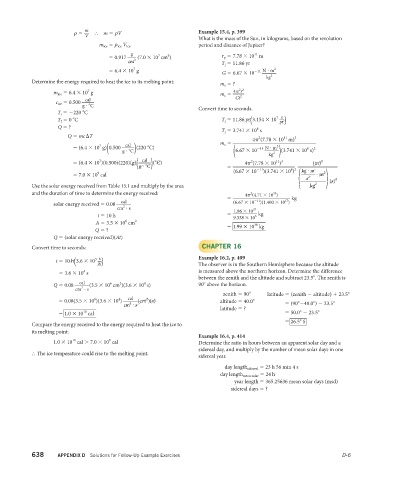
ρ = ∴ m = ρV Example 15.4, p. 399
V
What is the mass of the Sun, in kilograms, based on the revolution
period and distance of Jupiter?
m ice = ρ ice V ice
g
_
11
= 0.917 (7.0 × 10 cm ) r p = 7.78 × 10 m
7
3
cm 3 T j = 11.86 yr
= 6.4 × 10 g −11 N ⋅ m 2
7
_
G = 6.67 × 10
kg 2
Determine the energy required to heat the ice to its melting point:
m s = ?
2 3
7
_
m ice = 6.4 × 10 g m s = 4π r
_ Gt 2
cal
c ice = 0.500
g ⋅ °C
Convert time to seconds.
T i = −220 °C
7 s _
(
yr)
T f = 0 °C T j = 11.86 yr 3.154 × 10
Q = ? 8
T j = 3.741 × 10 s
Q = mc ΔT 2 11 3
4π (7.78 × 10 m)
____
m s =
(
cal
g ⋅ °C)
7
= (6.4 × 10 g) 0.500 _ ( 6.67 × 10 −11 N ⋅ m 2 (3.741 × 10 s) 2
2 )
_
(220 °C)
8
kg
cal
( g ⋅ °C)
= (6.4 × 10 )(0.500)(220)(g) _ = ___ __
7
11 3
2
3
(°C)
4π (7.78 × 10 )
(m)
8 2
(6.67 × 10 −11 )(3.741 × 10 ) kg ⋅ m 2
_
9
⋅ m
= 7.0 × 10 cal ( _ ) 2
2
s
Use the solar energy received from Table 15.1 and multiply by the area kg 2 (s)
and the duration of time to determine the energy received: 4π (4.71 × 10 )
35
2
= ___ kg
17
_ (6.67 × 10 −11 )(1.400 × 10 )
cal
solar energy received = 0.08
2
cm ⋅ s 37
1.86 × 10
= _
kg
t = 10 h 9.338 × 10 6
6
A = 3.5 × 10 cm 2 = 1.99 × 10 kg
30
Q = ?
Q = (solar energy received)(At)
Convert time to seconds: CHAPTER 16
3 s _
)
(
t = 10 h 3.6 × 10 Example 16.2, p. 409
The observer is in the Southern Hemisphere because the altitude
h
4
= 3.6 × 10 s is measured above the northern horizon. Determine the difference
between the zenith and the altitude and subtract 23.5°. The zenith is
_ 6 2 4
cal
Q = 0.08 (3.5 × 10 cm )(3.6 × 10 s) 90° above the horizon.
2
cm ⋅ s
zenith = 90° latitude = (zenith − altitude) + 23.5°
4 _
= 0.08(3.5 × 10 )(3.6 × 10 ) cal (cm )(s) altitude = 40.0° = (90°−40.0°) − 23.5°
2
6
2
cm ⋅ s
latitude = ?
= 1.0 × 10 cal = 50.0° − 23.5°
10
= 26.5° S
Compare the energy received to the energy required to heat the ice to
its melting point:
Example 16.4, p. 414
9
10
1.0 × 10 cal > 7.0 × 10 cal Determine the ratio in hours between an apparent solar day and a
sidereal day, and multiply by the number of mean solar days in one
∴ The ice temperature could rise to the melting point .
sidereal year.
day length sidereal = 23 h 56 min 4 s
day length mean solar = 24 h
year length = 365.25636 mean solar days (msd)
sidereal days = ?
638 APPENDIX D Solutions for Follow-Up Example Exercises D-6

