


Page 667 - 9780077418427.pdf
P. 667
Volume/207/MHDQ243/tiL12214_disk1of1/0073512214/tiL12214_pagefiles
tiL12214_appe_643-698.indd Page 644 09/10/10 8:37 AM user-f463
tiL12214_appe_643-698.indd Page 644 09/10/10 8:37 AM user-f463 Volume/207/MHDQ243/tiL12214_disk1of1/0073512214/tiL12214_pagefile
3
3
1.7. From Table 1.3, the density of aluminum is given as 2.70 g/cm . 1.10. According to Table 1.3, lead has a density of 11.4 g/cm .
3
Converting 2.1 kg to the same units as the density gives 2,100 g. Therefore, a 1.00 cm sample of lead will have a mass of
Solving ρ = m/V for the volume gives
m _
ρ = ∴ m = ρV
2,100 g
m _ _ V
V = = g g
ρ
_
_
3)
(
2.70 m = 11.4 (1.00 cm )
3
cm 3 cm
2,100 g
_ _ _ 3
cm
g
= × _ 3
2.70 1 g = 11.4 × 1.00 × cm
cm 3
3
g·cm
_
= 777.78 g·cm 3
g _
= 11.4 3
= 780 cm 3 cm
= 11.4 g
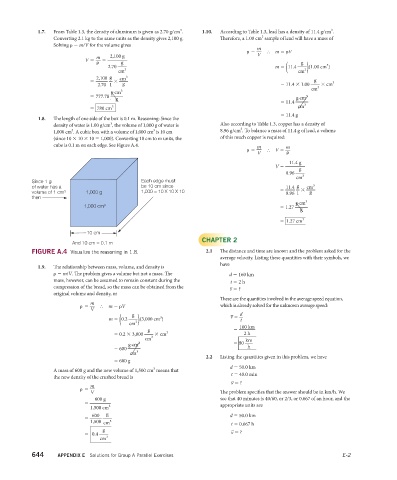
1.8. The length of one side of the box is 0.1 m. Reasoning: Since the
3
density of water is 1.00 g/cm , the volume of 1,000 g of water is Also according to Table 1.3, copper has a density of
3
3
3
1,000 cm . A cubic box with a volume of 1,000 cm is 10 cm 8.96 g/cm . To balance a mass of 11.4 g of lead, a volume
(since 10 × 10 × 10 = 1,000). Converting 10 cm to m units, the of this much copper is required:
cube is 0.1 m on each edge. See Figure A.4. m _ m _
ρ = ∴ V =
V ρ
11.4 g
_
V = g
_
8.96
3
Since 1 g Each edge must cm
of water has a be 10 cm since _ g cm 3
11.4 _ _
×
volume of 1 cm 3 1,000 g 1,000 = 10 X 10 X 10 = 8.96 1 g
then 3
_
1,000 cm 3 = 1.27 g·cm
g
= 1.27 cm 3
10 cm
And 10 cm = 0.1 m CHAPTER 2
FIGURE A.4 Visualize the reasoning in 1.8. 2.1 The distance and time are known and the problem asked for the
average velocity. Listing these quantities with their symbols, we
have
1.9. The relationship between mass, volume, and density is
ρ = m/V. The problem gives a volume but not a mass. Th e d = 160 km
mass, however, can be assumed to remain constant during the t = 2 h
compression of the bread, so the mass can be obtained from the − v = ?
original volume and density, or
These are the quantities involved in the average speed equation,
m _
ρ = ∴ m = ρV which is already solved for the unknown average speed:
V
d
g
( _ 3) 3 − _
v =
m = 0.2 (3,000 cm ) t
cm _
160 km
g
_ 3 =
= 0.2 × 3,000 × cm 2 h
cm 3 _
km
g·cm 3 = 80
_
h
= 600
cm 3
2.2 Listing the quantities given in this problem, we have
= 600 g
d = 50.0 km
3
A mass of 600 g and the new volume of 1,500 cm means that
t = 40.0 min
the new density of the crushed bread is
− v = ?
m _
ρ =
V The problem specifies that the answer should be in km/h. We
600 g
_ see that 40 minutes is 40/60, or 2/3, or 0.667 of an hour, and the
= appropriate units are
1,500 cm 3
600 _
_ g d = 50.0 km
=
1,500 cm 3 t = 0.667 h
g
_ − v = ?
= 0.4
cm 3
644 APPENDIX E Solutions for Group A Parallel Exercises E-2

