


Page 707 - 9780077418427.pdf
P. 707
Volume/207/MHDQ243/tiL12214_disk1of1/0073512214/tiL12214_pagefile
tiL12214_appe_643-698.indd Page 684 09/10/10 8:37 AM user-f463
tiL12214_appe_643-698.indd Page 684 09/10/10 8:37 AM user-f463 Volume/207/MHDQ243/tiL12214_disk1of1/0073512214/tiL12214_pagefiles
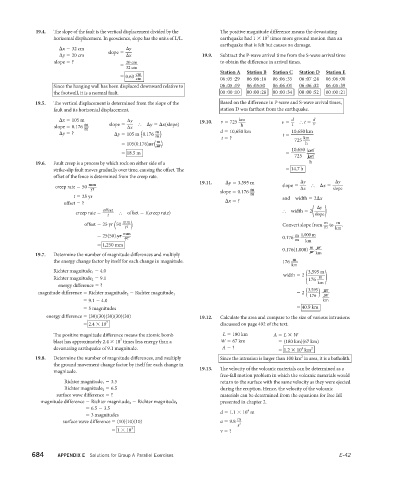
19.4. The slope of the fault is the vertical displacement divided by the The positive magnitude difference means the devastating
3
horizontal displacement. In geoscience, slope has the units of L/L. earthquake had 1 × 10 times more ground motion than an
earthquake that is felt but causes no damage.
Δx = 32 cm _
Δy
slope =
Δy = 20 cm Δx 19.9. Subtract the P-wave arrival time from the S-wave arrival time
slope = ? _ to obtain the difference in arrival times.
20 cm
=
32 cm
cm
_ Station A Station B Station C Station D Station E
= 0.63 cm 06 :05 :29 06 :06 :18 06 :06 :35 06 :07 :24 06 :06 :00
Since the hanging wall has been displaced downward relative to 06 :05 :19 06 :05:50 06 :06 :01 06 :06 :32 06 :05 :39
the footwall, it is a normal fault. 00 :00 :10 00 :00 :28 00 :00 :34 00 :00 :52 00 :00 :21
19.5. The vertical displacement is determined from the slope of the Based on the difference in P-wave and S-wave arrival times,
fault and its horizontal displacement. station D was farthest from the earthquake.
d _
d _
_
km
Δx = 105 m _ 19.10. v = 725 v = ∴ t =
Δy
m _ slope = ∴ Δy = Δx(slope) h t v
slope = 0.176 Δx
m
10,650 km
m _
Δy = ? Δy = 105 m (0.176 ) d = 10,650 km t = _
m t = ? _
km
m _ 725
= 105(0.176)m ( ) h
m
_ _
10,650 km
= 18.5 m =
725 _
km
19.6. Fault creep is a process by which rock on either side of a h
strike-slip fault moves gradually over time, causing the off set. Th e = 14.7 h
offset of the fence is determined from the creep rate.
Δy
Δy
_
_ 19.11. Δy = 3,595 m slope = ∴ Δx = _
mm
creep rate = 50
yr m _ Δx slope
slope = 0.176
m
t = 25 yr and width = 2Δx
offset = ? Δx = ?
( )
Δy
_ ∴ width = 2 _
offset
creep rate = ∴ offset = t(creep rate) slope
t
m _
m _
mm
(
yr )
offset = 25 yr 50 _ Convert slope from to .
m
km
_
mm
_
= 25(50) yr m _ 1,000 m
yr 0.176
m km
= 1,250 mm m _ m _
0.176(1,000)
19.7. Determine the number of magnitude differences and multiply m km
m _
the energy change factor by itself for each change in magnitude. 176
km
Richter magnitude 1 = 4.0 _
3,595 m
( 176 )
width = 2
Richter magnitude 2 = 9.1 m _
km
energy difference = ?
3,595 _
_ m
= 2 (
magnitude difference = Richter magnitude 2 − Richter magnitude 1 ) m _
176
= 9.1 − 4.0 km
= 5 magnitudes = 40.9 km
energy difference = (30)(30)(30)(30)(30) 19.12. Calculate the area and compare to the size of various intrusions
= 2.4 × 10 7 discussed on page 492 of the text.
The positive magnitude difference means the atomic bomb L = 180 km A = L × W
7
blast has approximately 2.4 × 10 times less energy than a W = 67 km = (180 km)(67 km)
devastating earthquake of 9.1 magnitude. A = ? = 1.2 × 10 km 2
4
2
19.8. Determine the number of magnitude differences, and multiply Since the intrusion is larger than 100 km in area, it is a batholith.
the ground movement change factor by itself for each change in
19.13. The velocity of the volcanic materials can be determined as a
magnitude.
free-fall motion problem in which the volcanic materials would
Richter magnitude 1 = 3.5 return to the surface with the same velocity as they were ejected
Richter magnitude 2 = 6.5 during the eruption. Hence, the velocity of the volcanic
surface wave difference = ? materials can be determined from the equations for free fall
presented in chapter 2.
magnitude difference = Richter magnitude 2 − Richter magnitude 1
= 6.5 − 3.5 4
= 3 magnitudes d = 1.1 × 10 m
m _
surface wave difference = (10)(10)(10) a = 9.8
s 2
= 1 × 10 3 v = ?
684 APPENDIX E Solutions for Group A Parallel Exercises E-42

