


Page 706 - 9780077418427.pdf
P. 706
Volume/207/MHDQ243/tiL12214_disk1of1/0073512214/tiL12214_pagefile
tiL12214_appe_643-698.indd Page 683 09/10/10 8:37 AM user-f463
tiL12214_appe_643-698.indd Page 683 09/10/10 8:37 AM user-f463 Volume/207/MHDQ243/tiL12214_disk1of1/0073512214/tiL12214_pagefiles
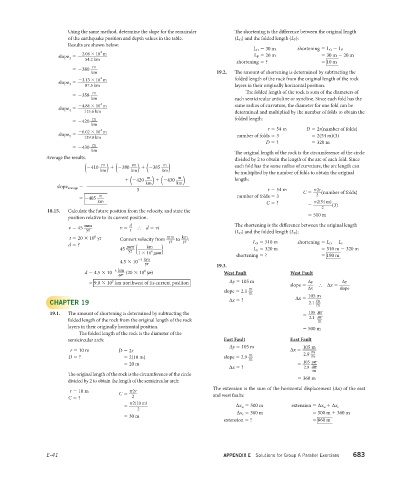
Using the same method, determine the slope for the remainder The shortening is the difference between the original length
of the earthquake position and depth values in the table. (L O ) and the folded length (L F ):
Results are shown below:
L O = 30 m shortening = L O − L F
__
4
−2.06 × 1 0 m
slope = L F = 20 m = 30 m − 20 m
2
54.2 km
shortening = ? = 10 m
m _
= −380
km 19.2. The amount of shortening is determined by subtracting the
4
__ folded length of the rock from the original length of the rock
−3.13 × 1 0 m
slope =
3
87.5 km layers in their originally horizontal position.
m _
= −358 The folded length of the rock is sum of the diameters of
km each semicircular anticline or syncline. Since each fold has the
__ same radius of curvature, the diameter for one fold can be
4
−4.86 × 1 0 m
slope =
4
115.6 km determined and multiplied by the number of folds to obtain the
m _
= −420 folded length:
km
r = 54 m D = 2r(number of folds)
__
4
−6.02 × 1 0 m
slope = number of folds = 3 = 2(54 m)(3)
5
139.9 km
D = ? = 320 m
m _
= −430
km
The original length of the rock is the circumference of the circle
Average the results. divided by 2 to obtain the length of the arc of each fold. Since
m _
m _
m _
( −410 + −380 + −385 each fold has the same radius of curvature, the arc length can
) (
)
) (
km
km
km
be multiplied by the number of folds to obtain the original
m _
m _
) (
)
(
+ −420 + −430 length:
km
km
slope average =
5 r = 54 m C = (number of folds)
π2r
_
m _ number of folds = 3 2
= −405
km C = ? π2(54 m)
_
=
2 (3)
18.15. Calculate the future position from the velocity, and state the
= 510 m
position relative to its current position.
_ d _ The shortening is the difference between the original length
mm
v = 45 yr v = ∴ d = vt (L O ) and the folded length (L F ):
t
mm
km
6
_
t = 20 × 10 yr Convert velocity from _ to :
yr
yr
d = ? mm _ L O = 510 m shortening = L O − L F
km
yr (
45 _ 6 ) L F = 320 m = 510 m − 320 m
1 × 10 mm
shortening = ? = 190 m
−5 km
_
4.5 × 10 19.3.
yr
_
−5 km 6
d = 4.5 × 10 (20 × 10 yr) West Fault West Fault
yr
2
Δy
Δy
_
= 9.0 × 10 km northwest of its current position Δy = 105 m slope = ∴ Δx = _
m _ Δx slope
slope = 2.1
m
105 m
Δx = _
m _
Δx = ?
CHAPTER 19 2.1
m
105 m _
19.1. The amount of shortening is determined by subtracting the = _
folded length of the rock from the original length of the rock 2.1 m _
m
layers in their originally horizontal position. = 500 m
The folded length of the rock is the diameter of the
semicircular arch: East Fault East Fault
Δy = 105 m _
105 m
r = 10 m D = 2r Δx = m _
m
D = ? = 2(10 m) slope = 2.9 m _ 2.9
m
105 m _
= 20 m = _
Δx = ? 2.9 m _
The original length of the rock is the circumference of the circle m
= 360 m
divided by 2 to obtain the length of the semicircular arch:
The extension is the sum of the horizontal displacement (Δx) of the east
r = 10 m _
π2r
C = and west faults:
C = ? 2
_
π2(10 m)
= Δx w = 500 m extension = Δx w + Δx e
2
Δx e = 360 m = 500 m + 360 m
= 30 m
extension = ? = 860 m
E-41 APPENDIX E Solutions for Group A Parallel Exercises 683

