


Page 703 - 9780077418427.pdf
P. 703
Volume/207/MHDQ243/tiL12214_disk1of1/0073512214/tiL12214_pagefile
tiL12214_appe_643-698.indd Page 680 09/10/10 8:37 AM user-f463
tiL12214_appe_643-698.indd Page 680 09/10/10 8:37 AM user-f463 Volume/207/MHDQ243/tiL12214_disk1of1/0073512214/tiL12214_pagefiles
to derive a relationship between pressure, density, and depth
CHAPTER 18 from the equations for density and weight.
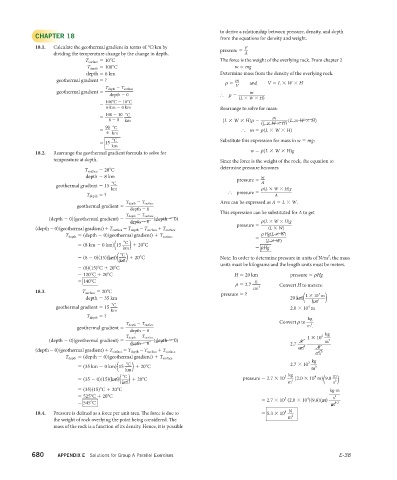
18.1. Calculate the geothermal gradient in terms of °C/km by F _
pressure =
dividing the temperature change by the change in depth. A
T surface = 10°C The force is the weight of the overlying rock. From chapter 2
T depth = 100°C w = mg
depth = 6 km Determine mass from the density of the overlying rock.
geothermal gradient = ? m _
ρ = and V = L × W × H
V
__
T depth − T surface
geothermal gradient = __
m
depth − 0 ∴ ρ =
(L × W × H)
__
100°C − 10°C
=
6 km − 0 km Rearrange to solve for mass:
_
100 − 10 °C _
= __
m
(
L
6 − 0 km (L × W × H)ρ = × W × H)
(L × W × H)
90 _ °C _
= ∴ m = ρ(L × W × H)
6 km
°C _ Substitute this expression for mass in w = mg:
= 15
km
w = ρ(L × W × H)g
18.2. Rearrange the geothermal gradient formula to solve for
temperature at depth. Since the force is the weight of the rock, the equation to
determine pressure becomes
T surface = 20°C
depth = 8 km w _
pressure =
°C _ A
geothermal gradient = 15
km ρ(L × W × H)g
__
T depth = ? ∴ pressure = A
__ Area can be expressed as A = L × W.
T depth − T surface
geothermal gradient =
depth − 0
This expression can be substituted for A to get
__
T depth − T surface
(depth − 0)(geothermal gradient) = (depth − 0)
depth − 0 ρ(L × W × H)g
__
pressure =
(depth − 0)(geothermal gradient) + T surface = T depth − T surface + T surface (L × W)
ρ Hg(L × W)
T depth = (depth − 0)(geothermal gradient) + T surface __
= (L × W)
= (8 km − 0 km) ( 15 )
°C _
+ 20°C
km = ρHg
°C _
= (8 − 0)(15)(km) ( ) Note: In order to determine pressure in units of N/m , the mass
2
+ 20°C
km
units must be kilograms and the length units must be meters.
= (8)(15)°C + 20°C
= 120°C + 20°C H = 20 km pressure = ρHg
g
= 140°C _
ρ = 2.7 Convert H to meters:
cm 3
18.3. T surface = 20°C
pressure = ? _
3
1 × 10 m
depth = 35 km 20 km ( )
km
°C _
4
geothermal gradient = 15 2.0 × 10 m
km
T depth = ? kg
Convert ρ to _
__ m . 3
T depth − T surface
geothermal gradient =
depth − 0
kg
3 _
__ 1 × 10
T depth − T surface
g
(depth − 0)(geothermal gradient) = (depth − 0) _ _ 3
m
depth − 0 2.7
g
cm 3 _
3
(depth − 0)(geothermal gradient) + T surface = T depth − T surface + T surface
cm
T depth = (depth − 0)(geothermal gradient) + T surface
kg
3 _
= (35 km − 0 km) ( 15 ) 2.7 × 10
°C _
+ 20°C
3
km m
kg
m _
3 _
= (35 − 0)(15)(km) ( ) pressure = 2.7 × 10 (2.0 × 10 m) 9.8
°C _
2)
(
4
+ 20°C
km m 3 s
= (35)(15)°C + 20°C kg⋅m
_
= 525°C + 20°C s _
2
4
3
= 2.7 × 10 (2.0 × 10 )(9.8)(m)
= 545°C m 3 2
8 N _
18.4. Pressure is defined as a force per unit area. The force is due to = 5.3 × 10
2
the weight of rock overlying the point being considered. Th e m
mass of the rock is a function of its density. Hence, it is possible
680 APPENDIX E Solutions for Group A Parallel Exercises E-38

