


Page 156 - HOW TO PROVE IT: A Structured Approach, Second Edition
P. 156
P1: PIG/
                   0521861241c03  CB996/Velleman  October 20, 2005  2:42  0 521 86124 1  Char Count= 0


                                   142                         Proofs
                                   derived this equivalence before from the truth table for the conditional connec-
                                   tive, and this truth table may have been hard to understand at first. Perhaps the
                                   reasoning we’ve given makes this equivalence, and therefore the truth table for
                                   the conditional connective, seem more natural.
                                     Of course, the roles of P and Q could be reversed in using this strategy. Thus,
                                   you can also prove P ∨ Q by assuming that Q is false and proving P.

                                                                              2
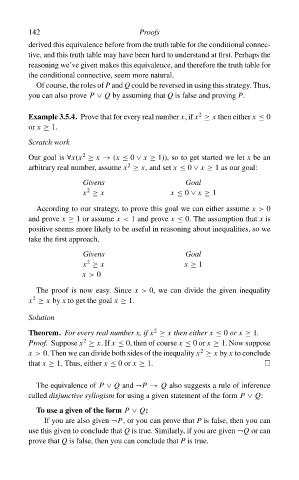
                                   Example 3.5.4. Prove that for every real number x,if x ≥ x then either x ≤ 0
                                   or x ≥ 1.
                                   Scratch work

                                                2
                                   Our goal is ∀x(x ≥ x → (x ≤ 0 ∨ x ≥ 1)), so to get started we let x be an
                                                            2
                                   arbitrary real number, assume x ≥ x, and set x ≤ 0 ∨ x ≥ 1 as our goal:
                                                Givens                     Goal
                                                  2
                                                x ≥ x                  x ≤ 0 ∨ x ≥ 1
                                     According to our strategy, to prove this goal we can either assume x > 0
                                   and prove x ≥ 1 or assume x < 1 and prove x ≤ 0. The assumption that x is
                                   positive seems more likely to be useful in reasoning about inequalities, so we
                                   take the first approach.
                                                 Givens                    Goal
                                                  2
                                                 x ≥ x                    x ≥ 1
                                                x > 0

                                     The proof is now easy. Since x > 0, we can divide the given inequality
                                    2
                                   x ≥ x by x to get the goal x ≥ 1.
                                   Solution

                                                                   2
                                   Theorem. For every real number x, if x ≥ x then either x ≤ 0 or x ≥ 1.
                                                 2
                                   Proof. Suppose x ≥ x.If x ≤ 0, then of course x ≤ 0or x ≥ 1. Now suppose
                                                                              2
                                   x > 0. Then we can divide both sides of the inequality x ≥ x by x to conclude
                                   that x ≥ 1. Thus, either x ≤ 0or x ≥ 1.
                                     The equivalence of P ∨ Q and ¬P → Q also suggests a rule of inference
                                   called disjunctive syllogism for using a given statement of the form P ∨ Q:
                                     To use a given of the form P ∨ Q:
                                       If you are also given ¬P, or you can prove that P is false, then you can
                                   use this given to conclude that Q is true. Similarly, if you are given ¬Q or can
                                   prove that Q is false, then you can conclude that P is true.

