


Page 151 - HOW TO PROVE IT: A Structured Approach, Second Edition
P. 151
P1: PIG/
                   0521861241c03  CB996/Velleman  October 20, 2005  2:42  0 521 86124 1  Char Count= 0


                                               Proofs Involving Disjunctions           137
                                Case 2. Q is true.
                                  [Proof of goal goes here.]
                                Since we know P ∨ Q, these cases cover all the possibilities. Therefore
                                the goal must be true.


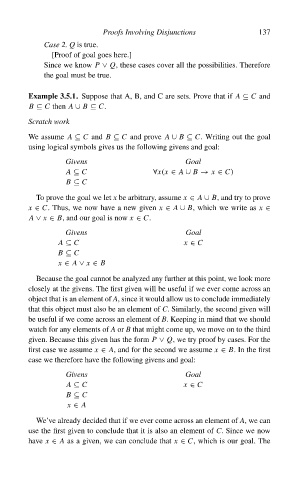
                            Example 3.5.1. Suppose that A, B, and C are sets. Prove that if A ⊆ C and
                            B ⊆ C then A ∪ B ⊆ C.
                            Scratch work
                            We assume A ⊆ C and B ⊆ C and prove A ∪ B ⊆ C. Writing out the goal
                            using logical symbols gives us the following givens and goal:
                                     Givens                         Goal
                                      A ⊆ C                 ∀x(x ∈ A ∪ B → x ∈ C)
                                      B ⊆ C
                              To prove the goal we let x be arbitrary, assume x ∈ A ∪ B, and try to prove
                            x ∈ C. Thus, we now have a new given x ∈ A ∪ B, which we write as x ∈
                            A ∨ x ∈ B, and our goal is now x ∈ C.

                                     Givens                         Goal
                                    A ⊆ C                           x ∈ C
                                    B ⊆ C
                                    x ∈ A ∨ x ∈ B

                              Because the goal cannot be analyzed any further at this point, we look more
                            closely at the givens. The first given will be useful if we ever come across an
                            object that is an element of A, since it would allow us to conclude immediately
                            that this object must also be an element of C. Similarly, the second given will
                            be useful if we come across an element of B. Keeping in mind that we should
                            watch for any elements of A or B that might come up, we move on to the third
                            given. Because this given has the form P ∨ Q, we try proof by cases. For the
                            first case we assume x ∈ A, and for the second we assume x ∈ B. In the first
                            case we therefore have the following givens and goal:
                                      Givens                        Goal
                                      A ⊆ C                         x ∈ C
                                      B ⊆ C
                                      x ∈ A

                              We’ve already decided that if we ever come across an element of A,wecan
                            use the first given to conclude that it is also an element of C. Since we now
                            have x ∈ A as a given, we can conclude that x ∈ C, which is our goal. The

