


Page 162 - HOW TO PROVE IT: A Structured Approach, Second Edition
P. 162
P1: PIG/
                   0521861241c03  CB996/Velleman  October 20, 2005  2:42  0 521 86124 1  Char Count= 0


                                   148                         Proofs
                                   For the ← direction, suppose y = x 0 . We also have P(x 0 ) as a given, and
                                   plugging in y for x 0 in this given we get P(y).
                                     2 → 3. Statement 2 is an existential statement, so we let x 0 be some object
                                   such that ∀y(P(y) ↔ y = x 0 ). The goal, statement 3, is a conjunction, so we
                                   treat it as two separate goals.

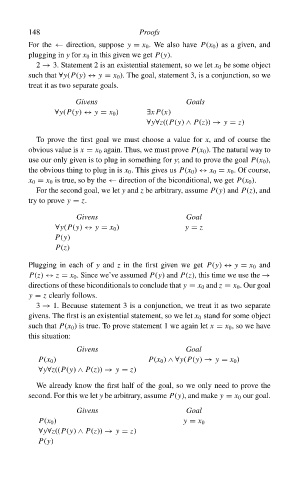
                                               Givens                      Goals
                                         ∀y(P(y) ↔ y = x 0 )     ∃xP(x)
                                                                 ∀y∀z((P(y) ∧ P(z)) → y = z)

                                     To prove the first goal we must choose a value for x, and of course the
                                   obvious value is x = x 0 again. Thus, we must prove P(x 0 ). The natural way to
                                   use our only given is to plug in something for y; and to prove the goal P(x 0 ),
                                   the obvious thing to plug in is x 0 . This gives us P(x 0 ) ↔ x 0 = x 0 . Of course,
                                   x 0 = x 0 is true, so by the ← direction of the biconditional, we get P(x 0 ).
                                     For the second goal, we let y and z be arbitrary, assume P(y) and P(z), and
                                   try to prove y = z.

                                               Givens                      Goal
                                         ∀y(P(y) ↔ y = x 0 )               y = z
                                         P(y)
                                          P(z)

                                   Plugging in each of y and z in the first given we get P(y) ↔ y = x 0 and
                                   P(z) ↔ z = x 0 . Since we’ve assumed P(y) and P(z), this time we use the →
                                   directions of these biconditionals to conclude that y = x 0 and z = x 0 . Our goal
                                   y = z clearly follows.
                                     3 → 1. Because statement 3 is a conjunction, we treat it as two separate
                                   givens. The first is an existential statement, so we let x 0 stand for some object
                                   such that P(x 0 ) is true. To prove statement 1 we again let x = x 0 ,sowehave
                                   this situation:
                                               Givens                      Goal
                                     P(x 0 )                     P(x 0 ) ∧∀y(P(y) → y = x 0 )
                                     ∀y∀z((P(y) ∧ P(z)) → y = z)
                                     We already know the first half of the goal, so we only need to prove the
                                   second. For this we let y be arbitrary, assume P(y), and make y = x 0 our goal.
                                               Givens                      Goal
                                     P(x 0 )                              y = x 0
                                     ∀y∀z((P(y) ∧ P(z)) → y = z)
                                     P(y)

